Introduction: The Role of 100G QSFP28 in Modern Networks
Over the past decade, global data traffic has grown at an unprecedented rate. As cloud computing, artificial intelligence, and streaming services continue to expand, networks are being pushed to their limits. Consequently, higher-speed connectivity solutions are no longer optional—they are essential. In this evolving landscape, 100G QSFP28 has become a widely adopted optical solution. It delivers high bandwidth while maintaining efficiency and cost control. Although newer technologies such as 400G and 800G are emerging, 100G remains a critical layer in network architecture.
Moreover, many organizations prefer stable and proven technologies when scaling infrastructure. Because of its maturity and broad compatibility, 100G QSFP28 continues to be deployed in both new and legacy environments.
What is 100G QSFP28?
Technology Overview
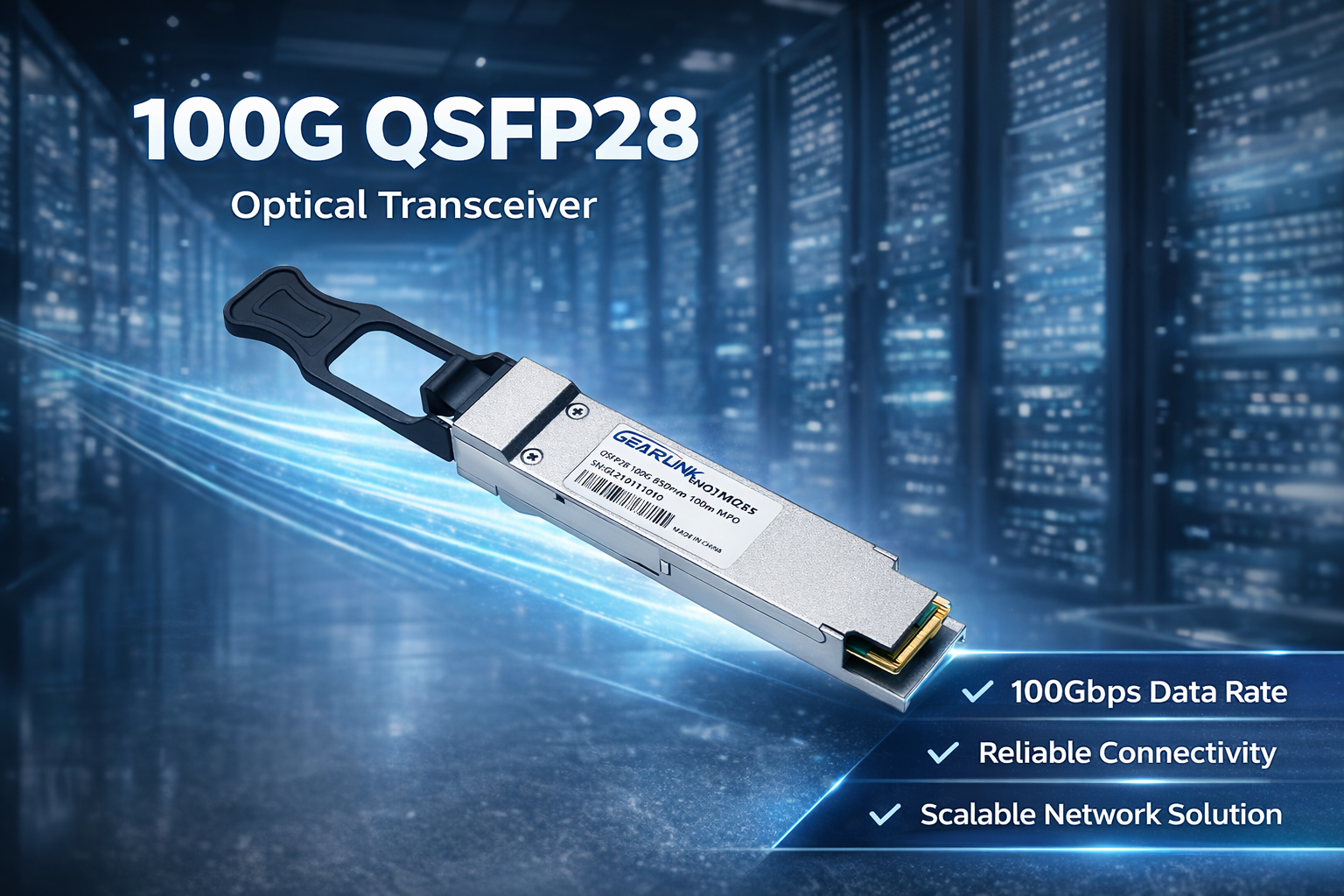
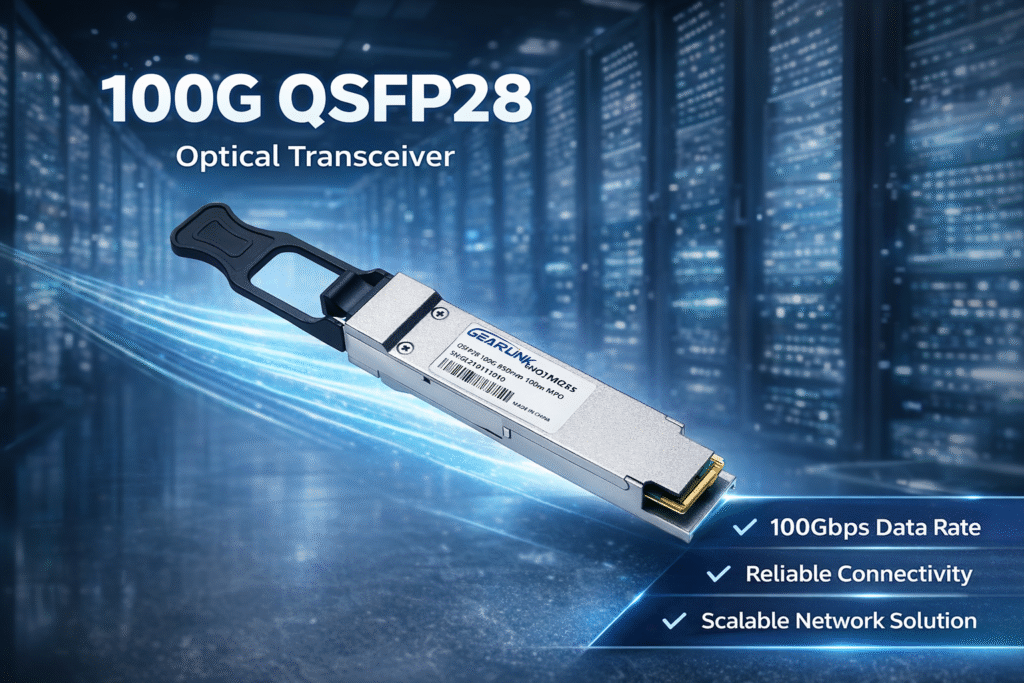
100G QSFP28 is a compact optical transceiver designed for 100 Gigabit Ethernet applications. It follows the QSFP28 (Quad Small Form-factor Pluggable) standard, which enables high-density deployment in switches and routers.
From a technical perspective, it uses four electrical lanes, each operating at 25Gbps. Together, these lanes deliver a total throughput of 100Gbps. Compared with earlier 40G technologies, this represents a major leap in performance.
Additionally, the module is designed to be hot-pluggable. Therefore, it can be installed or replaced without interrupting system operation. This feature simplifies maintenance and reduces downtime.
Core Specifications
| Parameter | Description |
| Data Rate | 100Gbps |
| Lane Structure | 4 × 25Gbps |
| Form Factor | QSFP28 |
| Power Consumption | Typically ≤3.5W |
| Connector Types | LC / MPO |
| Fiber Compatibility | SMF / MMF |
Because of these specifications, it is widely used in high-performance networking scenarios.
How 100G QSFP28 Works
Signal Transmission Process
The working mechanism of 100G QSFP28 is based on efficient signal conversion. First, electrical signals generated by the network device are fed into the module. Then, these signals are converted into optical signals.
After transmission through optical fiber, the signals reach the receiving module. At this point, they are converted back into electrical signals. Because this process is optimized for speed and accuracy, latency remains low.
Modulation Technology
Most implementations rely on NRZ modulation. This method is simple and reliable, making it suitable for stable deployments. While PAM4 is used in higher-speed modules, NRZ continues to dominate in 100G environments.
Types of 100G QSFP28 Modules
Different deployment scenarios require different transmission distances and fiber types. Therefore, several variants are available.
Common Variants Explained
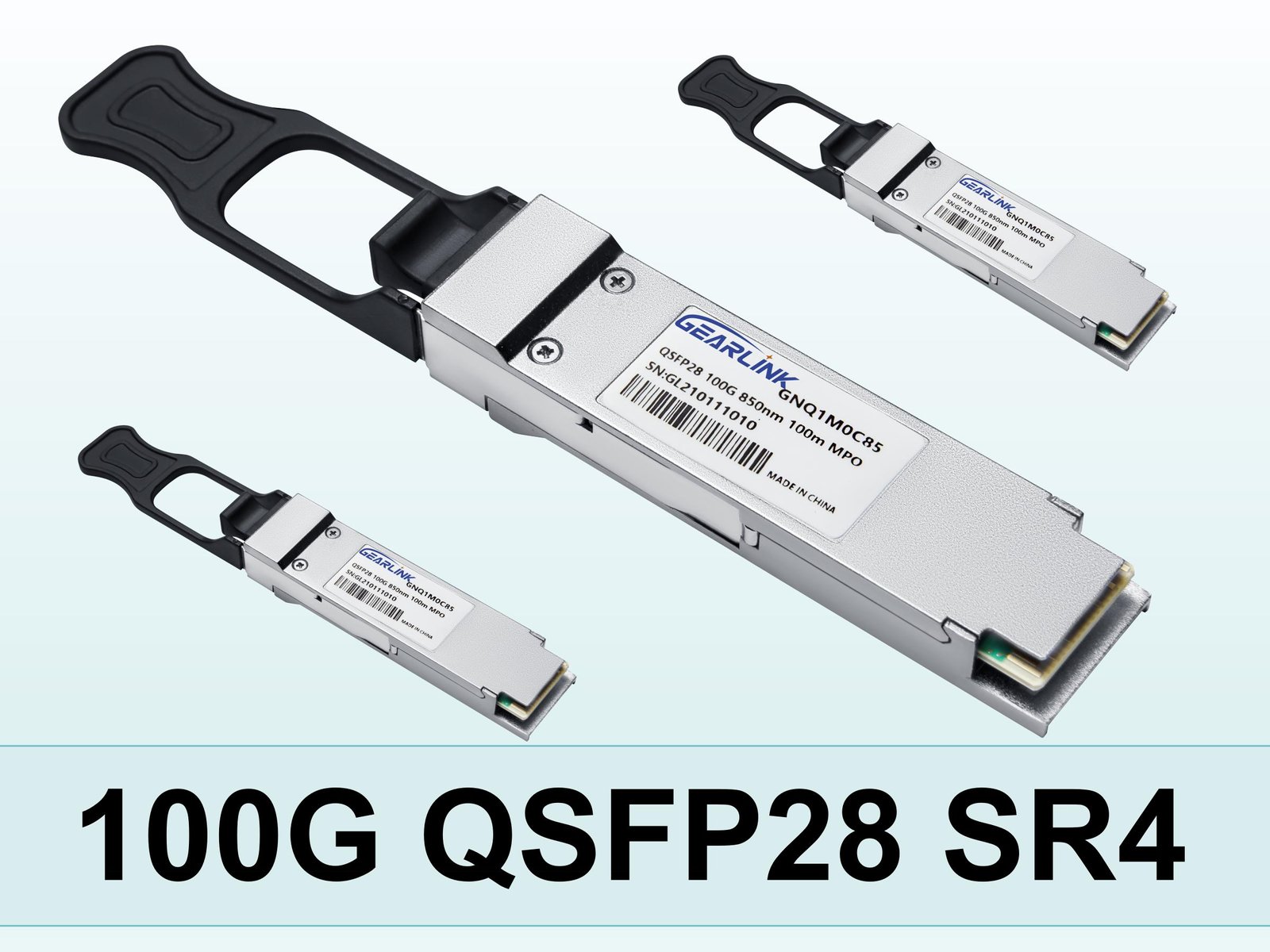
100G QSFP28 SR4 (Short Range)
SR4 modules are used for short-distance transmission over multimode fiber. Typically, they support distances up to 100 meters. As a result, they are ideal for intra-data center connections.
100G QSFP28 LR4 (Long Range)
LR4 modules operate over single-mode fiber and support distances up to 10 kilometers. Therefore, they are commonly used in campus networks and inter-building links.
100G QSFP28 ER4 (Extended Range)
ER4 modules are designed for long-distance transmission. They can reach up to 40 kilometers, making them suitable for metro and regional networks.
100G QSFP28 CWDM4 (Cost-Effective Solution)
CWDM4 modules use wavelength multiplexing technology. They support distances up to 2 kilometers and are often used for data center interconnects.
100G QSFP28 PSM4 (Parallel Transmission)
PSM4 modules use parallel single-mode fiber and support distances up to 10 kilometers. They are commonly used in high-density deployments.
Comparison Table
| Type | Fiber Type | Distance | Connector | Typical Use |
| SR4 | MMF | 100m | MPO | Data center |
| LR4 | SMF | 10km | LC | Campus |
| ER4 | SMF | 40km | LC | Metro |
| CWDM4 | SMF | 2km | LC | DCI |
| PSM4 | SMF | 10km | MPO | High-density |
Advantages of 100G QSFP28
High Port Density
Because of its compact design, more ports can be integrated into a single device. As a result, network capacity is increased without requiring additional space.
Energy Efficiency
Power consumption is relatively low compared to earlier technologies. Therefore, long-term operational costs can be reduced.
Cost-Effectiveness
Although higher-speed technologies are available, they often come with higher costs. In contrast, 100G QSFP28 offers a balanced solution that meets most requirements.
Flexibility
Different module types allow deployment in various scenarios. Whether for short-range or long-range connections, suitable options exist.
Mature Ecosystem
Since the technology has been widely adopted, compatibility and interoperability are generally reliable. This reduces deployment risks.
Applications of 100G QSFP28
Data Centers
In modern data centers, 100G QSFP28 is used extensively. It supports spine-leaf architectures, enabling fast communication between switches and servers.
Additionally, it is used for storage networking and high-performance computing environments.
Telecom Networks
Telecom operators use this technology for backbone and metro networks. Because of its reliability, it supports critical communication services.
Enterprise Networks
Enterprises use it for campus networks, cloud access, and disaster recovery. It ensures stable and high-speed connectivity across different locations.
Deployment Considerations
Fiber Selection
Choosing the correct fiber type is essential. Multimode fiber is suitable for short distances, while single-mode fiber is required for longer links.
Compatibility
Before deployment, compatibility should be verified. Although industry standards exist, vendor-specific differences may still occur.
Thermal Management
Since heat is generated during operation, proper cooling must be ensured. Otherwise, performance may degrade over time.
Cable Infrastructure
In addition to module selection, cable type and quality must be considered. Poor cabling can limit overall performance.
Comparison with Other Technologies
Compared with 40G QSFP+
100G solutions provide higher bandwidth and better efficiency. Therefore, they are increasingly replacing 40G deployments.
Compared with 400G Modules
Although 400G offers higher speeds, it is more expensive and complex. As a result, many organizations still rely on 100G for practical deployments.
Future Outlook
Even as higher-speed technologies continue to evolve, 100G QSFP28 remains a key part of network infrastructure. It is often used as a foundation for scalable architectures.
Furthermore, many organizations upgrade networks gradually. Because of this, 100G solutions will continue to coexist with newer technologies.
Conclusion
In conclusion, 100G QSFP28 provides a reliable, efficient, and cost-effective solution for high-speed networking. It has been widely adopted across data centers, telecom networks, and enterprise environments.
As demand for bandwidth continues to grow, this technology remains a practical choice. Its balance of performance, cost, and maturity ensures its ongoing relevance in modern networks.
FAQ
1. What is 100G QSFP28 used for?
It is used for high-speed optical connectivity in data centers, telecom networks, and enterprise environments.
2. What is the difference between 100G QSFP28 SR4 and 100G QSFP28 LR4?
SR4 is for short distances using multimode fiber, while LR4 supports longer distances using single-mode fiber.
3. What is the maximum transmission distance?
Depending on the module type, distances range from 100 meters to 40 kilometers.
4. Is it still widely used?
Yes, it remains widely deployed due to its cost-performance balance.
5. Is it suitable for future upgrades?
Yes, it can be integrated into scalable and evolving network architectures.