Introduction: Navigating the 100G Landscape with 100GBASE PSM4 QSFP28 Technology
The relentless demand for bandwidth, driven by cloud computing, AI, and big data, has necessitated a rapid migration to 100 Gigabit Ethernet (100GbE) in data centers and high-performance computing (HPC) environments. At the heart of this transition lies the crucial decision of selecting the appropriate optical transceiver. Among the diverse 100G solutions, the 100GBASE PSM4 QSFP28 module has emerged as a cornerstone technology, particularly favored for specific intermediate-reach applications. This comprehensive guide will explore the intricacies of this module, highlighting its design, unique features, and optimal use cases to help networking professionals make informed strategic decisions. Understanding the value proposition of the 100GBASE PSM4 QSFP28 is paramount for optimizing capital expenditure and ensuring the future scalability of modern network infrastructure.
Understanding the Architecture of the 100GBASE PSM4 QSFP28 Module

The 100GBASE PSM4 QSFP28 fundamentally translates to a Quad Small Form-factor Pluggable 28 (QSFP28) transceiver utilizing Parallel Single Mode (PSM4) technology to achieve 100 Gigabit Ethernet speeds.
The Power of the QSFP28 Form Factor
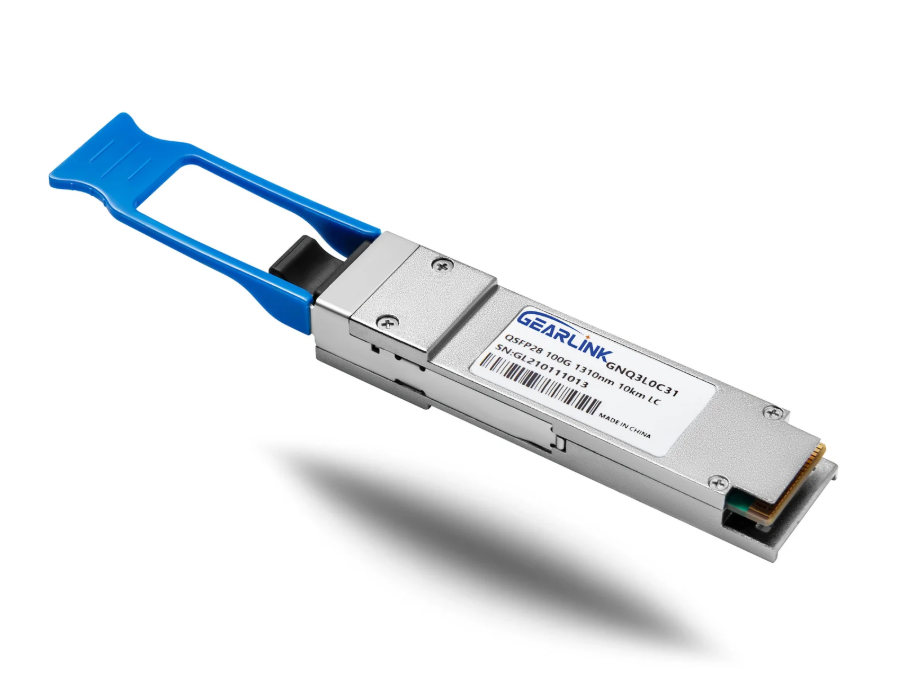
The QSFP28 form factor is the current industry standard for 100GbE modules due to its high density and low power consumption. It is designed to plug directly into the host equipment, such as switches and routers, offering four independent lanes capable of transmitting and receiving data at $25\text{ Gbps}$ each, thus aggregating to a total of $100\text{ Gbps}$. This compact design represents a significant leap in port density compared to older 100G solutions, which is vital for space-constrained data centers.
PSM4 Technology: Parallel Transmission over Single-Mode Fiber
The defining feature of this module is the use of Parallel Single Mode 4 (PSM4) technology, which operates based on the IEEE 802.3bm standard. Unlike CWDM4 (Coarse Wavelength Division Multiplexing) which uses four different wavelengths over a single fiber pair, PSM4 achieves $100\text{ Gbps}$ by utilizing four parallel single-mode fiber (SMF) pairs.
- Transmission: Four separate laser channels, each carrying 25Gbps, are transmitted over four distinct SMF strands.
- Reception: Four corresponding SMF strands are used to receive the 25Gbps streams.
- Fiber Count: This design necessitates the use of a total of eight single-mode fibers (four transmit, four receive) for a bidirectional link. This requirement is typically met using an MTP/MPO connector with an 8-fiber interface.
The straightforward, unmultiplexed nature of this parallel transmission scheme over SMF is key to its performance characteristics and cost structure.
Distinctive Features and Performance Metrics
The unique combination of the QSFP28 form factor and PSM4 technology endows the module with specific advantages and application boundaries.
Link Reach and Power Efficiency
The 100GBASE PSM4 QSFP28 is generally optimized for intermediate-reach applications, typically spanning up to 500 meters over standard single-mode fiber (OS2). This distance capability makes it an ideal solution for interconnecting core switches, spine-leaf architectures, and server farms within large campus networks or sizable hyperscale data centers. Crucially, the non-WDM design contributes to a lower power dissipation profile when compared to complex WDM-based modules, making it an economically attractive choice for environments where minimizing operational expenses (OPEX) is a priority.
The Role of MTP/MPO Connectivity
The reliance on four parallel fiber pairs mandates the use of an MTP/MPO connector interface. The MTP/MPO (Multi-fiber Push-On) connector is an industry standard for high-density fiber connectivity, capable of housing 8, 12, or 24 fibers in a single ferrule. For the PSM4 module, an 8-fiber MTP/MPO connector is employed. This standardized connectivity streamlines the deployment process in the data center, allowing for quick, clean, and dense cable management solutions, which ultimately reduces installation time and potential human error during setup.
Compatibility and Breakout Applications
A significant advantage of the 100GBASE PSM4 QSFP28 is its ability to support breakout applications. Because the four 25Gbps lanes are electrically independent, the module can be paired with a breakout cable (MPO to four duplex LC connectors) to connect a single 100G port to four separate 25Gbps ports. This capability provides network architects with exceptional flexibility, enabling cost-effective, high-density distribution from a 100G spine switch to multiple 25G leaf switches or servers. This flexibility is critical for scaling data center networks in a granular fashion.
Optimal Application Areas in the Optical Networking Field
The technical specifications of the 100GBASE PSM4 QSFP28 naturally steer its deployment toward specific scenarios within the optical networking landscape, particularly catering to the core needs of product users.
Data Center Inter-Rack and Inter-Row Connectivity
For connecting rows of server racks or adjacent switch clusters, where distances frequently fall within the 100 to 500-meter range, the PSM4 provides an excellent balance of cost and performance. The use of single-mode fiber throughout the data center—a growing trend due to its superior future-proofing capabilities—ensures that the infrastructure is ready for future 200G and 400G upgrades without major re-cabling efforts. It is this combination of manageable reach and SMF compatibility that makes the module a mainstay for these internal data center links.
Hyperscale and Cloud Computing Environments
In massive hyperscale environments, minimizing both power consumption and the cost per gigabit is paramount. Because the cost structure of the 100GBASE PSM4 QSFP28 tends to be favorable for its defined reach compared to longer-reach WDM alternatives, it is strategically deployed across the vast tracts of interconnected hardware that define these cloud centers. Furthermore, the standardization of the MTP/MPO interface facilitates the highly modular, plug-and-play installation required to sustain the relentless build-out schedule of these facilities.
Comparison with Competing 100G Standards
Network designers often weigh the 100GBASE PSM4 QSFP28 against 100GBASE SR4 and 100GBASE CWDM4.
- SR4 (Short Reach): Optimized for multi-mode fiber (MMF) over a maximum of 100 meters. While less expensive for very short links, it lacks the 500-meter reach and the future-proofing of SMF.
- CWDM4 (Coarse WDM): Utilizes two SMF strands for a reach of up to 2 km. While fiber-efficient, the WDM components can result in higher cost and often higher power consumption than PSM4.
Ultimately, the choice of the 100GBASE PSM4 QSFP28 is a conscious trade-off: accepting the requirement for eight fibers in exchange for simplified parallel optics, superior 500-meter reach compared to MMF, and often better cost-efficiency than 2 km WDM solutions.
The Optictran Value Proposition: Quality and Reliability
When specifying a technology as vital as the 100GBASE PSM4 QSFP28, the integrity and reliability of the supplier become critical. Optictran, as a trusted provider, ensures that its modules are manufactured to the highest industry standards, guaranteeing seamless interoperability and sustained performance. Rigorous testing protocols are implemented to confirm that every module meets the stringent signal integrity and thermal performance requirements essential for the continuous uptime demanded by modern data centers. Partnering with a specialist vendor ensures access to products that not only meet the required specifications but also provide long-term stability and support for complex network deployments.
Conclusion: Strategic Adoption for Future-Proof Networks
The 100GBASE PSM4 QSFP28 stands as a robust, specialized solution within the 100 Gigabit Ethernet ecosystem. Its specific design—leveraging the compact, low-power QSFP28 form factor with the parallel single-mode PSM4 optics—makes it uniquely suited for cost-effective, high-density links up to 500 meters. The reliance on MTP/MPO connectivity and the capacity for breakout applications cement its role as a flexible workhorse in large, evolving data center infrastructures. For optical module users strategically planning their 100G migration, understanding and correctly applying the capabilities of the 100GBASE PSM4 QSFP28 is not merely a technical choice but a strategic investment that enables scalable, reliable, and energy-efficient data communication for the future.
Frequently Asked Questions (FAQ)
Q1: What is the main difference between 100GBASE PSM4 QSFP28 and 100GBASE CWDM4?
The primary difference lies in fiber usage and technology. 100GBASE PSM4 QSFP28 uses eight single-mode fibers (four transmit, four receive) and parallel optics for a 500-meter reach. CWDM4 uses only two single-mode fibers (one transmit, one receive) but employs Coarse Wavelength Division Multiplexing (WDM) to multiplex the four signals, typically achieving a longer reach of $2\text{ km}$. PSM4 is often considered more cost-effective for the 500-meter range.
Q2: Can the 100GBASE PSM4 QSFP28 be used to connect to 25G servers?
Yes, absolutely. One of the key advantages of the 100GBASE PSM4 QSFP28 is its breakout capability. It can be connected using an MPO-to-LC harness cable to break the single 100 Gbps link into four separate 25 Gbps links, allowing a single switch port to connect to four $25\text{G}$ SFP28 ports on servers or leaf switches.
Q3: Why does 100GBASE PSM4 QSFP28 use an MTP/MPO connector?
It uses an MTP/MPO connector because the PSM4 technology requires four parallel transmission fibers and four parallel reception fibers, totaling eight fibers for a full-duplex link. The MTP/MPO connector is the industry standard for housing and connecting multiple fibers in a compact, high-density interface.