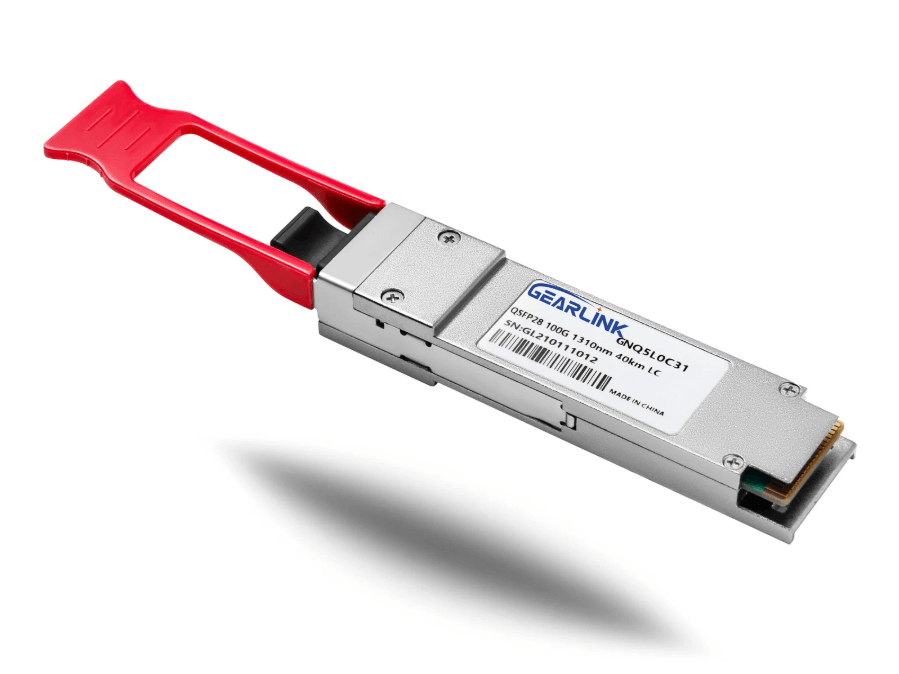
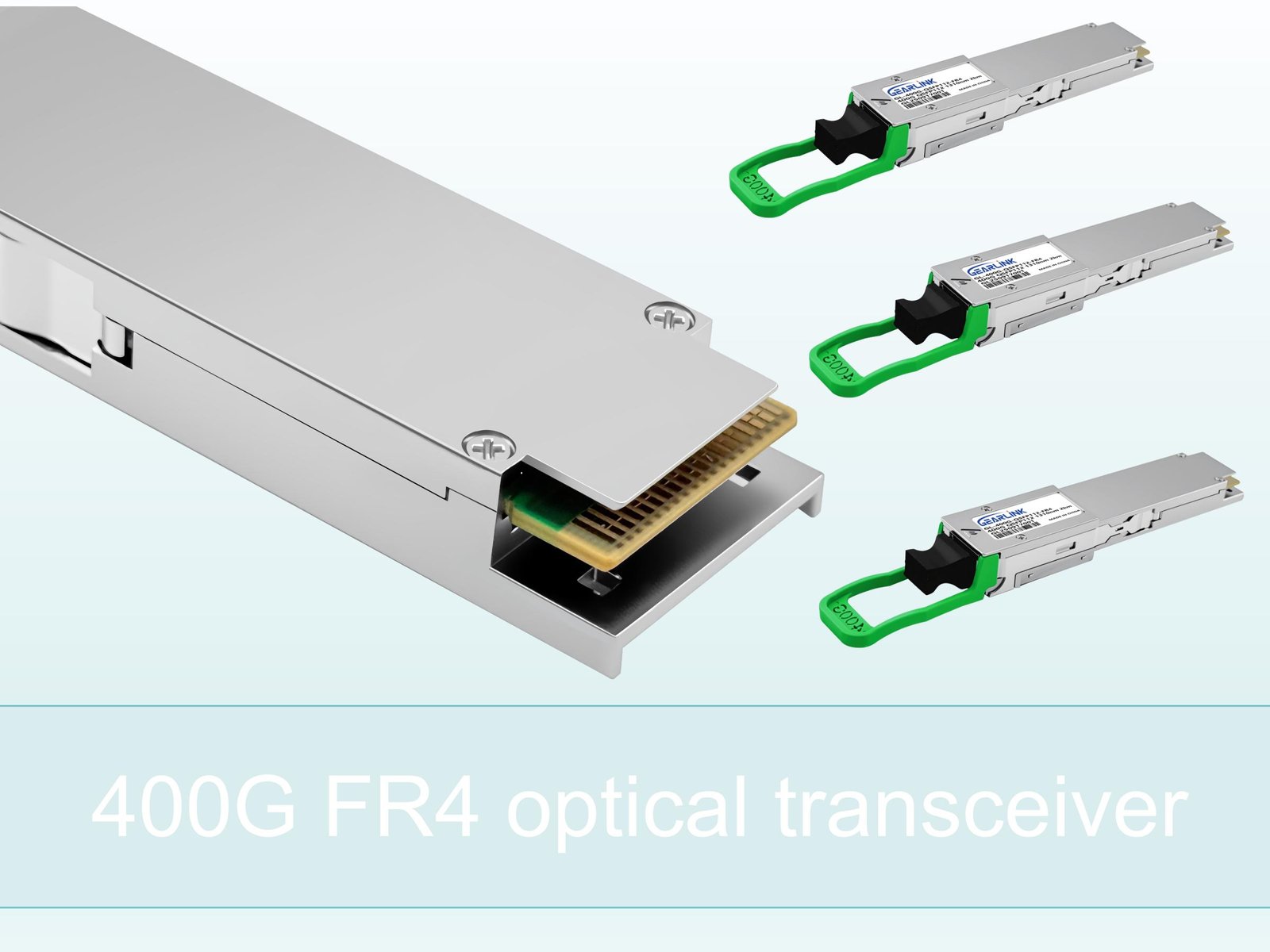
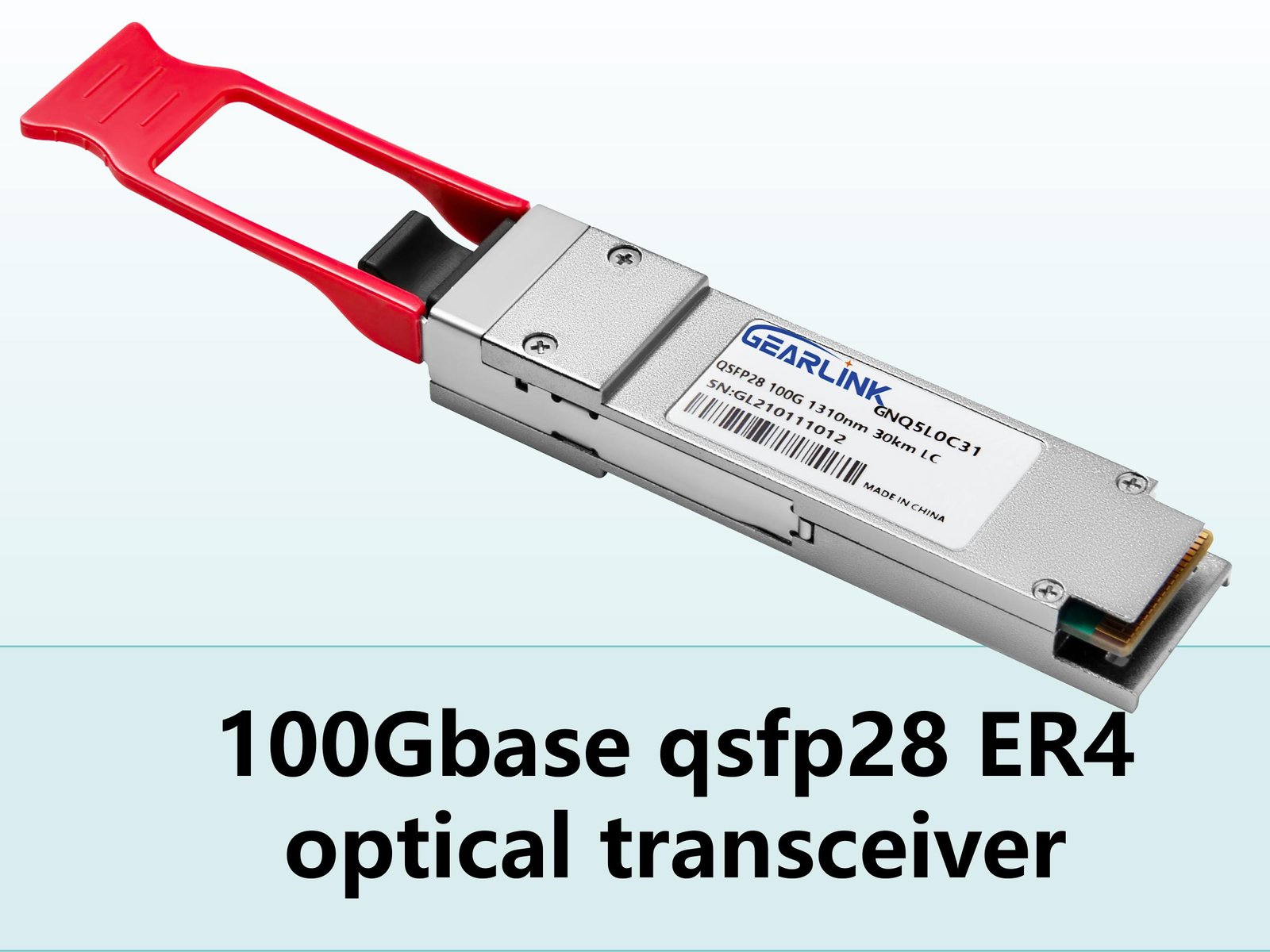
In the fast-evolving world of optical networking, the QSFP 100G PSM4, also known as 100GBASE PSM4 QSFP28 or QSFP 100G PSM4 S (Cisco model), has become one of the most widely adopted 100G solutions. This transceiver standard enables reliable, high-speed optical connections with a reach of up to 10 km over single-mode fiber (SMF), offering excellent performance at a competitive cost.
This guide explores the core technology, features, benefits, and applications of the QSFP 100G PSM4 module, along with a detailed comparison against other popular 100G standards such as CWDM4 and LR4.
1. What is QSFP 100G PSM4 (100GBASE PSM4 QSFP28)?
The QSFP 100G PSM4 is a 100 Gigabit Ethernet optical transceiver based on the Parallel Single Mode 4-lane (PSM4) standard, defined by the 100G PSM4 Multi-Source Agreement (MSA).
This module transmits and receives data over eight optical fibers — four fibers for transmitting (Tx) and four for receiving (Rx) — each operating at 25 Gbps, combining to deliver a total data rate of 100 Gbps.
The optical interface uses an MTP/MPO-12 connector, and transmission occurs over single-mode fiber (SMF) at a wavelength of 1310 nm.
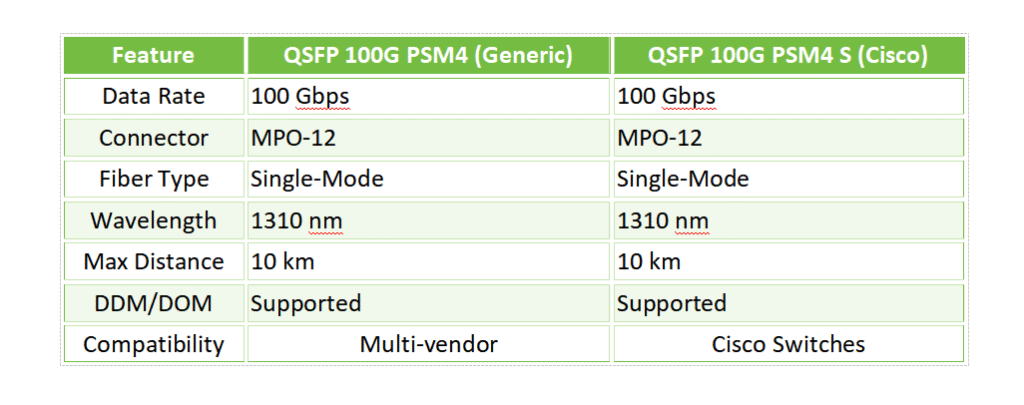
1.1 QSFP 100G PSM4 vs QSFP 100G PSM4 S (Cisco)
Both QSFP 100G PSM4 and QSFP 100G PSM4 S are functionally identical in terms of optical and electrical performance. The suffix “S” typically refers to Cisco’s branding and qualification process.
However, both generic and Cisco-compatible versions feature identical specifications, including DDM/DOM (Digital Diagnostic Monitoring) support — providing real-time parameters like optical power, temperature, and voltage. There’s no difference in monitoring capability between them.
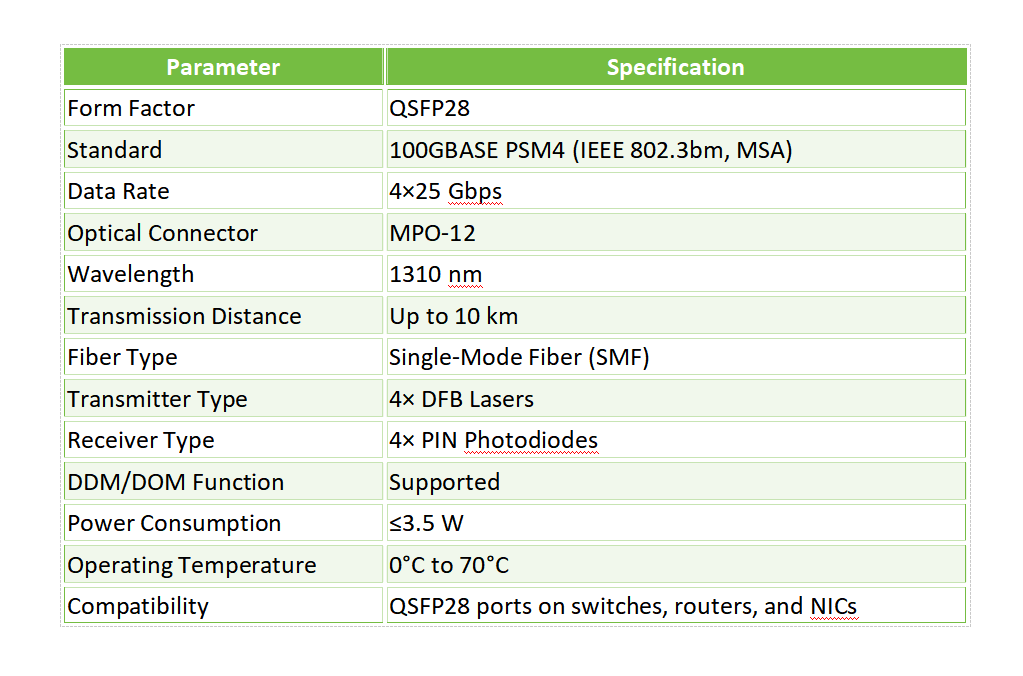
2. Technical Specifications of QSFP 100G PSM4
3. Key Features and Advantages
3.1 High-Speed 100G Transmission
Each of the four channels in QSFP 100G PSM4 carries 25 Gbps, ensuring full 100G throughput. It delivers consistent, high-performance connectivity for data center and enterprise applications.
3.2 Long Reach up to 10 km
Unlike short-reach standards like SR4 (100 m) or CWDM4 (2 km), the QSFP 100G PSM4 supports distances up to 10 km, making it suitable for inter-data center as well as intra-data center links.
3.3 Cost-Effective Optical Design
The PSM4 standard uses simple uncooled DFB lasers and PIN receivers, reducing component cost compared to complex CWDM optics, while still achieving 10 km transmission.
3.4 Superior Compatibility and Interoperability
The module is fully compliant with the IEEE 802.3bm and PSM4 MSA standards, ensuring seamless interoperability with network equipment from major brands (e.g., Cisco, Arista, Juniper, Huawei).
3.5 DDM/DOM Function for Easy Monitoring
Both generic and Cisco versions feature Digital Diagnostic Monitoring (DDM/DOM) for real-time status — temperature, TX/RX power, and voltage.
This simplifies maintenance and helps detect fiber degradation early.
3.6 Scalable Network Architecture
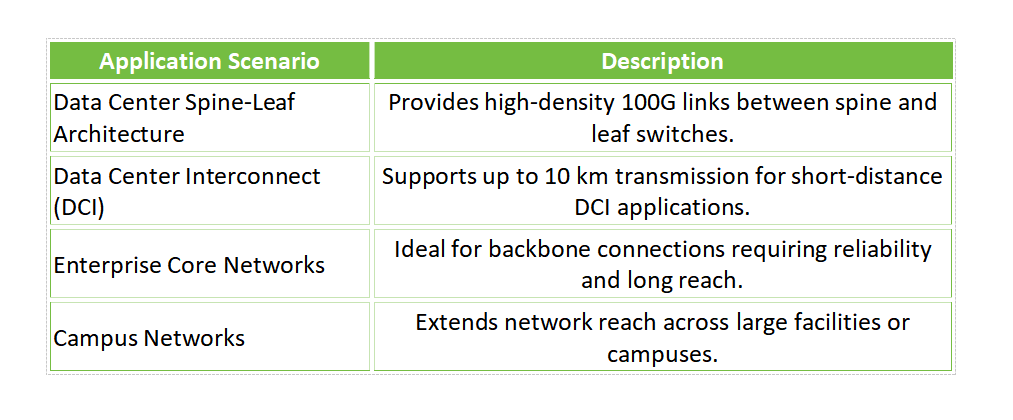
The QSFP 100G PSM4 fits perfectly in Spine-Leaf architectures, supporting high-density connectivity.
Thanks to its 10 km reach, it’s ideal not only for internal rack-to-rack cabling but also between data centers across campus or metro distances.
4. How the QSFP 100G PSM4 Works
Data transmission in PSM4 modules occurs in parallel — each of the four transmit fibers carries a 25 Gbps optical signal at 1310 nm. At the receiving end, four receivers detect and convert the optical signals back into electrical form.
This simple parallel architecture reduces latency and improves optical performance stability.
5. Typical Applications of QSFP 100G PSM4
6. Comparison: QSFP 100G PSM4 vs CWDM4 vs LR4
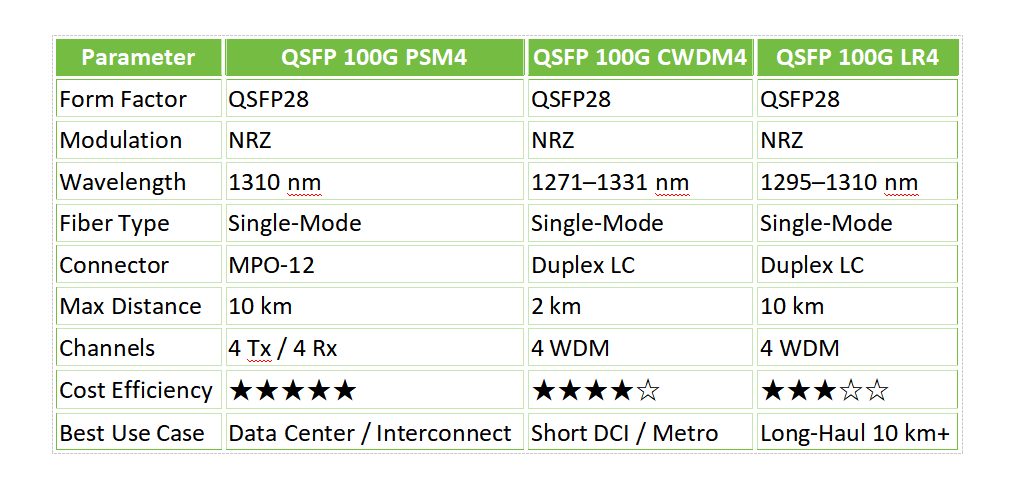
The table below highlights the key differences among the three most common 100G optical standards:
Summary:
PSM4: Best balance of cost and reach, supports up to 10 km with parallel SMF.
CWDM4: Compact cabling with LC connector, ideal for 2 km DCI.
LR4: Highest wavelength complexity but also supports 10 km, used for long-distance backbone links.
7. Why Global Data Centers Choose QSFP 100G PSM4
7.1 Cost and Performance Balance
PSM4 modules deliver excellent 10 km reach without using expensive wavelength multiplexing components.
7.2 Easy Installation
The MPO-12 interface supports plug-and-play deployment and structured cabling.
7.3 Vendor Flexibility
Interoperable across major switch vendors and compatible with QSFP28 ports, making upgrades simple.
7.4 Future-Proof Investment
PSM4 architecture remains a foundation for next-generation 200G and 400G designs, such as PSM8 and DR4.
8. Testing, Maintenance, and Reliability
All QSFP 100G PSM4 modules undergo rigorous bit error rate (BER) and eye diagram testing.
With DDM/DOM support, operators can easily monitor optical power levels and temperature in real time, ensuring stable network performance.
9. Conclusion
The QSFP 100G PSM4 (also known as 100GBASE PSM4 QSFP28 or QSFP 100G PSM4 S) represents a powerful, future-proof, and cost-effective 100G optical solution.
With a 10 km reach, strong interoperability, and scalable architecture, it serves as an excellent choice for data center interconnects and high-density cloud networks worldwide.
10. Frequently Asked Questions (FAQs)
Q1: What is the maximum transmission distance of QSFP 100G PSM4?
The module supports up to 10 km over single-mode fiber (SMF).
Q2: What is the difference between QSFP 100G PSM4 and QSFP 100G PSM4 S?
Functionally identical — “S” simply indicates the Cisco-specific qualification. Both offer identical DDM/DOM features.
Q3: Is DDM/DOM supported in generic versions?
Yes. All compliant modules, including third-party generics, support DDM/DOM monitoring for power, temperature, and voltage.
Q4: What are the main advantages of QSFP 100G PSM4?
Long reach (10 km), cost-efficiency, interoperability, and scalability for large networks.
Q5: Which applications benefit most from QSFP 100G PSM4?
Ideal for data center links, enterprise core, and inter–data center connectivity up to 10 km.