The migration to 100G Ethernet is no longer a future roadmap item; it is the established standard for modern data center backbones and high-speed interconnects. However, navigating the 100G transceiver market presents a complex set of choices. Network architects are faced with a diverse array of standards—SR4, LR4, CWDM4, and PSM4—each with distinct costs, capabilities, and infrastructure requirements. Among these options, the QSFP-100G-PSM4-S has carved out a critical and highly efficient niche.
This transceiver is not a universal solution, but its adoption is driven by a precise set of advantages that align perfectly with modern data center design philosophies. For the network engineer or IT manager weighing transceiver costs against cabling infrastructure and future scalability, a critical question emerges: when is the QSFP-100G-PSM4-S the right engineering and financial choice? This article provides an in-depth analysis of this module, moving beyond a simple data sheet review to explore its underlying technology, its primary competitive advantages, and the specific applications where it delivers maximum value.
Decoding the Technology: What Defines the QSFP-100G-PSM4-S?
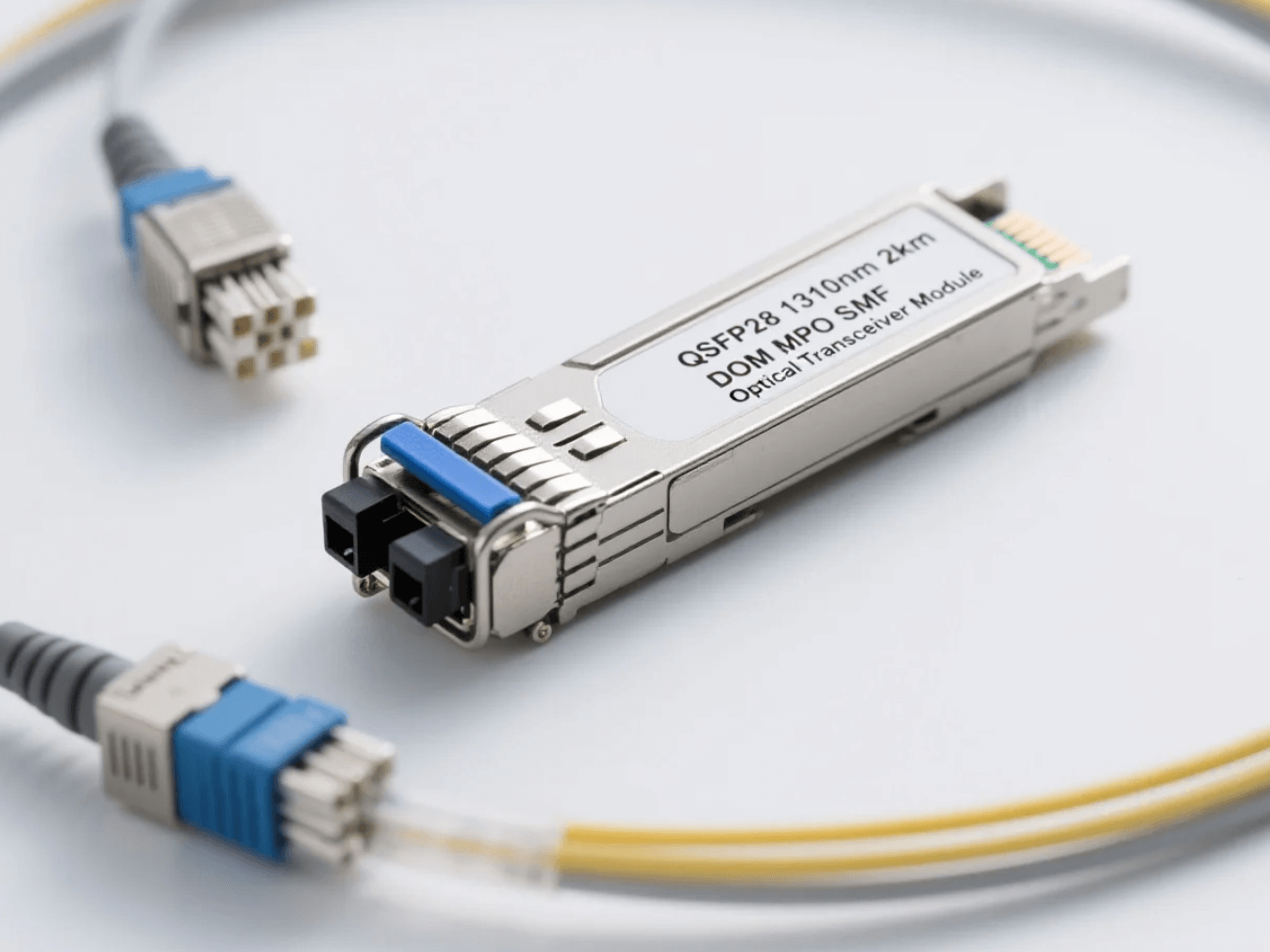
To appreciate its application, one must first understand the technology specified by its name. The QSFP-100G-PSM4-S is a hot-pluggable optical transceiver housed in the Quad Small Form-factor Pluggable (QSFP28) package, designed for 100G data rates. Its uniqueness, however, lies in the “PSM4” designation.
The Core of PSM4: Parallel Single Mode
PSM4 stands for Parallel Single Mode 4-lane. This specification defines both the optical transmission method and the physical fiber requirements.
At its heart, the PSM4 architecture is fundamentally straightforward. It achieves a 100G data rate by operating four independent, parallel optical lanes, with each lane carrying a 25.78125 Gbps (often simplified to 25G) NRZ signal. This means the module internally houses four transmitters and four receivers. Unlike Wavelength Division Multiplexing (WDM) technologies like CWDM4 or LR4, PSM4 does not multiplex different wavelengths of light onto a single fiber pair. Instead, it dedicates a separate fiber for each 25G lane.
Consequently, a PSM4 module requires eight single-mode fibers (SMF) to operate: four for transmitting (Tx) and four for receiving (Rx). These fibers are bundled into a single MPO-12 connector, which serves as the module’s optical interface. (Note: In an MPO-12 connector, 4 of the 12 available fibers are unused).
This design choice—using parallel fibers instead of multiple wavelengths—is the single most important differentiator. It results in a simpler internal module design. A QSFP-100G-PSM4-S does not require the complex and costly optical multiplexers (MUX) and demultiplexers (DEMUX) that are necessary components in all 100G WDM transceivers. This reduction in component complexity is directly correlated with a lower manufacturing cost, making the PSM4 module an economically attractive option.
The “S” Specification: Mastering the 500-Meter Sweet Spot
The “-S” suffix, while sometimes vendor-specific, generally refers to the standard PSM4 specification as defined by its Multi-Source Agreement (MSA). This specification is optimized for a transmission distance of up to 500 meters over single-mode fiber.
This 500-meter reach is a critical “sweet spot” in data center connectivity. It addresses a gap left by other 100G standards:
- It far exceeds multimode optics. The 100G-SR4 standard, which also uses a parallel MPO interface, is limited to 70 meters (OM3) or 100 meters (OM4) over multimode fiber (MMF).
- It avoids the cost of long-reach optics. The 100G-LR4 standard, designed for 10 kilometers, is significant overkill for a 300-meter link within a data center. Using an LR4 module for such a short link is an unnecessary expenditure.
The 500-meter capability of the QSFP-100G-PSM4-S is perfectly suited for large data halls, connecting end-of-row (EoR) switches, or linking spine-and-leaf switches across different aisles. It is also sufficient for many short-reach interconnects between buildings on a small campus.
The Strategic Deployment of a QSFP-100G-PSM4-S
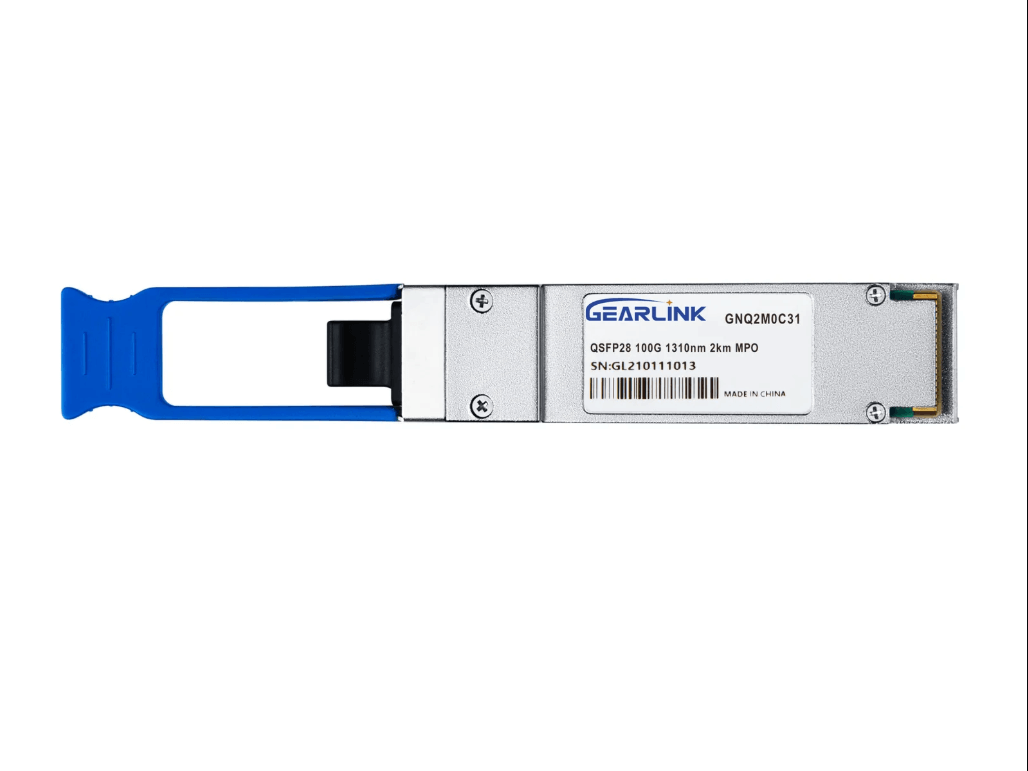
The true value of this module is realized when its technical design is applied to specific network architectures. Its advantages are most pronounced in two key areas: breakout functionality and the cost-benefit analysis of transceivers versus cabling.
The Killer Application: 100G to 4x25G Breakout
The most compelling reason to deploy a QSFP-100G-PSM4-S is its native ability to support 100G-to-4x25G breakout connectivity.
Because the PSM4 architecture consists of four independent 25G lanes, the module can be configured to “break out” its 100G MPO interface into four separate 25G links. This is accomplished physically by using an MPO-to-4xLC Duplex breakout cable. This cable connects the MPO port on the PSM4 module to four SFP28 ports on other devices, such as servers or Top-of-Rack (ToR) switches.
This breakout capability is a cornerstone of modern leaf-spine architecture for several reasons:
- Port Density and Aggregation: A network architect can use a single 100G QSFP28 port on a spine switch to aggregate traffic from four separate 25G-enabled ToR switches or servers. This quadruples the port density on the spine switch, leading to a much more efficient and scalable network fabric.
- Cost-Effective Server Connectivity: As 25G becomes the standard for server NICs, the QSFP-100G-PSM4-S provides a seamless and economical path to connect those servers to a 100G leaf switch. Instead of requiring four 25G ports on the switch, a single 100G port can service four 25G servers.
- A Critical Point of Comparison: This breakout functionality is not possible with WDM-based optics like CWDM4 or LR4. Those modules are inherently point-to-point. They optically combine the four 25G electrical lanes into a single data stream on one fiber pair. It is impossible to separate them optically at the other end without another expensive WDM module. The QSFP-100G-PSM4-S, like its multimode SR4 counterpart, retains the discrete parallel lanes, making breakout its definitive advantage.
The Economic Trade-Off: Transceiver Cost vs. Fiber Infrastructure
When evaluating a simple 100G point-to-point link (not a breakout scenario), the decision between a QSFP-100G-PSM4-S and a 100G-CWDM4 module becomes an economic equation.
- Transceiver Cost (CapEx): As mentioned, the PSM4 module is mechanically simpler. It lacks the costly MUX/DEMUX components. Therefore, the upfront purchase price of a QSFP-100G-PSM4-S is often significantly lower than that of a 100G-CWDM4 module.
- Fiber Infrastructure Cost (OpEx/CapEx): This is where the trade-off occurs.
- PSM4 requires an 8-fiber MPO trunk cable.
- CWDM4 requires only a 2-fiber (duplex) single-mode LC cable.
In a “greenfield” deployment, where new fiber is being installed, the cost of running an 8-fiber MPO trunk is not four times the cost of running a 2-fiber duplex patch cord. In many cases, the labor and pathway costs are identical. However, in a “brownfield” environment, where the existing fiber infrastructure is constrained and consists only of duplex LC patch panels, deploying PSM4 would be impossible without costly fiber plant upgrades.
The QSFP-100G-PSM4-S wins when:
- The primary driver is lowering the initial transceiver purchase cost.
- Breakout functionality is required now or is planned for the future.
- The deployment is a new build where high-density MPO trunking is the standard cabling plan.
The 100G-CWDM4 module wins when:
- The link distance is between 500m and 2km.
- The existing infrastructure is limited to 2-fiber duplex SMF.
- Breakout functionality is definitively not required.
Comparative Analysis: QSFP-100G-PSM4-S vs. Other 100G Standards
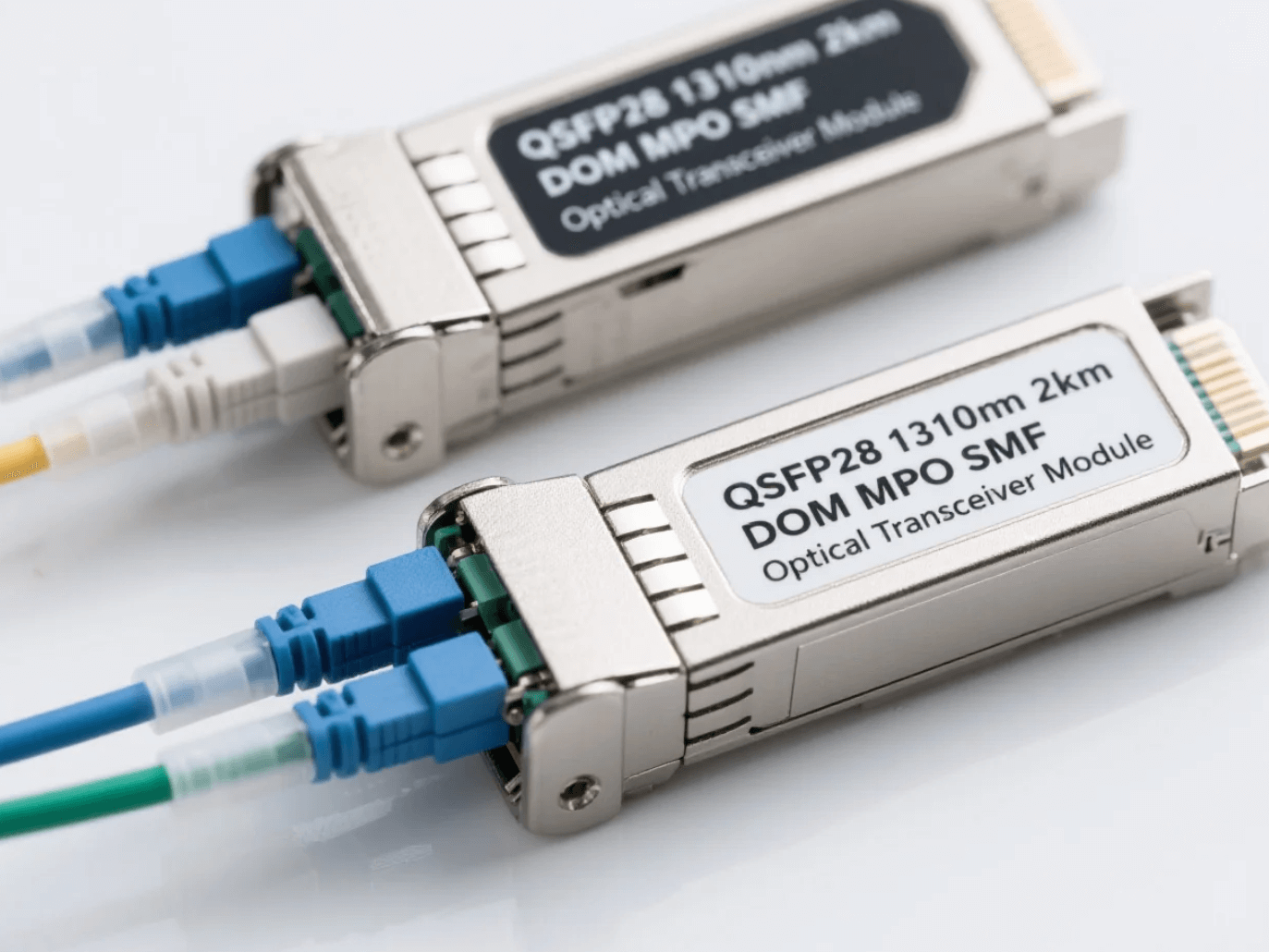
Choosing the right optic requires a direct comparison. The QSFP-100G-PSM4-S fills a specific gap that is left open by its counterparts.
QSFP-100G-PSM4-S vs. 100G-SR4
Both PSM4 and SR4 are parallel optic modules that use an MPO connector, and both are champions of 4x25G breakout. The decision here is simple and is dictated by fiber type and distance.
- SR4: Uses multimode fiber (MMF) for a maximum reach of 100 meters.
- PSM4: Uses single-mode fiber (SMF) for a maximum reach of 500 meters.
If the link is under 100 meters (e.g., within the same rack or to an adjacent rack), the 100G-SR4 is almost always the more cost-effective choice, as both MMF fiber and SR4 transceivers are typically cheaper than their single-mode equivalents. However, the moment the link exceeds 100 meters, the SR4 is no longer an option, and the QSFP-100G-PSM4-S becomes the logical successor for parallel applications.
QSFP-100G-PSM4-S vs. 100G-CWDM4
This is the most nuanced comparison, as both modules operate over single-mode fiber.
- Breakout: As established, PSM4 supports 4x25G breakout. CWDM4 does not. This is the primary functional differentiator.
- Fiber: PSM4 requires 8 fibers. CWDM4 requires 2 fibers.
- Reach: PSM4 is rated for 500 meters. CWDM4 is rated for 2 kilometers.
- Cost: The PSM4 module is generally cheaper. The CWDM4 fiber cabling is more efficient (uses fewer strands).
The choice is clear: If you need breakout, you must use PSM4 (or SR4 for shorter distances). If you need a point-to-point link over 500 meters, you must use CWDM4 (or LR4 for longer). The “gray area” is for point-to-point links under 500 meters. In this scenario, the network architect must perform a cost analysis: is the lower price of the QSFP-100G-PSM4-S module attractive enough to justify allocating 8 fiber strands to the link? In modern, high-density MPO-based builds, the answer is increasingly “yes.”
QSFP-100G-PSM4-S vs. 100G-LR4
These two modules serve entirely different purposes and rarely compete.
- LR4 (Long Reach): Uses WDM technology over duplex SMF for links up to 10 kilometers. It is a high-cost, high-performance module designed for campus-area-network (CAN) backbones, metro links, or data center interconnects (DCI) between separate facilities.
- PSM4: Is a data-center-reach module. Using a 10km LR4 for a 400-meter link is functional, but it represents a significant and unnecessary capital expenditure. The QSFP-100G-PSM4-S is the purpose-built tool for the sub-500m application, offering a far more economical solution.
Practical Implementation and Considerations
Deploying the QSFP-100G-PSM4-S is straightforward, but it requires attention to cabling, which is a common point of failure.
The module uses an MPO-12 connector. For a 100G-to-100G connection, a “Type B” MPO trunk cable (key-up to key-up) is required. This “straight-through” cable maps fiber 1 at one end to fiber 12 at the other, fiber 2 to 11, and so on. For PSM4, this correctly aligns the transmit (Tx) pins of the first module with the receive (Rx) pins of the second module.
For 100G-to-4x25G breakout applications, a PSM4-specific MPO-to-4xLC duplex fanout cable is required. This cable correctly maps the 4 Tx/Rx pairs from the MPO connector to the four individual LC duplex connectors. Using the wrong polarity cable is one of the most common and frustrating Day 1 installation problems, and it is entirely avoidable.
Furthermore, adherence to the PSM4 MSA (Multi-Source Agreement) ensures interoperability. A high-quality, MSA-compliant QSFP-100G-PSM4-S from a trusted vendor like Optictran will be interoperable with modules from other compliant vendors and with host switch/router equipment.
Conclusion: The Right Tool for a Crucial Data Center Job
The 100G optical ecosystem is rich with options because data center needs are not monolithic. The QSFP-100G-PSM4-S is not a “do-everything” transceiver. It is a specialized, highly efficient, and cost-effective tool that solves a specific set of problems with precision.
Its value is not defined by raw speed—all 100G modules offer that. Its value is unlocked in its application:
- It is the definitive, cost-effective solution for 100G-to-4x25G breakout applications.
- It provides a low-cost 100G point-to-point solution for the common 100-to-500-meter range, particularly in new data centers with MPO-based cabling.
By forgoing the expensive WDM components, PSM4 technology delivers a simpler, more affordable module that aligns perfectly with the goal of high-density aggregation. For the network architect designing a scalable and economical leaf-spine fabric, the QSFP-100G-PSM4-S is not just an option; it is an essential component in the modern data center toolkit.
Frequently Asked Questions (FAQ)
Q1: Can I use a QSFP-100G-PSM4-S with multimode fiber?
No. The QSFP-100G-PSM4-S is explicitly designed for single-mode fiber (SMF). The “S” in PSM4 stands for single-mode. Using it with multimode fiber will not work. The multimode equivalent is the 100G-SR4, which is limited to 100 meters.
Q2: What is the main difference between PSM4 and CWDM4?
There are two main differences:
- Technology: PSM4 uses four parallel fiber lanes (8 fibers total). CWDM4 uses four different wavelengths of light multiplexed onto a single fiber pair (2 fibers total).
- Function: PSM4 can be used for 100G-to-4x25G breakout. CWDM4 cannot; it is only for 100G point-to-point links.
Q3: Can I connect two QSFP-100G-PSM4-S modules together?
Yes. You can create a 100G point-to-point link up to 500 meters long by connecting two QSFP-100G-PSM4-S modules. This requires a single-mode MPO-12 (Type B Polarity) trunk cable.
Q4: Why is the QSFP-100G-PSM4-S often cheaper than a 100G-CWDM4?
The QSFP-100G-PSM4-S has a simpler internal design. It consists of four 25G lasers and four 25G receivers. A CWDM4 module requires the same lasers and receivers, but it also needs complex and expensive internal optics—a multiplexer (MUX) to combine the four wavelengths and a demultiplexer (DEMUX) to separate them. This lower component complexity makes the PSM4 module cheaper to manufacture.
Q5: Does this module work in a standard QSFP28 port?
Yes. The “QSFP” in the name refers to the QSFP (Quad Small Form-factor Pluggable) form factor. The 100G-capable version of this form factor is called QSFP28. The QSFP-100G-PSM4-S is designed to work in any QSFP28 port on a switch, router, or server NIC that supports 100G PSM4 optics.