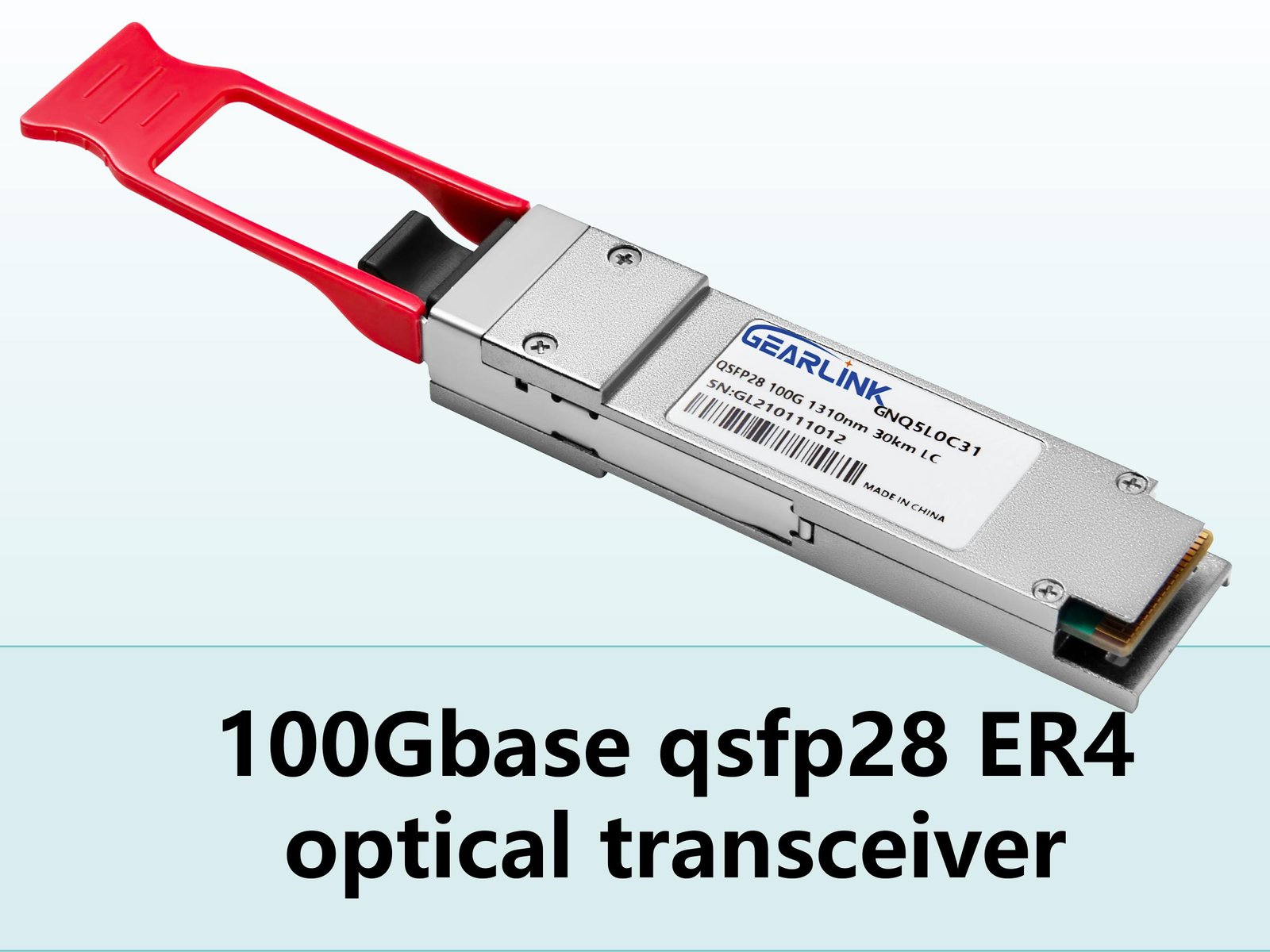
In today’s high-speed network environments, the terms QSFP 100G ER4L S, 100GBASE ER4 and 100G ER4 often surface together—and rightly so. This article will explore how the Cisco-branded QSFP 100G ER4L S relates to the generic 100GBASE ER4 / 100G ER4 standards, what features are offered, when you should use each, and how to evaluate them for your network. The target is simple: help you understand QSFP 100G ER4L S (Cisco model) as well as generic 100GBASE ER4 and 100G ER4 modules and pick wisely for your long-reach 100 Gb Ethernet applications.
What Are “100GBASE ER4” and “100G ER4” and How Does QSFP 100G ER4L S Fit In?
The term 100GBASE ER4 is a generic IEEE-Ethernet standard for 100 Gb/s over single-mode fibre using four lanes of WDM (wavelength division multiplexing) at the 1310 nm band.
The abbreviation 100G ER4 is often used interchangeably with 100GBASE ER4.
The model QSFP 100G ER4L S (from Cisco) is a vendor-specific transceiver that implements the “ER4-Lite” variant of the 100GBASE ER4 standard (sometimes called ER4L) and is compatible with the generic 100GBASE ER4/ER4L specification.
In effect: when you compare “QSFP 100G ER4L S”, “100GBASE ER4” and “100G ER4”, you are looking at the same fundamental performance class—but the first is a branded model, and the latter two are the generic standard names.
Key Technical Specifications of QSFP 100G ER4L S / 100GBASE ER4 / 100G ER4
Let’s break down the important specs. The branded QSFP 100G ER4L S and generic 100GBASE ER4/ER4L share many common features.
Optical reach and fibre type
The standard 100GBASE ER4 is designed for transmission over two-fibre single-mode (SMF) using LC duplex connectors, with reach up to 40 km under proper conditions.
For the QSFP 100G ER4L S, Cisco’s data indicates up to 40 km reach with host FEC enabled, over G.652 single-mode fibre.
Without FEC support, typical reach may drop to 30 km.
Wavelengths and lanes
These modules use 4×25 Gb/s lanes (i.e., four separate optical lanes) multiplexed for 100 Gb/s. For example, the standard lists wavelengths around 1295.56 nm, 1300.05 nm, 1304.58 nm, 1309.14 nm.
For QSFP 100G ER4L S: transmitter uses four LAN-WDM wavelengths roughly 1295-1310 nm.
Connectors, form factor & power
Form factor: QSFP28 (Quad Small Form-Factor Pluggable) is common for these modules.
Connectors: Duplex LC (for single-mode fibre) is typical.
Power consumption: For many modules ≤ 4.5 W is typical.
Standards compliance & compatibility
100GBASE ER4 is defined in IEEE Std 802.3ba and subsequent amendments.
ER4L (Lite) variants provide the same form factor but optimized (often for cost or reach).
Vendor modules like QSFP 100G ER4L S ensure interoperability and vendor support.
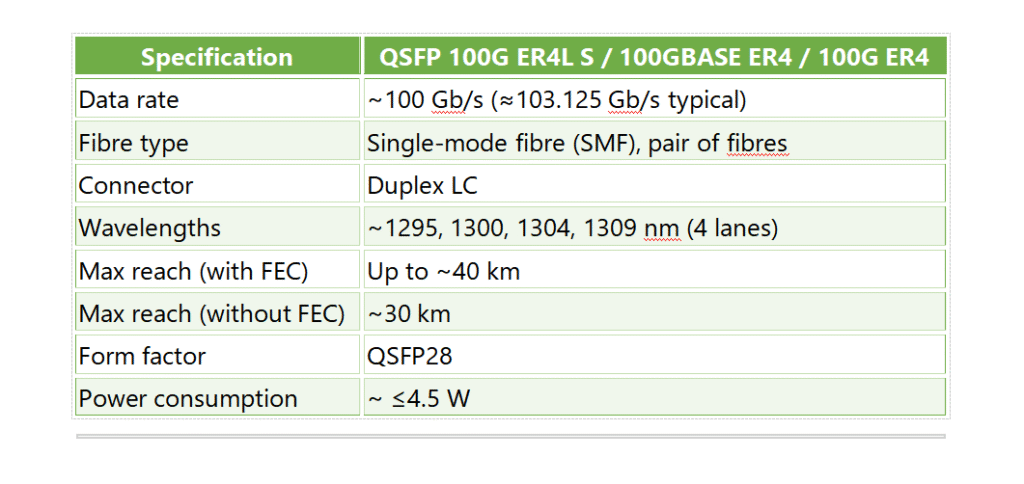
Summary Table
Here is a summarised table for easy comparison:
Why Choose QSFP 100G ER4L S / 100GBASE ER4 / 100G ER4?
Now that you know what these modules are, we can discuss why you might want to choose them, and what benefits they bring to your network.
Long-reach 100 Gb Ethernet applications
If your deployment calls for 100 Gb/s throughput over longer distances (tens of kilometres) between data centres, across campus or metropolitan networks, then a module rated for 40 km reach such as the 100GBASE ER4/100G ER4 class is well-suited.
The branded QSFP 100G ER4L S provides this reach in a vendor-supported manner within Cisco equipment.
Future-proofing and standards consistency
By selecting a module that conforms to the generic standard (100GBASE ER4 or 100G ER4) or a vendor equivalent (QSFP 100G ER4L S), you ensure compatibility, upgrade paths, and inter-vendor operability. You avoid lock-in on a proprietary “100G long-reach” variant that may deviate from established specs.
Cost-effectiveness with reach trade-offs
The “Lite” version (ER4L) may provide the long reach at somewhat lower cost or less headroom than full-blown modules. If your link budget supports it and you deploy single-mode fibre with minimal loss, you may deploy up to 40 km reach effectively. If your link is shorter, you may not need the highest spec, but having headroom is beneficial.
Considerations and caveats
FEC (Forward Error Correction) support is important for the full reach. Without FEC support on the host platform, reach may drop to ~30 km.
Fibre conditions, connector losses, splices and patch panels all affect actual reach. The spec says “up to 40 km” under ideal conditions.
Ensure your switch or router supports the QSFP28 form factor and 100G modules of this type (e.g., QSFP 100G ER4L S on Cisco gear).
Verify that the vendor-specific module is compatible with your equipment (some “compatible” modules may still require check).
How to Evaluate and Deploy Them in Your Network
Checklist before procurement
Confirm that your equipment supports 100G QSFP28 modules labelled as ER4/ER4L and that QSFP 100G ER4L S is accepted by the vendor.
Check fibre type: you need SMF (Single-mode fibre), often G.652.
Assess link budget: sum the fibre length, number of splices/patches, connector losses, margin for ageing.
Confirm if your host platform supports FEC; to achieve full 40 km reach you typically need FEC.
Confirm connectors: Duplex LC on both ends (typical for ER4/ER4L) and ensure cleanliness and quality.
Check power and cooling: module ≤ 4.5 W is typical, but ensure switch port supports this.
Review vendor certification: if using Cisco’s QSFP 100G ER4L S module, you’ll want to verify that it’s genuine Cisco or fully compatible.
Plan for diagnostics: modules often support DDM/DOM (Digital Diagnostic Monitoring). For example, many 100GBASE ER4 modules have DOM support.
Deployment best-practices
Clean and inspect LC connectors; even small contamination can significantly reduce reach.
Label and document fibre runs, losses, and maintain a log of link performance (BER, optical power, temperature).
Use optical power meter/OTDR to verify that the link loss is within budget for the module.
Monitor the module diagnostics (DDM/DOM) periodically to catch issues early (temperature, voltage, transmit/receive power).
Keep spare modules if possible; long-reach 100G modules may have longer lead times or higher cost.
Consider future growth: if you may upgrade to 400G or beyond later, ensure your fibre plant has headroom (e.g., spare fibre, low loss). This way, your investment in modules such as QSFP 100G ER4L S or generic 100GBASE ER4/100G ER4 will serve you now and scale.
When to Use — Use-Case Scenarios
Data-centre interconnect (DCI)
If you have two data centres within 10-40 km of each other and wish to deploy 100 Gb/s links, modules in the 100GBASE ER4/100G ER4 class (or QSFP 100G ER4L S) are ideal. The long reach allows you to avoid multiple hops or regeneration.
Campus backbone links
Between buildings separated by several kilometres across campus, the longer-reach 100G module simplifies fibre infrastructure and avoids needing multiple patch panels or intermediate equipment.
Metropolitan network links
If you’re a service provider or enterprise connecting sites across a metro region with SMF fibre, then 100GBASE ER4/ER4L modules make sense for cost-effective 100G service delivery.
Upgrade path from 10/40G to 100G
If your network currently uses 10G or 40G over SMF and you wish to jump to 100G without rewiring fibre, selecting a module like QSFP 100G ER4L S or equivalent allows reuse of existing fibre plant (if link budget allows).
Frequently Asked Questions
Here are 5 common Q&A items, all referencing the core keywords — QSFP 100G ER4L S, 100GBASE ER4, and 100G ER4.
Q1: What is the difference between QSFP 100G ER4L S and 100GBASE ER4?
A1: QSFP 100G ER4L S is a vendor-specific module (Cisco) that implements the generic 100GBASE ER4 (and its “Lite” variant ER4L) standard. Thus, QSFP 100G ER4L S essentially aligns with 100GBASE ER4/100G ER4 in reach and specification, but you benefit from the vendor branding, support, and certification.
Q2: Can I use a 100G ER4 module on any switch labelled 100 Gb Ethernet?
A2: Yes, provided the switch supports QSFP28 100G modules compatible with 100GBASE ER4/ER4L. You must check that the port and firmware support QSFP 100G ER4L S or equivalent generic 100G ER4 module, and that link budget and fibre type align.
Q3: What fibre type and reach can I expect with 100GBASE ER4 or QSFP 100G ER4L S?
A3: These modules are designed for single-mode fibre (SMF) using duplex LC connectors, with typical reach up to ~40 km when FEC is supported. Without FEC, expect ~30 km. Link loss, splices, and connector quality will affect actual performance.
Q4: Is the “ER4L” (Lite) variant significantly different from “ER4”?
A4: The “L” indicates a “Lite” version that may offer cost or design optimisations while still targeting similar reach (up to ~40 km) for 100GBASE ER4 applications. For example, QSFP 100G ER4L S supports full 40 km with FEC. The generic 100GBASE ER4 standard also targets ~40 km. The difference is modest and often transparent to users.
Q5: When should I not choose a 100GBASE ER4 / 100G ER4 / QSFP 100G ER4L S module?
A5: If your link is very short (for example < 2-3 km) and you could use a cheaper or lower-spec module (e.g., LR4 or SR types). Also, if your fibre plant has high losses or you cannot support FEC, then the full reach may not be achieved. In those cases, evaluate alternatives with shorter reach and lower cost.
Conclusion
In summary, the QSFP 100G ER4L S (Cisco model) and the generic 100GBASE ER4 / 100G ER4 transceiver standards represent powerful, long-reach 100 Gb/s optical modules suited for single-mode fibre links up to ~40 km. By choosing modules based on these standards, you ensure future-proof, compatible and cost-effective 100G Ethernet deployment for data-centres, campus or metro networks. Remember to check your host platform’s support, fibre plant quality, FEC capability, and budget. With those aligned, the decision becomes straightforward—and the result is a reliable 100G link ready to serve your high-capacity needs.