Introduction: Understanding the Role of QSFP 100G SR4 S in Modern Networks
In the digital era, where data is growing at an unprecedented rate, high-speed and reliable network infrastructure has become a fundamental requirement. As organizations continue to expand their cloud services, artificial intelligence workloads, and big data applications, the demand for efficient optical interconnect solutions has significantly increased. Among these solutions, qsfp 100g sr4 s stands out as a practical and widely adopted technology for short-distance transmission.
To begin with, modern data centers require solutions that are not only fast but also scalable and cost-effective. Therefore, technologies like qsfp 100g sr4 s are often selected because they strike a balance between performance and affordability. In addition, the simplicity of deployment makes this module especially attractive for both new installations and upgrades.
Furthermore, as network architectures evolve toward spine-leaf designs, high-density interconnects are becoming essential. In such environments, qsfp 100g sr4 s plays a critical role in ensuring seamless communication between switches and servers. Consequently, understanding how this module works and where it fits is crucial for network engineers and decision-makers alike.
What is QSFP 100G SR4 S?
Basic Definition and Structure
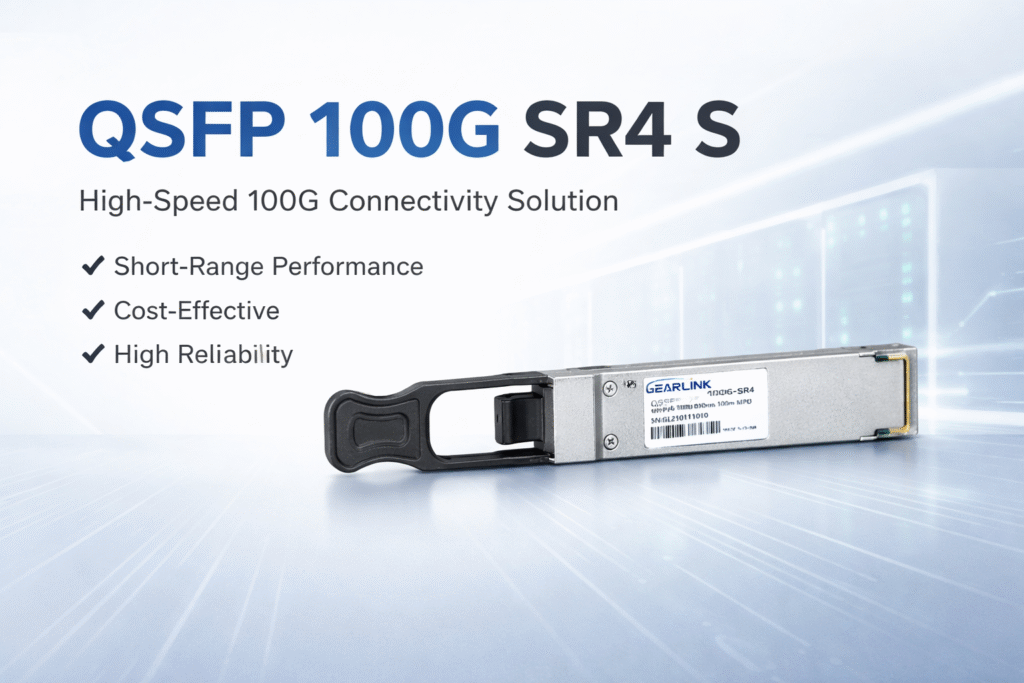
The qsfp 100g sr4 s is a 100 Gigabit optical transceiver module designed for short-reach data transmission over multimode fiber. It uses a QSFP (Quad Small Form-factor Pluggable) interface, which allows four independent channels to operate simultaneously.
More specifically, each channel typically transmits data at 25Gbps. As a result, the total bandwidth reaches 100Gbps. This parallel transmission method significantly improves efficiency compared to earlier single-lane technologies.
Additionally, the module usually features an MPO/MTP connector. This connector enables multiple fiber strands to be connected in a compact form, which is essential for high-density deployments.
Technical Specifications Overview
Below is a simplified overview of typical specifications:
| Parameter | Description |
| Data Rate | 100Gbps |
| Fiber Type | Multimode (OM3/OM4) |
| Connector | MPO/MTP |
| Transmission Distance | 70m (OM3), 100m (OM4) |
| Wavelength | 850nm |
| Power Consumption | <3.5W |
As shown above, the qsfp 100g sr4 s is optimized for short-distance, high-speed environments.
How QSFP 100G SR4 S Works
Parallel Optics Technology
At its core, the qsfp 100g sr4 s relies on parallel optical transmission. Instead of sending all data through a single channel, it splits the data into four lanes.
Each lane operates independently at 25Gbps. Consequently, the combined throughput reaches 100Gbps. This approach reduces bottlenecks and enhances reliability.
Moreover, VCSEL (Vertical-Cavity Surface-Emitting Laser) technology is typically used. These lasers are known for their efficiency and low cost, which further contributes to the popularity of the module.
Data Transmission Process
The transmission process can be summarized as follows:
Electrical signals are received from the switch
Signals are converted into optical signals
Data is transmitted through four fiber lanes
Optical signals are converted back into electrical signals
Because of this streamlined process, latency is minimized and performance is optimized.
Advantages of QSFP 100G SR4 S
Cost-Effective Deployment
One of the primary advantages of the qsfp 100g sr4 s is its affordability. Since it operates over multimode fiber, infrastructure costs are significantly reduced compared to single-mode solutions.
Additionally, existing multimode cabling can often be reused. Therefore, upgrade costs are minimized.
High Port Density
Another key benefit is high port density. Due to its compact QSFP form factor, more ports can be installed within the same physical space.
As a result, data centers can scale efficiently without requiring additional rack space.
Low Power Consumption
Power efficiency is another important consideration. The qsfp 100g sr4 s is designed to consume relatively low power.
Consequently, operational costs are reduced, and cooling requirements are simplified.
QSFP 100G SR4 S vs Other 100G Modules
To better understand its value, it is helpful to compare the qsfp 100g sr4 s with other common 100G transceivers.
Detailed Comparison Table
| Feature | SR4 S | LR4 | CWDM4 |
| Fiber Type | Multimode | Single-mode | Single-mode |
| Distance | Short | Long | Medium |
| Cost | Low | High | Medium |
| Use Case | Data center | Long-haul | Metro |
| Connector | MPO | LC | LC |
Clearly, the qsfp 100g sr4 s excels in short-range, high-density applications.
Application Scenarios
Data Centers
In modern data centers, high-speed connections between switches are essential. The qsfp 100g sr4 s is widely used for this purpose.
For example, spine-to-leaf connections often rely on such modules to ensure fast and reliable communication.
Cloud Computing
Cloud service providers require scalable infrastructure. Therefore, the qsfp 100g sr4 s is frequently deployed to support high-bandwidth workloads.
Enterprise Networks
Enterprises upgrading to 100G networks also benefit from this technology. It provides a cost-effective way to improve network performance.
Deployment Best Practices
Fiber Management
Proper fiber management is essential. Clean connectors and correct polarity must be ensured.
Otherwise, performance issues may occur.
Compatibility Check
Before deployment, compatibility should be verified. Although most modules follow standards, vendor-specific coding may be required.
Environmental Considerations
Temperature and airflow must be controlled. This ensures stable operation over time.
Installation and Maintenance
Installation Steps
Inspect the module carefully
Insert it into the port
Connect the fiber cable
Verify link status
Maintenance Tips
Clean connectors regularly
Monitor performance metrics
Replace faulty modules promptly
These practices help maintain optimal performance.
Future Outlook
Although newer technologies like 400G and 800G are emerging, the qsfp 100g sr4 s remains highly relevant.
In many scenarios, 100G infrastructure is still widely used. Therefore, this module will continue to play a key role.
Furthermore, hybrid networks often require backward compatibility. This makes the qsfp 100g sr4 s a reliable long-term solution.
Conclusion
Overall, the qsfp 100g sr4 s provides an excellent balance of performance, cost, and scalability. It is particularly well-suited for short-range data center applications.
As network demands continue to grow, solutions like this will remain essential. Therefore, adopting the qsfp 100g sr4 s can help organizations build efficient and future-ready networks.
FAQs
1. What is QSFP 100G SR4 S mainly used for?
The module is mainly used for short-distance 100G connections in data centers.
2. How far can QSFP 100G SR4 S transmit?
Typically, the module supports up to 100 meters over OM4 fiber.
3. Is QSFP 100G SR4 S cost-effective?
Yes, the module is considered highly cost-effective for short-range applications.
4. What connector is used in QSFP 100G SR4 S?
The module uses an MPO/MTP connector.
5. Can QSFP 100G SR4 S be used in enterprise networks?
Yes, the module is widely used in enterprise and cloud environments.