In today’s rapidly evolving networking world, two long-reach 40-gigabit optical module standards—40GBASE LR4 and QSFP 40G PSM4 LR—are frequently discussed because they address similar needs while offering different technical approaches. Since both names often refer to similar long-reach 40G solutions, confusion is quite common. Nevertheless, when these two technologies are clearly compared, network planners gain strong confidence in choosing the best option for their infrastructure.
Right from the beginning, it is important to clarify that 40GBASE LR4 and QSFP 40G PSM4 LR both serve the core purpose of enabling long-distance, high-speed, and extremely stable optical transmission. Even though they achieve this goal in different ways, the reliability they bring to modern data networks has made them essential. Because terms like “40GBASE LR4” and “QSFP 40G PSM4 LR” appear in vendor specifications, deployment guides, and product catalogs, understanding their similarities and differences brings immediate value to engineers and IT managers.
Throughout this guide, you will see both 40GBASE LR4 and QSFP 40G PSM4 LR mentioned many times, because they remain the primary focus of this analysis, and because they help shape the long-reach strategies adopted in many data centers, aggregation networks, and enterprise infrastructures.
Understanding 40GBASE LR4 and QSFP 40G PSM4 LR in Simple Terms
Even though optical communication sounds complicated, the concepts behind 40GBASE LR4 and QSFP 40G PSM4 LR can be explained in a very approachable way. The key difference lies in how data is transmitted over fiber, even though both operate at the same 40-gigabit speed.
What 40GBASE LR4 Means in Practical Usage
The 40GBASE LR4 standard delivers 40-gigabit connectivity using four wavelengths carried through a single pair of single-mode fibers. Instead of sending four separate signals on different fibers, 40GBASE LR4 combines them using WDM (wavelength-division multiplexing). As a result, long distances—typically up to 10 km—can be achieved while consuming minimal fiber resources.
Because of this design, 40GBASE LR4 becomes extremely useful in fiber-limited environments. For example, campus networks, carrier rooms, or buildings with constrained fiber availability often rely heavily on 40GBASE LR4.
What QSFP 40G PSM4 LR Represents in Real Deployments
On the other hand, QSFP 40G PSM4 LR takes a more straightforward parallel-fiber method. Instead of multiple wavelengths on one pair of fibers, this module uses four fibers for transmitting and four fibers for receiving, resulting in a total of eight single-mode fibers.
Although this design requires more fiber cores, it simplifies the optical architecture and lowers cost in many scenarios. QSFP 40G PSM4 LR typically supports distances of 2–10 km, depending on fiber quality and vendor specifications.
Moreover, QSFP 40G PSM4 LR modules are widely deployed in data-center environments where fiber resources are abundant and parallel optical cabling systems are already in place.
Key Technical Differences Between 40GBASE LR4 and QSFP 40G PSM4 LR
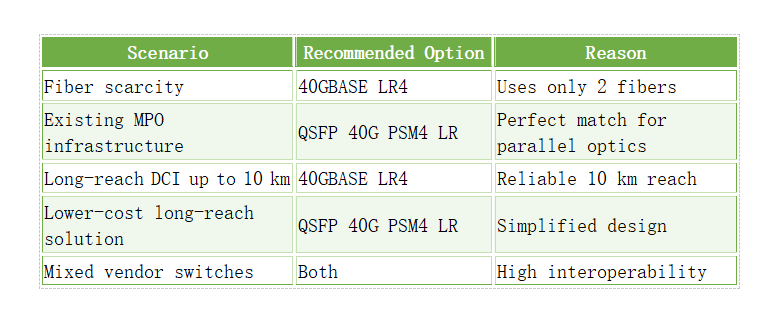
Even though they address similar needs, important technical distinctions exist between 40GBASE LR4 and QSFP 40G PSM4 LR. The following tables present a clear comparison, making it easier to understand.
Table 1 — Core Transmission Difference
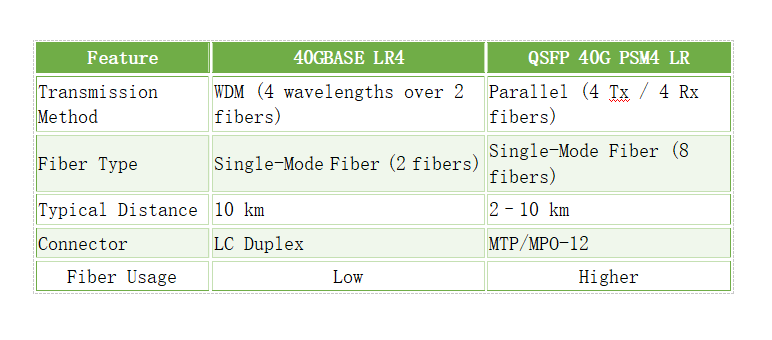
Table 2 — Module Structure & Interface
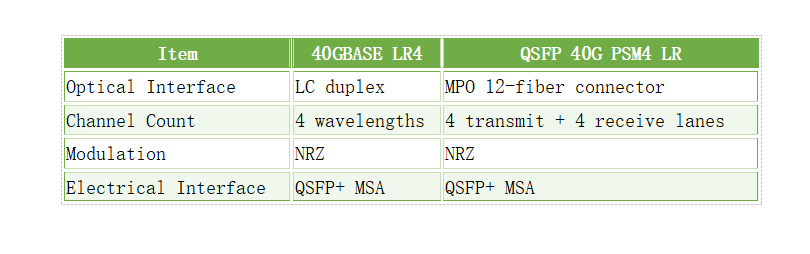
Table 3 — Best Use-Case Comparison
Why Both 40GBASE LR4 and QSFP 40G PSM4 LR Are Still Popular
Although the networking industry is rapidly moving toward 100G, 200G, 400G, and even 800G, the 40G ecosystem remains widely used, especially in:
Campus networks
Enterprise aggregation
Metro access
Cost-sensitive data centers
Legacy switch expansions
Because of their reliability, toughness, and long reach, 40GBASE LR4 and QSFP 40G PSM4 LR continue to hold critical positions.
Lower Cost Compared to 100G or 400G Solutions
Choosing either 40GBASE LR4 or QSFP 40G PSM4 LR is often motivated by mature technology. The pricing has become extremely attractive due to years of mass production.
Furthermore, equipment supporting 40G remains widely available and very stable.
Excellent Interoperability
Both 40GBASE LR4 and QSFP 40G PSM4 LR follow well-established industry standards. Therefore:
Modules from different vendors work smoothly together.
Cross-platform compatibility is usually trouble-free.
Integrators can mix and match according to budget needs.
Reliable Long-Distance Transmission
Because both module types are built for long-reach scenarios, the optical performance is solid and predictable. This reliability ensures minimal packet loss, stable latency, and strong resilience during heavy workloads.
A Closer Look at the Applications of 40GBASE LR4 and QSFP 40G PSM4 LR
Even though both serve 40-gigabit links, their application environments can differ.
Where 40GBASE LR4 Performs Best
40GBASE LR4 modules are the top choice when:
Fiber resources are limited
A campus network spans multiple buildings
A metro access network requires long-distance 40G links
A carrier network needs standard WDM-based long reach
Because only two fibers are used, deployment becomes easier and more flexible.
Where QSFP 40G PSM4 LR Shows Advantages
QSFP 40G PSM4 LR modules shine in:
Data-center rack-to-rack connectivity
Leaf-spine topologies with MPO panels
Environments where parallel optics are already installed
Long-reach links where cost must stay low
Moreover, installation becomes very simple when MPO cabling already exists.
Performance Characteristics of 40GBASE LR4 and QSFP 40G PSM4 LR
Performance remains a core factor for many engineers. The following breakdown explains the optical, electrical, and thermal characteristics.
Optical Performance
Both module types usually support:
40G Ethernet
Digital Diagnostics (DDM/DOM)
NRZ modulation
Error-free transmission over rated distances
However, the main difference remains in the fiber structure.
Power Consumption and Heat
In general:
40GBASE LR4 tends to use slightly more power due to wavelength lasers.
QSFP 40G PSM4 LR sometimes demonstrates lower power consumption.
Nevertheless, both remain well below the thermal thresholds of QSFP+ standards.
Device Compatibility
Since both modules follow the QSFP+ MSA framework, they operate correctly on:
Cisco
Arista
Juniper
H3C
Huawei
Dell
Mellanox/NVIDIA
Brocade
Interoperability remains extremely strong.
Installation and Deployment Tips
Although the installation process is simple, several best practices ensure stable long-term operation.
Tip 1: Always Clean Fiber Connectors
Because long-reach modules are sensitive to dust, proper cleaning dramatically reduces insertion loss.
Tip 2: Avoid Excessive Bending of Fibers
Maintaining recommended bend radius prevents performance degradation.
Tip 3: Monitor DDM Values Regularly
Observing:
Tx Power
Rx Power
Temperature
Bias Current
helps detect issues early.
Choosing Between 40GBASE LR4 and QSFP 40G PSM4 LR: A Practical Guide
Even though both modules support long-reach connectivity, selection depends entirely on the environment.
Choose 40GBASE LR4 if:
Fiber resources are extremely limited
A clean LC duplex system is preferred
The link distance approaches 10 km
You need WDM-based long reach
Choose QSFP 40G PSM4 LR if:
MPO cabling is already deployed
Cost savings are important
The environment is built around parallel optics
Slightly shorter long-reach links are acceptable
Because both solutions deliver reliability, choosing one does not eliminate the other.
Final Thoughts: Why Understanding 40GBASE LR4 and QSFP 40G PSM4 LR Matters
To summarize, both 40GBASE LR4 and QSFP 40G PSM4 LR represent powerful and trustworthy long-reach optical solutions. Even though they differ in fiber usage and optical design, they both ensure stable, high-quality 40-gigabit connections—something that many enterprise and data-center environments still rely heavily on today.
Because of their proven reliability, strong interoperability, and predictable performance, they remain essential building blocks of modern networks.
If you are planning fiber upgrades or considering long-reach 40G deployment, understanding the difference between 40GBASE LR4 and QSFP 40G PSM4 LR will dramatically improve the quality of your decisions. With the clarity provided in this guide, choosing the right module becomes significantly easier, more confident, and ultimately more successful.
Q1: What is the main purpose of a 40GBASE LR4 transceiver?
A1: A 40GBASE LR4 transceiver enables long-reach 40G optical transmission over single-mode fiber, and it is commonly compared with QSFP 40G PSM4 LR solutions.
Q2: How does QSFP 40G PSM4 LR differ from 40GBASE LR4?
A2: QSFP 40G PSM4 LR uses parallel fiber transmission, while 40GBASE LR4 uses wavelength-division multiplexing. Both support long-reach 40G links.
Q3: Is QSFP 40G PSM4 LR compatible with standard QSFP+ ports?
A3: Yes. QSFP 40G PSM4 LR modules are designed for QSFP+ slots, similar to how 40GBASE LR4 is deployed in the same hardware environment.
Q4: Which option is better for data-center interconnects, 40GBASE LR4 or QSFP 40G PSM4 LR?
A4: Both work well for long-reach 40G links, but 40GBASE LR4 is usually chosen when fiber resources are limited.
Q5: Do 40GBASE LR4 and QSFP 40G PSM4 LR support DDM/DOM monitoring?
A5: Yes. Both 40GBASE LR4 and QSFP 40G PSM4 LR commonly support digital optical monitoring for reliable operation.