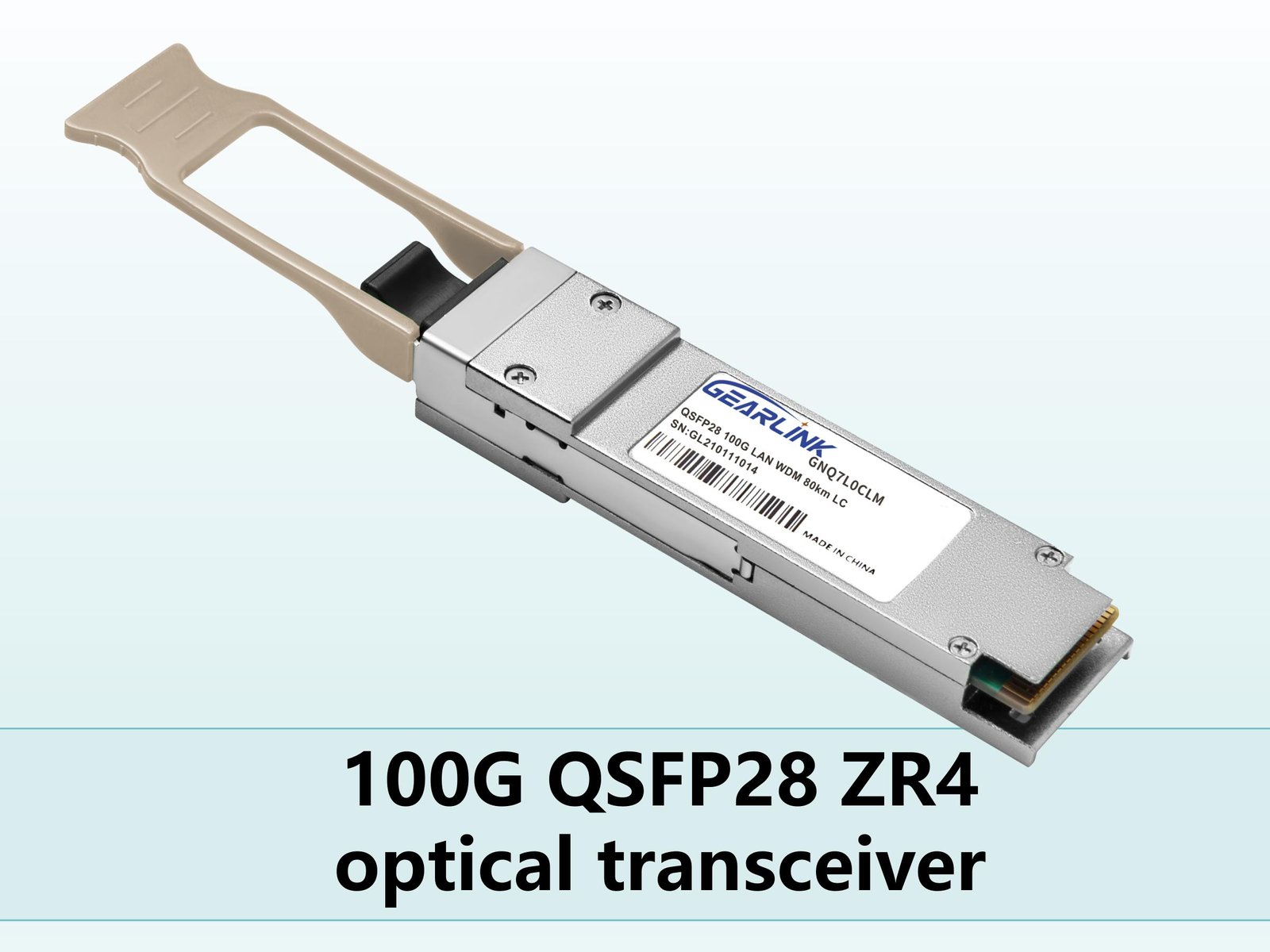
In today’s high-performance networks, the terms QSFP 100G ZR4 S, 100G ZR4 and QSFP28 ZR4 are often used interchangeably. In fact, for practical purposes they refer to the same class of optical transceiver module — just described differently depending on vendor, form-factor or marketing. In the very first paragraph it is important to clarify this: the QSFP 100G ZR4 S is a specific model from Cisco (Cisco’s part), while 100G ZR4 refers generically to a 100 Gbps link with ZR4 reach and 4 channels, and QSFP28 ZR4 denotes the QSFP28 form-factor for that ZR4 specification.
As such, if you are evaluating a network upgrade or data-center build and you see any of those three terms — QSFP 100G ZR4 S, 100G ZR4, QSFP28 ZR4 — you are essentially looking at the same 100 Gbps extended-reach optical module class. This article will explain how they relate, what the key specifications are, how they compare, and what to watch out for when buying or deploying.
What do the terms mean?
The “100G ZR4” concept
First of all, “100G ZR4” means a 100-Gigabit per second connection (“100G”) and the “ZR4” designation means (in this context) four optical channels (4 lanes) with a long-reach capability (up to ~80 km in SMF in many cases). For example, Cisco’s QSFP-100G-ZR4-S supports up to 80 km over single-mode fiber (SMF) with duplex LC connectors.
In the generic sense:
“100G” = 100 Gbps aggregate rate (often 4×25 Gbps lanes)
“ZR4” = ZR class (extended reach) + “4” lanes/channels
So when someone says “100G ZR4”, they are referring to a module that supports 100 Gbps, four lanes, long-reach.
The “QSFP28 ZR4” form-factor description
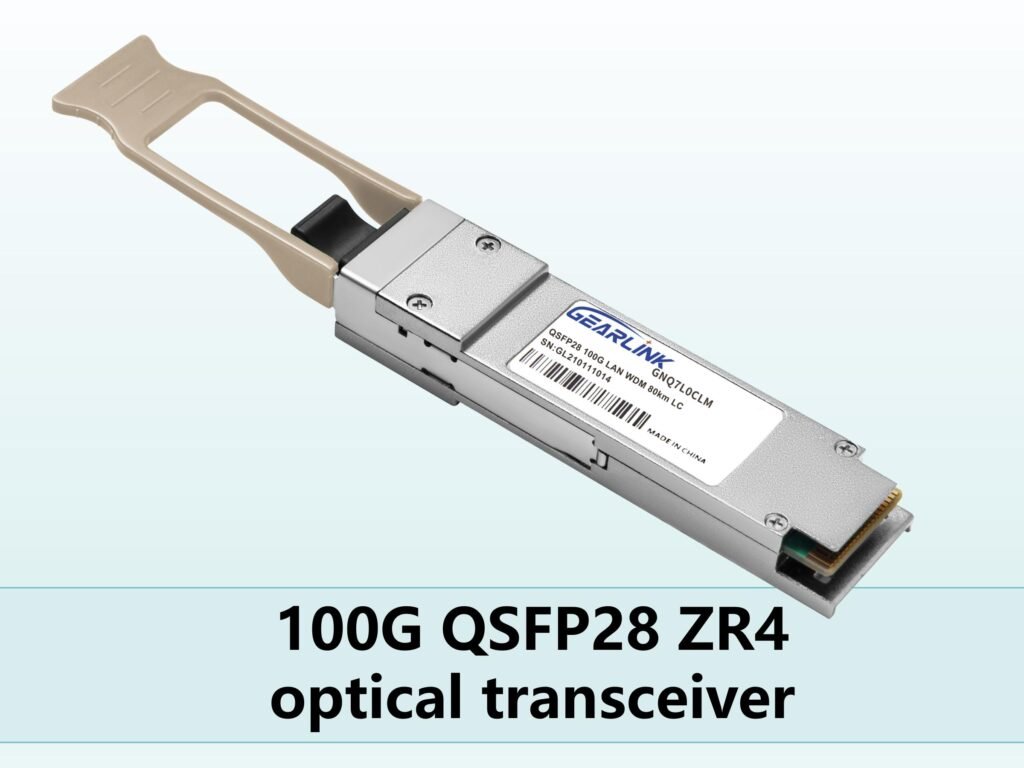
Next: “QSFP28 ZR4” emphasises the form-factor: QSFP28 is the pluggable module standard that supports 4×25 G electrical lanes (for 100 G) and is widely used. Therefore “QSFP28 ZR4” simply states a QSFP28 module with ZR4 reach support. In other words: form-factor = QSFP28; reach class = ZR4.
The “QSFP 100G ZR4 S” (Cisco) model
Finally, “QSFP 100G ZR4 S” is the specific part number from Cisco. According to Cisco documentation, the QSFP-100G-ZR4-S module is a QSFP-28 form-factor, supports 100G, uses direct-detect technology, supports O-band (1295/1300/1304/1309 nm) wavelengths, and reaches up to ~80 km.
Thus:
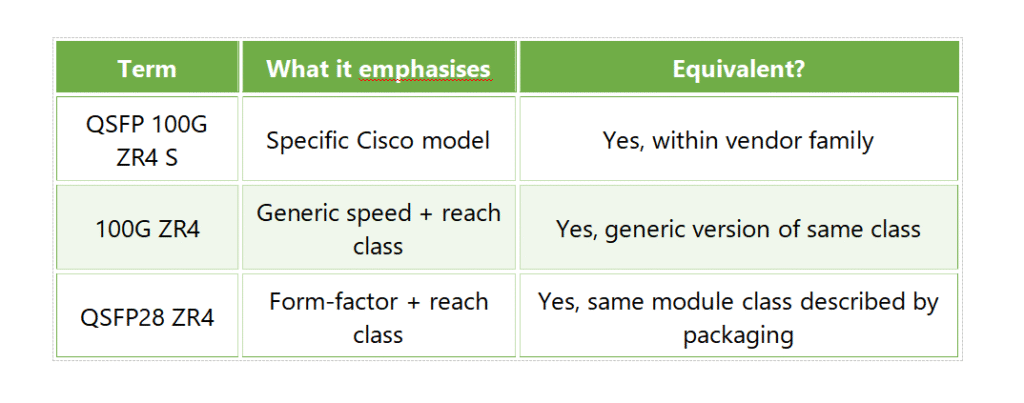
Because the market uses all three, you will often see compatibility or cross-listing under these names — essentially they point to the same product type, as you noted.
Key Specifications & Features
Let’s dive into what these modules deliver, referencing Cisco’s QSFP-100G-ZR4-S as a representative example of the 100G ZR4 / QSFP28 ZR4 class.
Speed & lanes
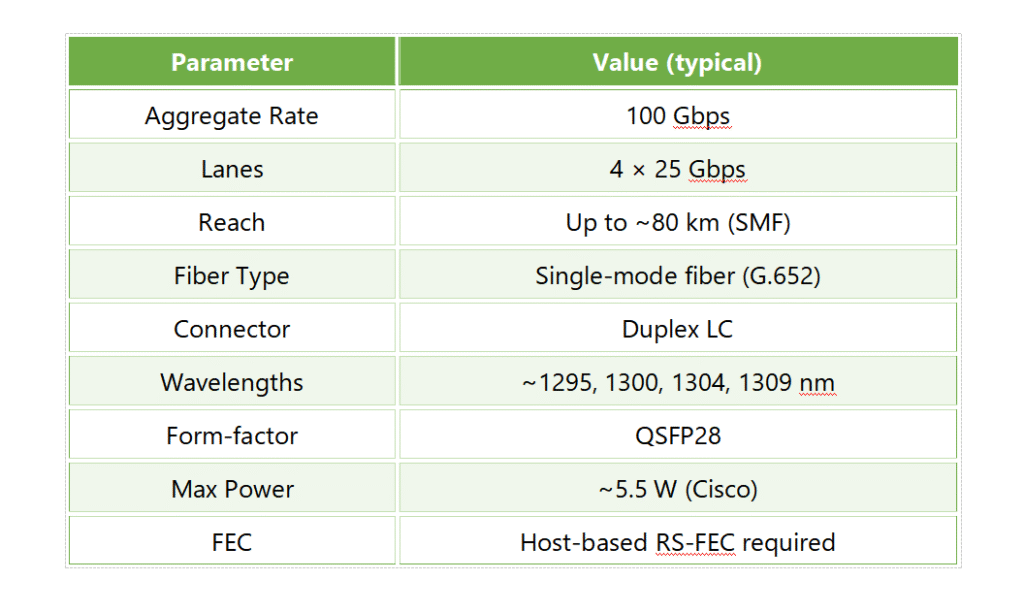
The module provides 100 Gbps aggregate rate via four lanes of 25 Gbps each (4×25G) in a QSFP28 package.
Reach / fiber type / connector
Reach: up to 80 km over G.652 single-mode fiber (SMF) according to Cisco documentation.
Connector type: Duplex LC.
Wavelengths: O-band (approx 1295 nm, 1300 nm, 1304 nm, 1309 nm) to minimise chromatic dispersion.
Form-factor & power
QSFP28 form-factor (which fits in standard QSFP28 ports).
Maximum power consumption up to approx 5.5 W in Cisco’s case.
Technology highlights
Direct-detect modulation (NRZ) as opposed to coherent, making it cost-efficient.
Integrated Semiconductor Optical Amplifier (SOA) in Cisco’s module to enable the 80 km reach while staying within the QSFP28 envelope.
Requires host-based RS-FEC (Reed-Solomon Forward Error Correction) on the switch/router port.
Summary table
Why this module class matters (and market insight)
Use cases and benefits
Because the 100G ZR4 / QSFP28 ZR4 / QSFP 100G ZR4 S modules deliver high bandwidth at extended reach and a compact form-factor, they are very attractive in several scenarios:
Connecting regional data centers, metro-to-metro links, or enterprise sites across ~80 km distances.
Service-provider backhaul for 4G/5G fronthaul or aggregation of mobile sites.
Enabling 100 Gbps links in existing QSFP28 ports (leveraging current hardware) rather than requiring larger coherent pluggables or separate transport gear.
Market language and equivalence
As noted earlier, vendors and buyers often use these three terms — QSFP 100G ZR4 S (Cisco model), 100G ZR4 (generic), QSFP28 ZR4 (form-factor descriptor) — to reference essentially the same class of product. From a purchasing and deployment point of view, understanding that they equate helps avoid confusion and ensures you compare apples-to-apples.
What to watch out for
Ensure that the host switch/router port supports QSFP28 form-factor and the necessary host-based RS-FEC, since ZR4 modules generally require FEC. For example, Cisco notes that the QSFP-100G-ZR4-S always needs RS-FEC on the host port.
While “100G ZR4” may be generic, vendor interoperability is not always guaranteed; Cisco states it does not guarantee interoperability with non-Cisco transceivers, despite similar specs.
Power and cooling: higher power (5+ W) and good airflow may be required because of the extended reach design.
Fiber quality and link budget: The 80 km reach is under ideal conditions (good SMF fiber, low loss connectors). Real-world distances may vary.
Pricing and availability: Given the extended reach and market demand, modules in this class may carry a premium; compatibility (vendor lock-in vs multi-vendor) can also affect cost.
Why adoption is strong
Because CSPs (service providers), data-centers and enterprises increasingly need 100 Gbps links at longer distances without moving to coherent transport or higher cost solutions, the 100G ZR4 class offers a “sweet spot” — high speed, extended reach, and form-factor compatibility — making it compelling. Cisco’s white-paper emphasises this point.
Deployment guide: Best practices
Planning your link
Measure fibre attenuation and total insertion loss (connectors, splices) to verify you can meet link budget for ~80 km or less.
Confirm host platform supports QSFP28 and RS-FEC.
Confirm connector type (usually Duplex LC) and SMF type (G.652, G.657) is appropriate.
Ensure ambient conditions, cooling and power budget support the ~5 W module (or vendor equivalent).
Installation tips
Insert module into QSFP28 port while system is powered per vendor instructions.
Monitor DOM/diagnostic readings post-installation (many modules support Digital Optical Monitoring). Cisco’s module does support DOM.
Perform BER testing or link validation to verify full 100 Gbps operation over the target reach.
Verify FEC status and ensure host platform has FEC enabled.
Operating & maintenance
Periodically check optical power, temperature and voltage via DOM.
Monitor changes in insertion loss or fiber degradation over time.
On failures or margin issues, replace connectors/splices or reduce reach accordingly.
Migration considerations
If you currently have 10G or 40G links and need to upgrade to 100 Gbps over long links (~50-80km), choosing a module of the 100G ZR4 class makes sense because it uses mature QSFP28 ports rather than moving straight to 400G or coherent transport modules. This can simplify migration and reduce cost.
Comparison: 100G ZR4 class vs other 100G modules
Here is a quick comparison of typical optical module classes:
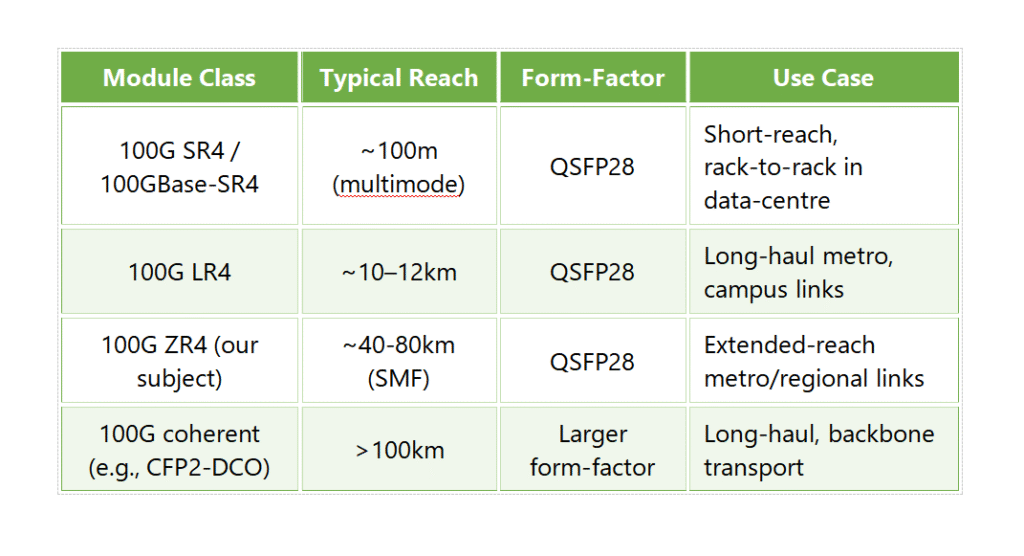
Thus, when you read “100G ZR4” or “QSFP28 ZR4” or see the Cisco part “QSFP 100G ZR4 S”, you should map it to the row marked extended-reach (~40-80km) in a compact QSFP28 form-factor.
FAQ – 5 Key Questions & Answers
Below are five questions and answers related to QSFP 100G ZR4 S / 100G ZR4 / QSFP28 ZR4.
What is the difference between QSFP 100G ZR4 S and 100G ZR4?
The term “QSFP 100G ZR4 S” is a vendor-specific model designation (Cisco) that falls into the same product class as “100G ZR4”. The “100G ZR4” term is generic, meaning 100 Gbps rate with ZR4 reach (4 lanes, extended reach). So essentially the same class.
Can a QSFP28 ZR4 module work in any QSFP28 port?
Generally yes, provided the host port supports QSFP28 and the necessary features (such as RS-FEC) that the module requires. It’s still wise to confirm compatibility with your switch/router vendor.
What distances can I expect from a 100G ZR4 / QSFP28 ZR4 module?
In typical cases up to ~80 km over single-mode fiber for modules like Cisco’s QSFP-100G-ZR4-S. Real-world reach will depend on fiber losses, connector/splice quality, ambient conditions.
Does a QSFP 100G ZR4 S module support breakout (e.g., 4×25G)?
According to Cisco’s FAQ, the QSFP-100G-ZR4-S module only operates in 100G mode and does not support breakout into 4×25G lanes.
Is the price of 100G ZR4 modules significantly higher than shorter-reach 100G modules?
Yes — due to the extended-reach optics, amplifier design (SOA) and more stringent link budgets, modules in the 100G ZR4 class tend to carry a higher cost than standard short-reach 100G modules. That is balanced by the benefit of longer reach and reuse of QSFP28 infrastructure.
Conclusion
In summary, when you encounter the terms QSFP 100G ZR4 S, 100G ZR4 or QSFP28 ZR4, treat them as referring to the same product class: 100-Gbps optical transceiver modules with four lanes, extended reach (~80 km), and QSFP28 packaging (in the case of the Cisco model). They enable high-speed links at longer distances without stepping up to larger coherent transport modules or changing port architectures.
By understanding the equivalence of these terms, the key spec details (speed, reach, lanes, form-factor, FEC requirement) and deployment considerations (fiber budget, host support, compatibility), you can make a more informed decision and avoid confusion in the optical module marketplace.