Introduction: Why QSFP56 Is Becoming Essential in High-Speed Networks
In modern data centers and enterprise networks, bandwidth demand is increasing at an unprecedented pace. Applications such as cloud computing, artificial intelligence, big data analytics, and large-scale storage systems require faster and more reliable data transmission. As a result, new optical interface technologies (QSFP56)are constantly being introduced to support higher speeds and better efficiency.
Among these innovations, QSFP56 has emerged as one of the most important form factors for 200G Ethernet connectivity. Designed as an evolution of the well-known QSFP family, QSFP56 enables significantly higher data rates while maintaining a compact footprint and excellent compatibility with existing network infrastructure.
In recent years, QSFP56 solutions have been widely adopted in hyperscale data centers, high-performance computing clusters, and telecom backbone networks. Compared with earlier generations, the QSFP56 standard provides improved signal integrity, higher modulation efficiency, and better scalability for future network upgrades.
Moreover, network engineers increasingly prefer QSFP56 because it delivers 200Gbps bandwidth through four high-speed electrical lanes, each running at 50Gbps using PAM4 modulation. Consequently, greater transmission capacity can be achieved without dramatically increasing power consumption or hardware complexity.
Therefore, understanding QSFP56 technology is becoming essential for anyone involved in modern networking infrastructure. In this guide, the architecture, advantages, applications, and deployment considerations of QSFP56 will be explained in clear and practical terms.
Understanding QSFP56: What QSFP56 Really Means
The Definition and Evolution of QSFP56
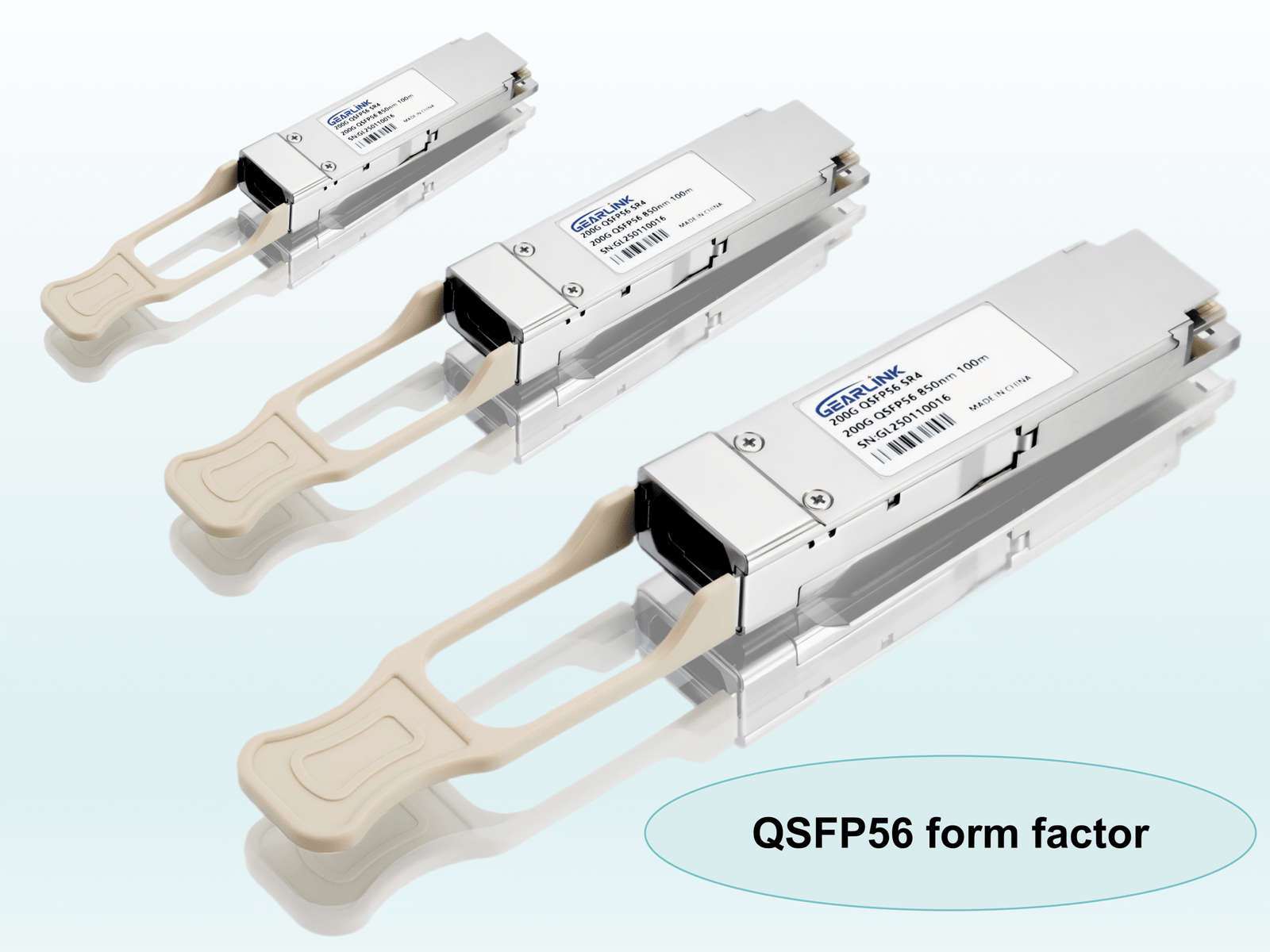
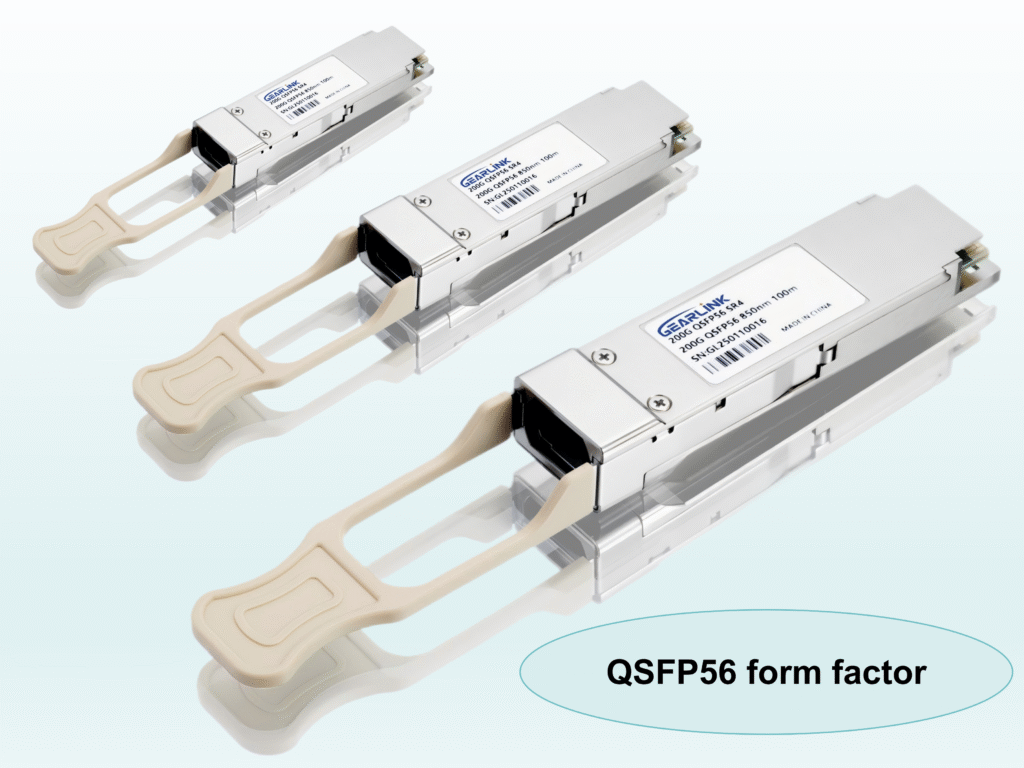
The term QSFP56 refers to a high-speed pluggable optical transceiver form factor designed for 200G Ethernet and InfiniBand networking environments. The name itself comes from several key components:
| Term | Meaning |
| QSFP | Quad Small Form-factor Pluggable |
| 56 | Indicates 56Gbps signaling per lane |
| 4 lanes | Four electrical channels |
As a result, the total aggregate bandwidth reaches 200Gbps, typically using PAM4 modulation.
Historically, QSFP56 was developed as the next step after QSFP28, which supports 100G networking. While QSFP28 uses 25G NRZ signaling across four lanes, QSFP56 doubles the per-lane throughput through more advanced modulation techniques.
Because of this improvement, QSFP56 allows network designers to achieve higher bandwidth while maintaining the same physical port density.
How QSFP56 Works in Modern Network Hardware
To better understand QSFP56 technology, it is helpful to look at how data flows through the module.
A typical QSFP56 module contains several critical components:
| Component | Function |
| Laser transmitter | Converts electrical signals into optical signals |
| Photodetector | Converts optical signals back to electrical signals |
| DSP chip | Handles PAM4 signal processing |
| Electrical interface | Connects to switch or NIC |
| Optical interface | Connects to fiber cable |
When data is transmitted, the electrical signal generated by the switch ASIC enters the QSFP56 module. Then the DSP processes the signal and converts it into optical form using lasers.
Afterward, the signal travels through fiber optic cables to another QSFP56 module, where the reverse process occurs.
Because of advanced signal processing, high transmission efficiency can be achieved while minimizing errors and signal distortion.
QSFP56 Architecture and Technical Specifications
Key QSFP56 Technical Parameters
Understanding the specifications of QSFP56 helps engineers select the correct module for different networking scenarios.
Below is a simplified overview of typical QSFP56 characteristics:
| Parameter | Specification |
| Form factor | QSFP56 |
| Maximum data rate | 200Gbps |
| Electrical lanes | 4 lanes |
| Per lane speed | 50Gbps PAM4 |
| Connector type | MPO or LC |
| Transmission media | Single-mode or multimode fiber |
| Power consumption | Typically 4–7W |
| Hot-pluggable | Yes |
| Operating temperature | 0°C to 70°C (commercial) |
These parameters make QSFP56 highly suitable for high-density switching environments.
QSFP56 Modulation Technology: PAM4 Explained
One of the most important innovations in QSFP56 is PAM4 modulation.
Traditional Ethernet optical modules relied on NRZ modulation, where only two signal levels exist. However, NRZ becomes inefficient at higher data rates.
PAM4 solves this limitation by introducing four signal levels, effectively doubling the data capacity per lane.
| Modulation | Signal Levels | Data Efficiency |
| NRZ | 2 | 1 bit per symbol |
| PAM4 | 4 | 2 bits per symbol |
Because of this improvement, QSFP56 can transmit twice the data using the same number of channels.
Nevertheless, PAM4 signals are more sensitive to noise. Therefore, advanced digital signal processing and error correction mechanisms are required.
Common QSFP56 Optical Transceiver Types
QSFP56 modules are available in multiple variants designed for different distances and fiber types.
QSFP56 SR4
| Feature | Description |
| Fiber type | Multimode |
| Distance | Up to 100m |
| Connector | MPO-12 |
| Application | Data center interconnect |
QSFP56 SR4 is widely used for short-distance links inside data centers.
QSFP56 DR4
| Feature | Description |
| Fiber type | Single-mode |
| Distance | Up to 500m |
| Connector | MPO-12 |
| Application | Data center spine-leaf architecture |
QSFP56 DR4 provides higher reach than SR4 while maintaining parallel fiber architecture.
QSFP56 FR4
| Feature | Description |
| Fiber type | Single-mode |
| Distance | 2km |
| Connector | Duplex LC |
| Application | Campus networks and metro connections |
QSFP56 FR4 uses CWDM wavelengths to transmit 4 channels over duplex fiber.
QSFP56 LR4
| Feature | Description |
| Fiber type | Single-mode |
| Distance | 10km |
| Connector | LC |
| Application | Metro network and telecom infrastructure |
Because longer reach is supported, QSFP56 LR4 modules are often deployed in telecom aggregation layers.
Advantages of QSFP56 Technology
Higher Bandwidth Without Increasing Port Size
One of the biggest benefits of QSFP56 is that 200G bandwidth can be achieved using the same physical size as QSFP28.
Consequently, network operators can double bandwidth without redesigning their switching hardware.
Improved Power Efficiency
Another advantage is better power efficiency per bit transmitted.
Even though QSFP56 modules process more data, the power increase is relatively small. Therefore, data centers can scale capacity without dramatically increasing power consumption.
Compatibility with Existing Infrastructure
QSFP56 switches are typically designed to support backward compatibility.
For example:
| Switch Port | Compatible Modules |
| QSFP56 | QSFP28 |
| QSFP56 | QSFP+ (via adapter) |
As a result, network upgrades can be performed gradually.
QSFP56 Deployment Scenarios
Data Center Spine-Leaf Networks
Modern hyperscale data centers often rely on spine-leaf network architecture.
In these environments, QSFP56 is commonly used for:
Leaf-to-spine connections
Server aggregation
Storage interconnect
Because bandwidth demand is extremely high, QSFP56 provides an efficient way to increase network capacity.
High-Performance Computing (HPC)
In HPC clusters, large volumes of data must be transferred between thousands of nodes.
Therefore, low latency and high throughput are critical. QSFP56 is widely used in 200G InfiniBand networks, enabling ultra-fast communication.
Cloud Service Providers
Cloud platforms operate massive distributed infrastructures.
QSFP56 allows cloud operators to:
Increase bandwidth density
Reduce network congestion
Improve virtualization performance
Consequently, many hyperscale companies are deploying QSFP56 in large numbers.
QSFP56 vs Other Optical Transceiver Form Factors
Understanding how QSFP56 compares with other modules can help determine when it should be used.
| Feature | QSFP28 | QSFP56 | QSFP-DD |
| Maximum speed | 100G | 200G | 400G |
| Electrical lanes | 4 | 4 | 8 |
| Per lane speed | 25G | 50G | 50G |
| Modulation | NRZ | PAM4 | PAM4 |
| Power consumption | Lower | Medium | Higher |
From this comparison, it becomes clear that QSFP56 serves as the bridge between 100G and 400G networking.
Future Development of QSFP56 Technology
Although 400G networking is rapidly growing, QSFP56 will continue to play a significant role.
Several trends are expected:
Wider deployment in mid-scale data centers
Integration with AI cluster networks
Improved DSP chips for better signal quality
Lower manufacturing cost over time
As semiconductor technology advances, QSFP56 modules are expected to become more affordable and energy efficient.
Best Practices for Deploying QSFP56 Modules
To ensure stable network operation, several best practices should be followed.
Choose the Right Fiber Type
| Module | Fiber |
| SR4 | Multimode |
| DR4 | Single-mode |
| FR4 | Single-mode |
| LR4 | Single-mode |
Selecting the correct fiber prevents signal loss.
Monitor Optical Power Levels
Optical links should be monitored regularly to ensure proper signal strength.
Typical parameters include:
Transmit power
Receive sensitivity
Optical loss budget
Proper monitoring helps prevent unexpected link failures.
Ensure Switch Compatibility
Before deploying QSFP56 modules, compatibility with switch firmware should always be verified.
In many cases, vendor qualification lists provide guidance.
Conclusion: Why QSFP56 Matters for the Future of Networking
As digital infrastructure continues to expand, the need for higher bandwidth and better efficiency will only increase.
QSFP56 represents a major step forward in optical transceiver technology. By enabling 200Gbps connectivity within a compact and scalable form factor, QSFP56 allows modern networks to meet growing performance demands without excessive hardware complexity.
Furthermore, the combination of PAM4 modulation, advanced DSP processing, and flexible fiber options makes QSFP56 highly versatile across many networking environments.
For data centers, telecom operators, and high-performance computing platforms, QSFP56 provides a reliable foundation for next-generation connectivity.
Therefore, as organizations continue to upgrade their network infrastructure, QSFP56 will remain an important technology bridging the transition from 100G to even faster networking standards.