Introduction: Why 400G FR4 Is Transforming Modern Networks
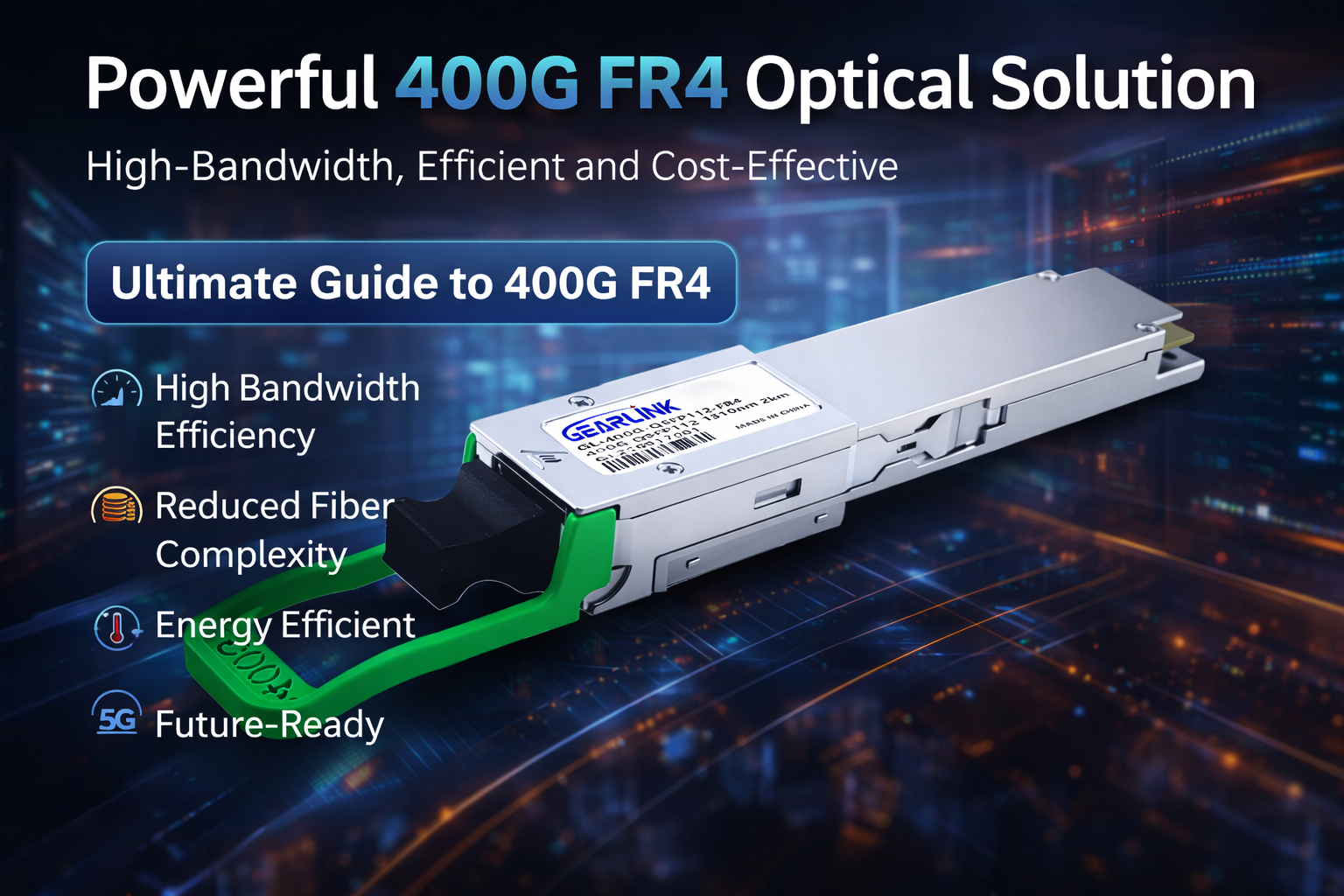
In today’s rapidly evolving data landscape, 400G FR4 has emerged as a powerful solution for high-speed optical transmission. As data centers continue to scale and bandwidth demand keeps rising, this technology is increasingly being adopted for its balance between performance, cost, and efficiency.
At its core, 400G FR4 enables 400G data transmission over single-mode fiber using four wavelengths. Compared to traditional solutions, it offers a more streamlined architecture and improved scalability. As a result, it is widely used in hyperscale data centers, cloud computing environments, and enterprise backbone networks.
Moreover, as network infrastructure is being upgraded worldwide, the importance of 400G FR4 is being recognized more than ever. In the following sections, we will explore how it works, its advantages, applications, comparisons, and deployment considerations.
What Is 400G FR4 and How Does It Work?
Basic Definition of 400G FR4
400G FR4 refers to a 400 Gigabit Ethernet optical transceiver standard that uses four lanes of 100G signals. Each lane operates at a different wavelength, typically within the CWDM (Coarse Wavelength Division Multiplexing) range.
In simpler terms, instead of sending all data through a single channel, 400G FR4 splits it into four parallel optical signals. These signals are then combined and transmitted over a single fiber pair.
Key Technical Principles Behind 400G FR4
The working principle of 400G FR4 can be summarized as follows:
Four wavelengths are used (typically around 1271nm, 1291nm, 1311nm, and 1331nm)
Each wavelength carries 100Gbps
PAM4 modulation is utilized to double data efficiency
Signals are multiplexed and transmitted over single-mode fiber
Additionally, advanced DSP (Digital Signal Processing) is applied to ensure signal integrity. Because of this, stable transmission over distances up to 2km can be achieved.
Key Features of 400G FR4 Technology
High Bandwidth Efficiency
One of the standout features of 400G FR4 is its efficient use of bandwidth. By leveraging four wavelengths, it maximizes data throughput while minimizing fiber usage.
Compact Form Factor
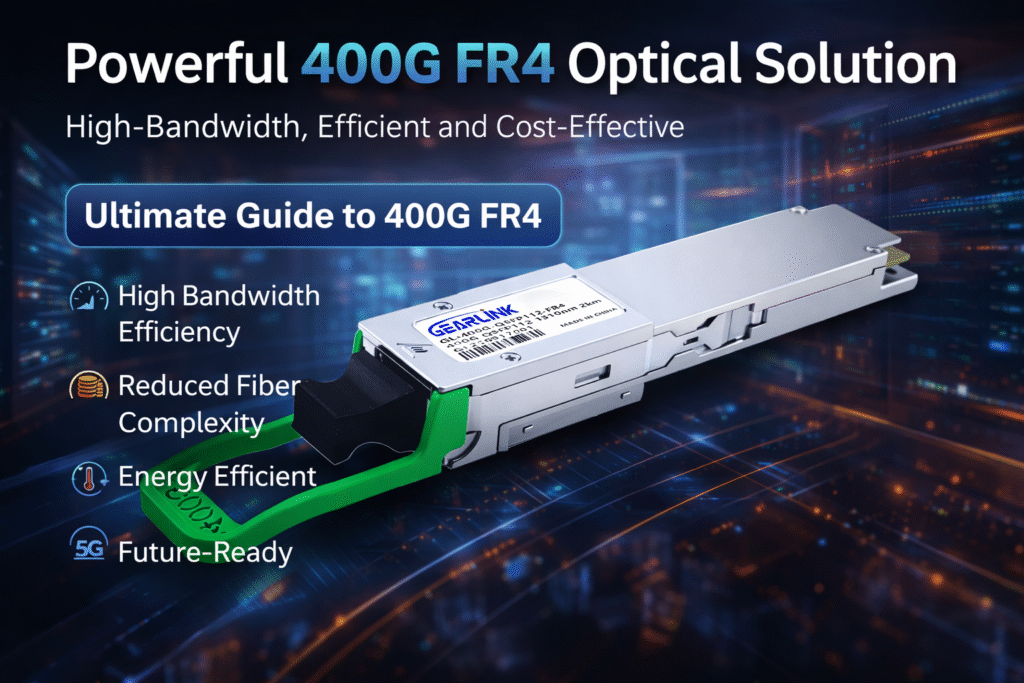
Most 400G FR4 modules are packaged in QSFP-DD or OSFP form factors. This compact design allows higher port density in switches and routers.
Cost Optimization
Compared to other 400G solutions like DR4, 400G FR4 reduces fiber requirements, which significantly lowers deployment costs.
Energy Efficiency
Lower power consumption is another benefit. As energy costs rise, efficient solutions like 400G FR4 are increasingly preferred.
400G FR4 vs Other 400G Optical Modules
To better understand its value, let’s compare 400G FR4 with other common 400G technologies.
Comparison Table
| Feature | 400G FR4 | 400G DR4 | 400G LR4 |
| Transmission Distance | Up to 2km | Up to 500m | Up to 10km |
| Fiber Type | Single-mode fiber | Single-mode fiber | Single-mode fiber |
| Wavelength Count | 4 | 4 | 4 |
| Cost | Medium | Low | High |
| Use Case | Data center interconnect | Short-reach links | Long-distance links |
From the table above, it can be clearly seen that 400G FR4 strikes a balance between distance and cost.
Advantages of Using 400G FR4 in Data Centers
Reduced Fiber Complexity
Unlike parallel optics, 400G FR4 only requires duplex fiber. This simplifies cabling and reduces operational complexity.
Scalability for Future Growth
As network demand grows, scalable solutions are essential. 400G FR4 allows seamless upgrades without major infrastructure changes.
Improved Reliability
Because fewer fibers are used, fewer points of failure exist. Consequently, system reliability is improved.
Common Applications of 400G FR4
Cloud Data Centers
Large-scale cloud providers rely heavily on 400G FR4 to handle massive data traffic between servers and switches.
Enterprise Networks
Enterprises that require high-speed connectivity are increasingly adopting 400G FR4 for backbone networks.
Telecommunications Infrastructure
Telecom operators use 400G FR4 to support 5G backhaul and metro network expansion.
Deployment Considerations for 400G FR4
Fiber Compatibility
Before deploying 400G FR4, it is important to ensure compatibility with existing single-mode fiber infrastructure.
Connector Type
Most modules use LC duplex connectors. Proper handling and cleaning are essential for optimal performance.
Thermal Management
Since high-speed modules generate heat, proper cooling systems should be implemented.
How to Choose the Right 400G FR4 Module
Key Selection Criteria
When selecting a 400G FR4 module, consider the following:
Transmission distance requirements
Compatibility with existing equipment
Power consumption
Vendor reliability
Practical Selection Table
| Criteria | Recommendation |
| Distance ≤ 2km | Choose 400G FR4 |
| High density | QSFP-DD form factor |
| Power sensitive | Low-power optimized modules |
| Budget constraints | Cost-effective FR4 solutions |
Future Trends of 400G FR4 Technology
Looking ahead, 400G FR4 is expected to remain a key technology in data center evolution. However, newer technologies such as 800G optics are emerging.
Even so, 400G FR4 will continue to be widely used due to its maturity and cost-effectiveness. In many scenarios, it will serve as a transitional solution before full 800G adoption.
Challenges and Limitations of 400G FR4
Distance Limitation
Although efficient, 400G FR4 is limited to around 2km. For longer distances, LR4 solutions are required.
Signal Complexity
Because PAM4 modulation is used, signal processing becomes more complex. As a result, advanced DSP is required.
Conclusion: Why 400G FR4 Is a Smart Investment
In conclusion, 400G FR4 offers a powerful combination of performance, efficiency, and cost savings. It is widely adopted in modern data centers and continues to play a crucial role in network upgrades.
As demand for bandwidth continues to grow, solutions like 400G FR4 will remain highly relevant. Therefore, investing in this technology is considered a forward-looking decision.
FAQ
1. What is 400G FR4 used for?
400G FR4 is used for high-speed data transmission in data centers, cloud networks, and telecom infrastructure.
2. What is the distance of 400G FR4?
400G FR4 typically supports transmission distances up to 2 kilometers over single-mode fiber.
3. How does 400G FR4 compare to 400G DR4?
Compared to DR4, 400G FR4 uses fewer fibers and supports longer distances, making it more flexible.
4. What fiber is required for 400G FR4?
400G FR4 uses duplex single-mode fiber, which simplifies cabling compared to parallel optics.
5. Is 400G FR4 suitable for future networks?
Yes, 400G FR4 is widely considered a future-ready solution due to its scalability and efficiency.