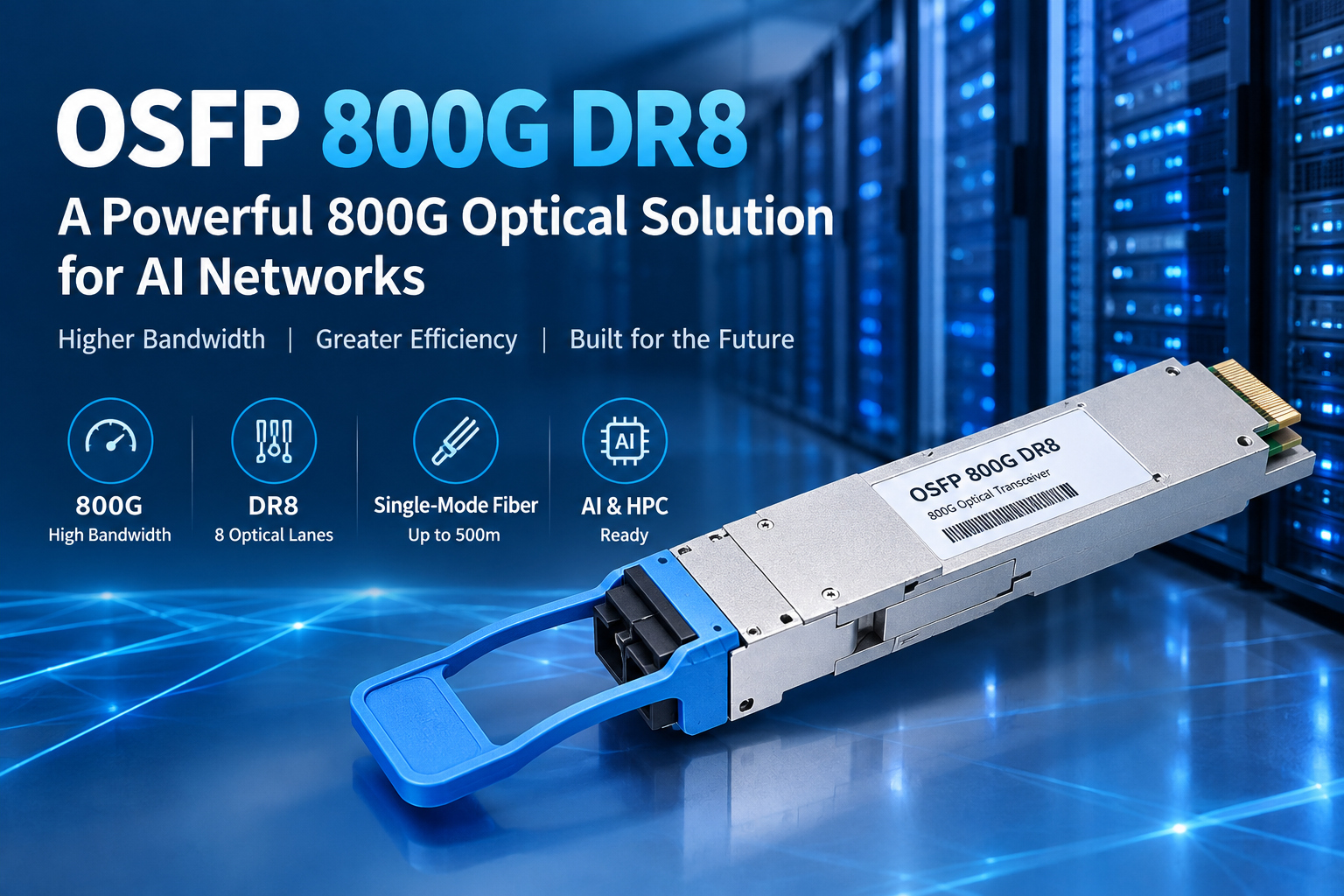
As AI clusters and high-performance data centers continue to grow, network traffic is increasing at an unprecedented rate. The OSFP 800G DR8 has become an important optical solution for connecting high-speed switches, servers, and computing systems. By combining the OSFP form factor with an 8-channel 800G optical architecture, this transceiver provides the bandwidth and reach needed for demanding data center environments.
Unlike traditional 100G or 400G optical modules, 800G solutions are designed for the next generation of high-density networking. In particular, the OSFP 800G DR8 is designed to support short-reach single-mode fiber connections while maintaining high data throughput and efficient front-panel port density.
As a result, network designers are increasingly evaluating 800G DR8 modules when upgrading AI infrastructure, cloud data centers, and high-performance computing networks.
What Is OSFP 800G DR8?
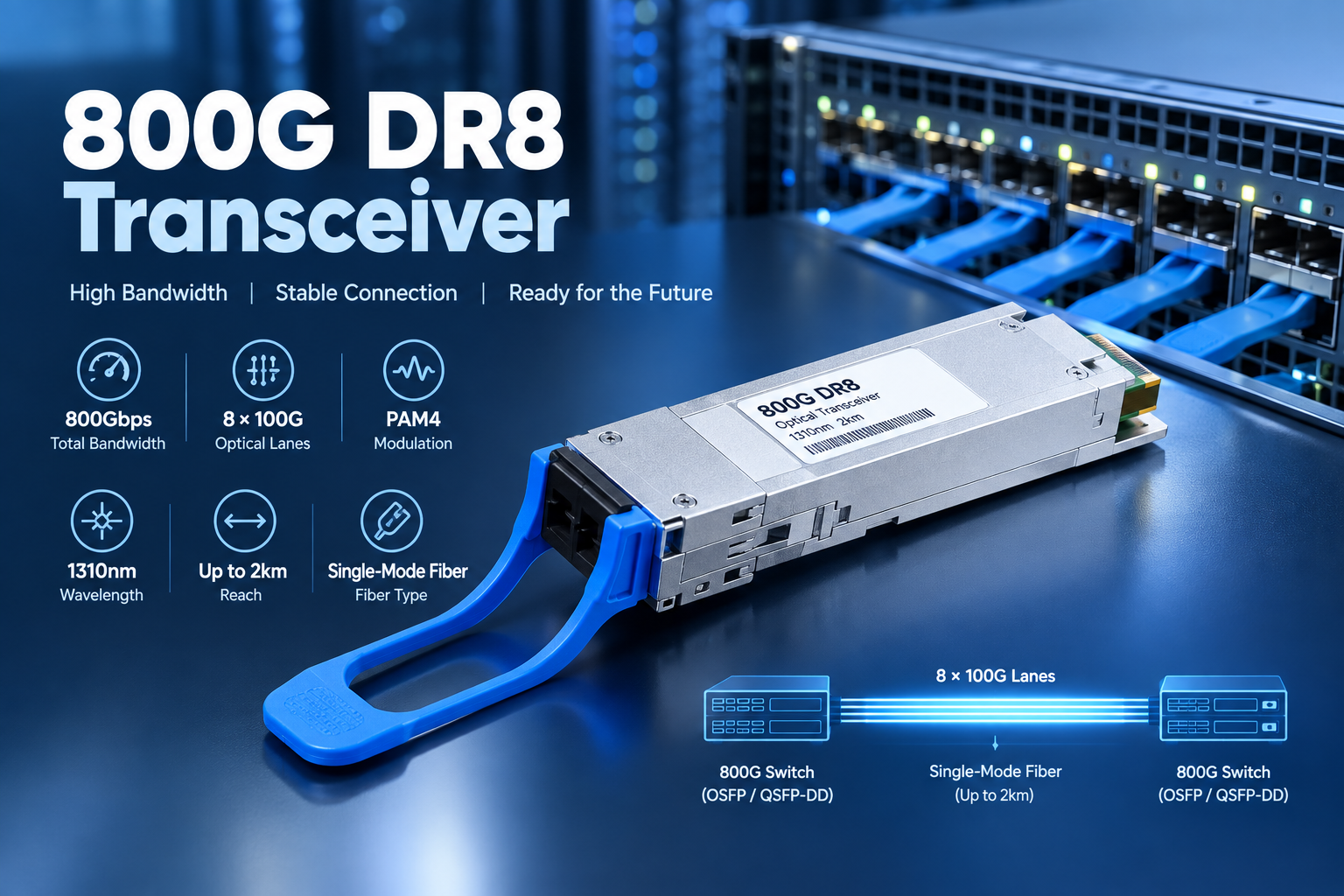
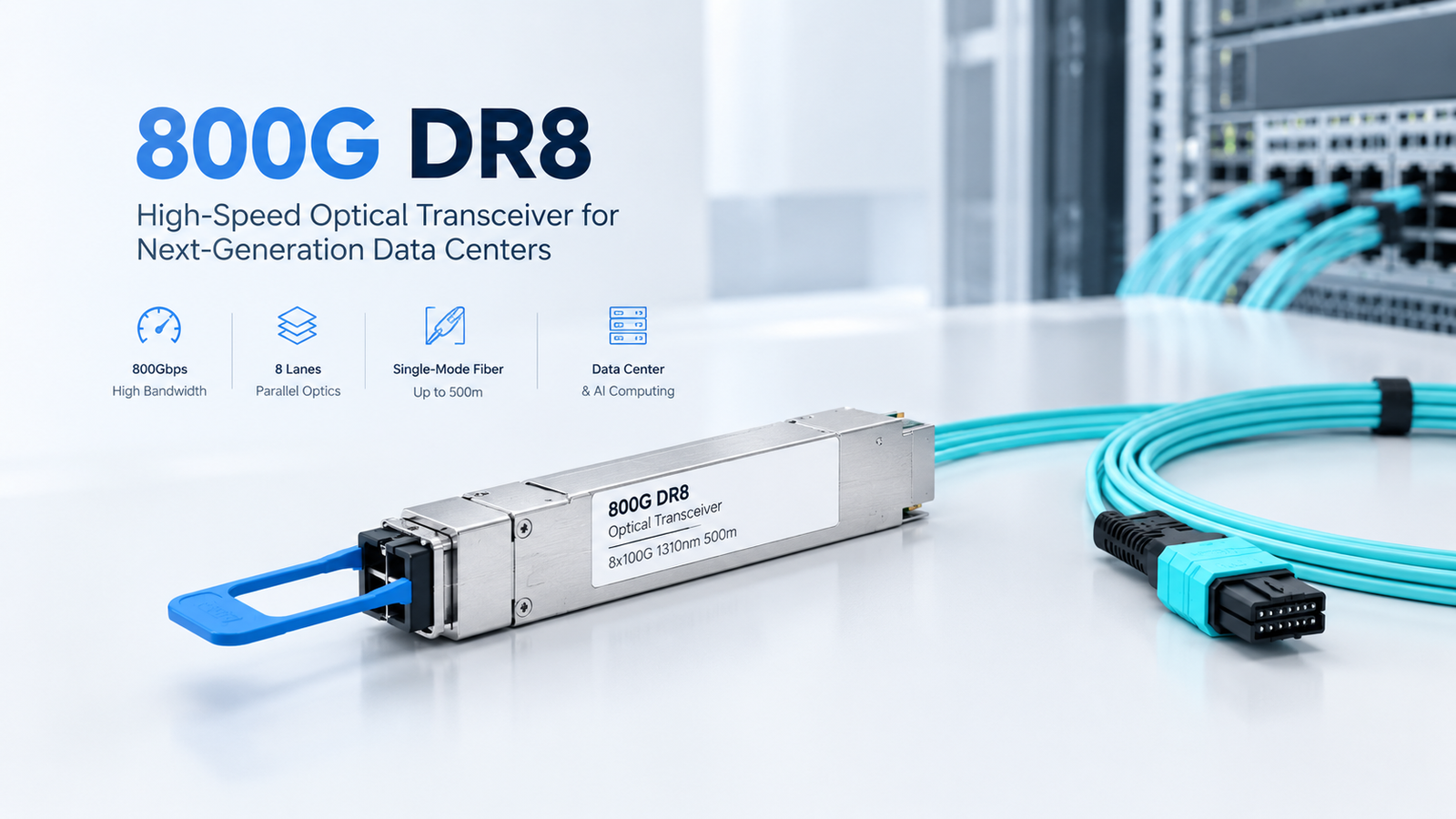
The OSFP 800G DR8 is an 800Gb/s optical transceiver based on the OSFP form factor. The term “OSFP” refers to Octal Small Form Factor Pluggable, while “DR8” generally describes an 8-lane 100G optical configuration designed for approximately 500 meters over parallel single-mode fiber.
In simple terms, the module divides the total 800Gb/s bandwidth into eight optical lanes.
Each optical lane operates at approximately 100Gb/s, allowing the complete module to reach an aggregate data rate of 800Gb/s.
How Does OSFP 800G DR8 Work?
The basic transmission structure can be understood as:
| Parameter | Typical Configuration |
| Form factor | OSFP |
| Total data rate | 800Gb/s |
| Optical lanes | 8 |
| Lane speed | 100Gb/s |
| Fiber type | Single-mode fiber |
| Typical reach | Up to 500 m |
| Optical wavelength | Around 1310 nm |
| Modulation | PAM4 |
| Connector | MPO-16 / related parallel-fiber interface |
| Application | AI, HPC, data centers, switch-to-switch |
The exact specifications can vary between manufacturers and product versions. Therefore, compatibility should always be confirmed against the target switch, optical interface, firmware, and fiber infrastructure.
Why OSFP 800G DR8 Matters for Modern Data Centers
The rapid development of AI computing has created new demands for network bandwidth. Large GPU clusters can generate enormous amounts of east-west traffic, especially when many accelerators work together on the same workload.
Consequently, 400G connections are increasingly being complemented or replaced by 800G links in new high-performance network architectures.
The OSFP 800G DR8 provides several practical advantages.
First, it delivers twice the aggregate bandwidth of a 400G optical connection. Second, its parallel optical architecture supports high-density switch connections. Furthermore, the OSFP package is well suited to high-speed network equipment that has been designed around 800G interfaces.
800G Bandwidth for AI and HPC
AI workloads are particularly sensitive to network performance. GPU servers frequently exchange large amounts of data during distributed training and inference.
For example, a large AI cluster may require continuous communication between multiple GPU nodes. If the network becomes a bottleneck, expensive computing resources may not be fully utilized.
Therefore, high-speed optical links such as the OSFP 800G DR8 can help create a higher-capacity network fabric.
The following table shows a simplified comparison:
| Network Speed | Aggregate Bandwidth | Typical Use |
| 100G | 100Gb/s | Enterprise and data center links |
| 200G | 200Gb/s | High-speed server and switch connections |
| 400G | 400Gb/s | Modern data center networks |
| 800G | 800Gb/s | AI, HPC, large-scale data centers |
| 1.6T | 1.6Tb/s | Emerging next-generation networks |
As network speeds increase, optical transceivers must also evolve. That is why 800G technology is becoming increasingly important.
OSFP 800G DR8 Optical Architecture Explained
The architecture of the OSFP 800G DR8 may look complicated at first. However, the basic concept is relatively straightforward.
The module uses eight optical lanes. Each lane carries approximately 100Gb/s of data. Together, these lanes provide an aggregate rate of 800Gb/s.
Eight 100G Optical Lanes
A simplified optical architecture can be represented as:
800G = 8 × 100G optical lanes
Each optical lane uses PAM4 signaling to transmit data at a high rate.
PAM4 is different from traditional NRZ signaling because it uses four signal levels instead of two. This allows more bits to be transferred during each symbol.
However, PAM4 also introduces greater sensitivity to signal quality. Consequently, the electrical and optical design of an 800G transceiver is more demanding than that of older-generation modules.
Single-Mode Fiber for 800G DR8
The OSFP 800G DR8 is normally associated with single-mode fiber. This is important because single-mode fiber provides the optical performance required for higher-speed transmission.
A parallel-fiber configuration is generally used. Instead of sending all 800Gb/s through one optical lane, the traffic is distributed across multiple fibers.
This approach makes it possible to achieve high bandwidth while keeping the transmission distance suitable for data center environments.
OSFP 800G DR8 vs. 800G SR8
One common question is how DR8 differs from SR8.
Both are 800G optical solutions, but they are designed for different fiber environments and transmission distances.
| Feature | OSFP 800G DR8 | 800G SR8 |
| Fiber | Single-mode | Multimode |
| Typical reach | Up to 500 m | Shorter reach |
| Optical wavelength | Around 1310 nm | Around 850 nm |
| Typical application | Data center interconnect | Short data center links |
| Fiber infrastructure | SMF | MMF |
| Main advantage | Longer reach | Cost-effective short reach |
Therefore, the choice should not be based only on module price.
Instead, network engineers should consider fiber type, link distance, switch compatibility, optical budget, connector design, and future upgrade plans.
OSFP 800G DR8 vs. 800G FR4
Another important comparison is between DR8 and FR4.
Although both solutions provide 800Gb/s connectivity, their optical architectures are different.
The OSFP 800G DR8 uses eight optical lanes, while an 800G FR4 design generally uses four optical wavelengths, with each wavelength carrying approximately 200Gb/s.
| Feature | 800G DR8 | 800G FR4 |
| Optical lanes | 8 | 4 |
| Typical wavelength approach | 1310 nm | CWDM4-type wavelength scheme |
| Fiber | Parallel SMF | Duplex SMF |
| Typical reach | Up to 500 m | Commonly around 2 km |
| Fiber interface | Parallel fiber | Duplex fiber |
| Main application | Short-reach high-density links | Longer data center links |
Because FR4 can use duplex single-mode fiber, it may be preferred when the network requires longer reach without using a large number of parallel fibers.
By contrast, DR8 can provide an efficient short-reach solution where parallel-fiber infrastructure is already available.
Key Benefits of OSFP 800G DR8
The OSFP 800G DR8 provides several benefits for modern data center networks.
1. High Bandwidth
The most obvious advantage is the 800Gb/s aggregate data rate.
Compared with 400G modules, an 800G transceiver can provide twice the bandwidth through a single optical interface. This can help network operators increase capacity without simply doubling the number of front-panel ports.
2. Suitable for AI Clusters
AI clusters require fast communication between GPUs, servers, and switches.
Because the OSFP 800G DR8 is designed for high-speed networking, it can be used in architectures where low network congestion and high aggregate bandwidth are important.
3. High Port Density
Modern switches must provide very high bandwidth within a limited rack space.
The OSFP form factor allows high-speed optical interfaces to be integrated into dense switch designs. Consequently, 800G networking can increase the bandwidth available per rack unit.
4. Single-Mode Fiber Compatibility
Single-mode fiber offers a practical foundation for high-speed optical networks.
For data centers that already use SMF infrastructure, DR8 technology can be considered for short-reach 800G connections.
5. Potential for Network Upgrades
A carefully designed 800G network can provide additional bandwidth for future workloads.
However, the upgrade should be evaluated as a complete system. Switch ASICs, host interfaces, optical modules, fiber assemblies, and software support all need to work together.
OSFP 800G DR8 Applications
The OSFP 800G DR8 is primarily intended for high-performance networking environments.
Typical applications include:
| Application | Why 800G DR8 Can Be Used |
| AI data centers | High bandwidth between switches and compute clusters |
| HPC | Fast communication between computing nodes |
| Cloud data centers | High-capacity switch interconnects |
| GPU clusters | Supports large east-west traffic volumes |
| Data center networks | High-density 800G connectivity |
| Network upgrades | Higher bandwidth per optical port |
For AI infrastructure, optical links are especially important because GPU systems can generate large amounts of traffic during distributed workloads.
How to Choose an OSFP 800G DR8 Transceiver
Selecting an OSFP 800G DR8 should involve more than checking the 800G data rate.
Several technical parameters should be reviewed before purchasing.
Check Switch Compatibility
First, confirm that the target switch supports the required OSFP 800G module.
The physical form factor alone does not guarantee compatibility. EEPROM coding, firmware, electrical specifications, optical specifications, and vendor requirements may also affect operation.
Check Fiber Type
The fiber system must match the transceiver.
For a DR8 module, single-mode parallel fiber is typically required. Therefore, the existing fiber infrastructure should be checked before deployment.
Check Connector Configuration
Connector type is another important factor.
Because the DR8 architecture uses multiple optical lanes, a parallel-fiber connector is commonly used. The exact connector should be matched with the module and fiber assembly.
Check Transmission Distance
The required distance should also be confirmed.
If the link is significantly longer than the intended DR8 reach, another 800G architecture, such as FR4 or another extended-reach solution, may be more appropriate.
Check Operating Conditions
Data center equipment may operate under different temperature and airflow conditions.
Therefore, buyers should review:
Operating temperature
Power consumption
Optical budget
Maximum reach
DOM/DDM support
FEC requirements
Host electrical interface
Switch compatibility
OSFP 800G DR8 and FEC
Forward Error Correction, or FEC, is particularly important in high-speed PAM4 networks.
PAM4 allows more data to be transmitted per symbol, but the signal is more sensitive to noise and distortion than traditional NRZ signaling.
As a result, FEC is commonly used to improve link reliability.
The actual FEC behavior depends on the complete networking system. The switch, transceiver, host interface, firmware, and physical link all need to be considered.
Therefore, an OSFP 800G DR8 should not be evaluated only by its optical specifications. The electrical and protocol environment is equally important.
Power Consumption and Thermal Management
Higher bandwidth generally brings greater design challenges.
An 800G transceiver performs high-speed electrical processing, optical conversion, monitoring, and signal conditioning. Consequently, power consumption and thermal management are important considerations.
In dense AI switches, many 800G modules can operate at the same time.
Therefore, system designers should consider:
Transceiver power consumption
Switch airflow direction
Rack-level cooling
Module temperature
Optical performance at elevated temperatures
Long-term operating stability
A module that performs well in a laboratory environment should also be evaluated under the actual thermal conditions of the target switch.
OSFP 800G DR8 Deployment Considerations
Before deploying an OSFP 800G DR8 network, several practical factors should be reviewed.
Fiber Polarity
Parallel-fiber systems require correct polarity.
If the transmit and receive lanes are not mapped correctly, the link may fail even when the transceiver and switch are functioning normally.
Fiber Quality
At 800Gb/s, optical quality becomes increasingly important.
Poor connectors, excessive insertion loss, contamination, or damaged fibers can reduce link performance.
For this reason, connectors should be cleaned and inspected before installation.
Link Budget
The optical power budget should be checked for every link.
A simplified link budget includes:
Transmitter power − receiver sensitivity − fiber loss − connector loss − additional system margin
The available margin should be sufficient for reliable operation.
OSFP 800G DR8 vs. Other 800G Form Factors
OSFP is not the only form factor used for 800G networking.
QSFP-DD and other packaging technologies are also used in high-speed optical systems.
| Form Factor | Typical Position | Common Consideration |
| OSFP | High-density 800G and above | High power and thermal capacity |
| QSFP-DD | 400G/800G networking | Compact ecosystem |
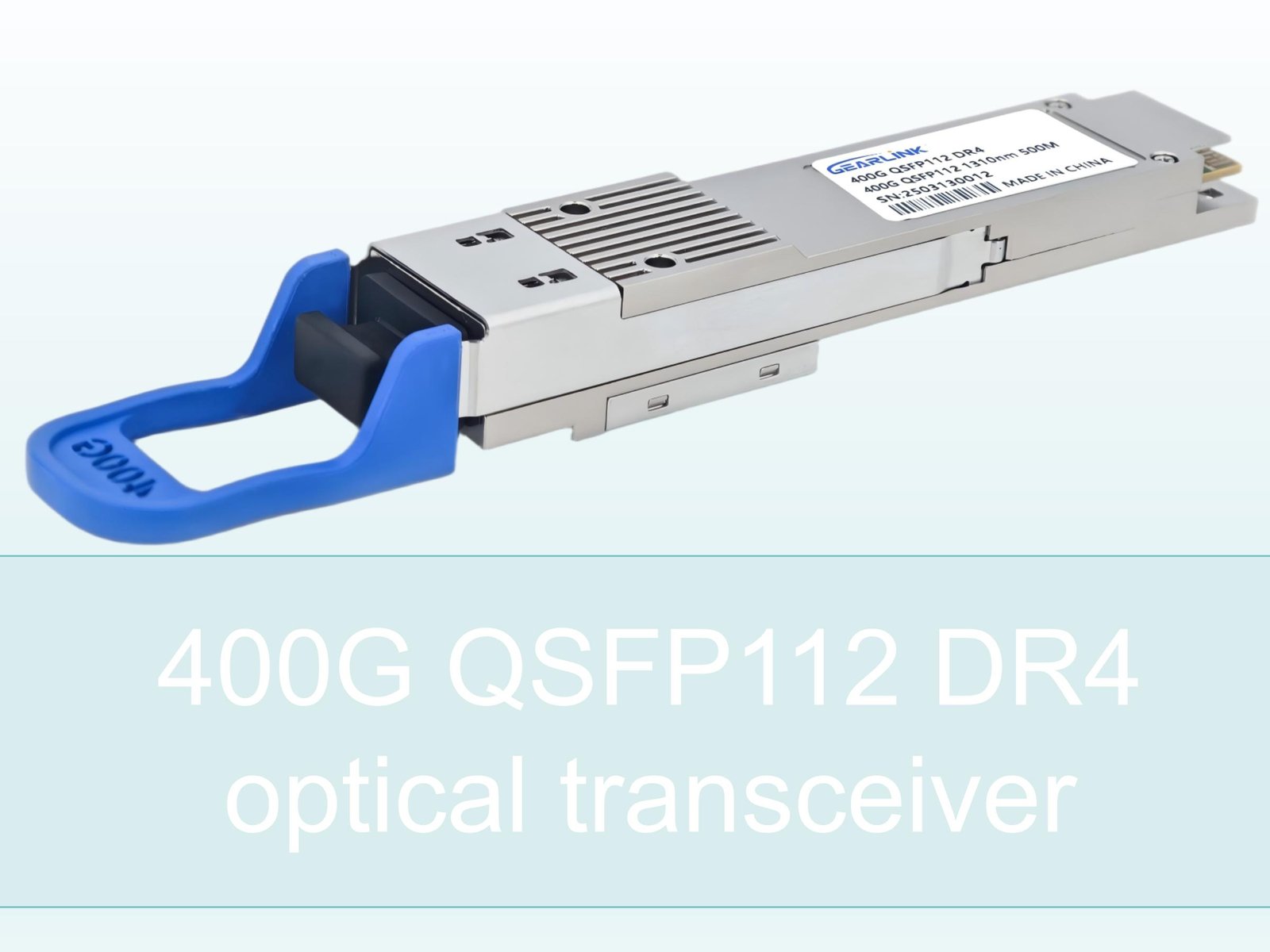
| QSFP112 | High-speed networking | Designed around 112G electrical lanes |
| OSFP 2×400G | Emerging high-density designs | Flexible port architecture |
The appropriate form factor depends on the switch platform and system architecture.
Therefore, users should always start with the switch’s supported interface rather than selecting a module based only on its data rate.
Future of OSFP 800G DR8 Networking
The demand for high-speed optical connectivity is expected to remain strong as AI and cloud infrastructure continue to expand.
Today, 800G links are increasingly important in large-scale data center architectures. At the same time, the industry is already moving toward higher-speed interfaces.
Future networks may use 1.6T optical modules and increasingly advanced electrical and optical technologies.
Nevertheless, 800G remains an important transition point because it provides a significant increase in bandwidth while fitting into existing high-speed data center development strategies.
For network operators, this means that OSFP 800G DR8 can serve as one of the building blocks for high-capacity AI and data center networks.
Final Thoughts on OSFP 800G DR8
The OSFP 800G DR8 combines an 800Gb/s data rate, eight optical lanes, PAM4 signaling, and single-mode parallel-fiber connectivity in a high-density OSFP package.
Its short-reach architecture makes it suitable for many connections inside modern data centers, particularly where high bandwidth is required between switches and AI or HPC systems.
At the same time, DR8 is not a universal replacement for every 800G optical solution. Fiber type, transmission distance, connector design, switch compatibility, FEC, power consumption, and thermal conditions should all be reviewed before deployment.
Ultimately, the right optical module is the one that matches the complete network environment. By evaluating the electrical interface, optical architecture, fiber infrastructure, and equipment compatibility together, network operators can build a reliable foundation for the next generation of high-speed data center networking.
Frequently Asked Questions About OSFP 800G DR8
1. What is an OSFP 800G DR8?
An OSFP 800G DR8 is an 800Gb/s optical transceiver using the OSFP form factor and an eight-lane 100G optical architecture. It is typically designed for short-reach single-mode fiber connections in data centers.
2. What fiber does OSFP 800G DR8 use?
The OSFP 800G DR8 typically uses single-mode fiber with a parallel-fiber configuration. The exact connector and fiber assembly should be confirmed according to the specific transceiver design.
3. What is the typical reach of OSFP 800G DR8?
A typical DR8 configuration is designed for up to approximately 500 meters over suitable single-mode fiber. Actual performance depends on the module specification and complete optical link.
4. What is the difference between OSFP 800G DR8 and 800G SR8?
The main difference is the fiber and optical architecture. DR8 is generally designed for single-mode fiber and a longer short-reach distance, while SR8 is typically associated with multimode fiber and shorter data center links.
5. Is OSFP 800G DR8 suitable for AI data centers?
Yes, the OSFP 800G DR8 is designed for high-bandwidth networking and can be used in AI and high-performance computing environments where large amounts of traffic must be exchanged between switches and compute systems. Actual suitability depends on switch compatibility and the complete network design.