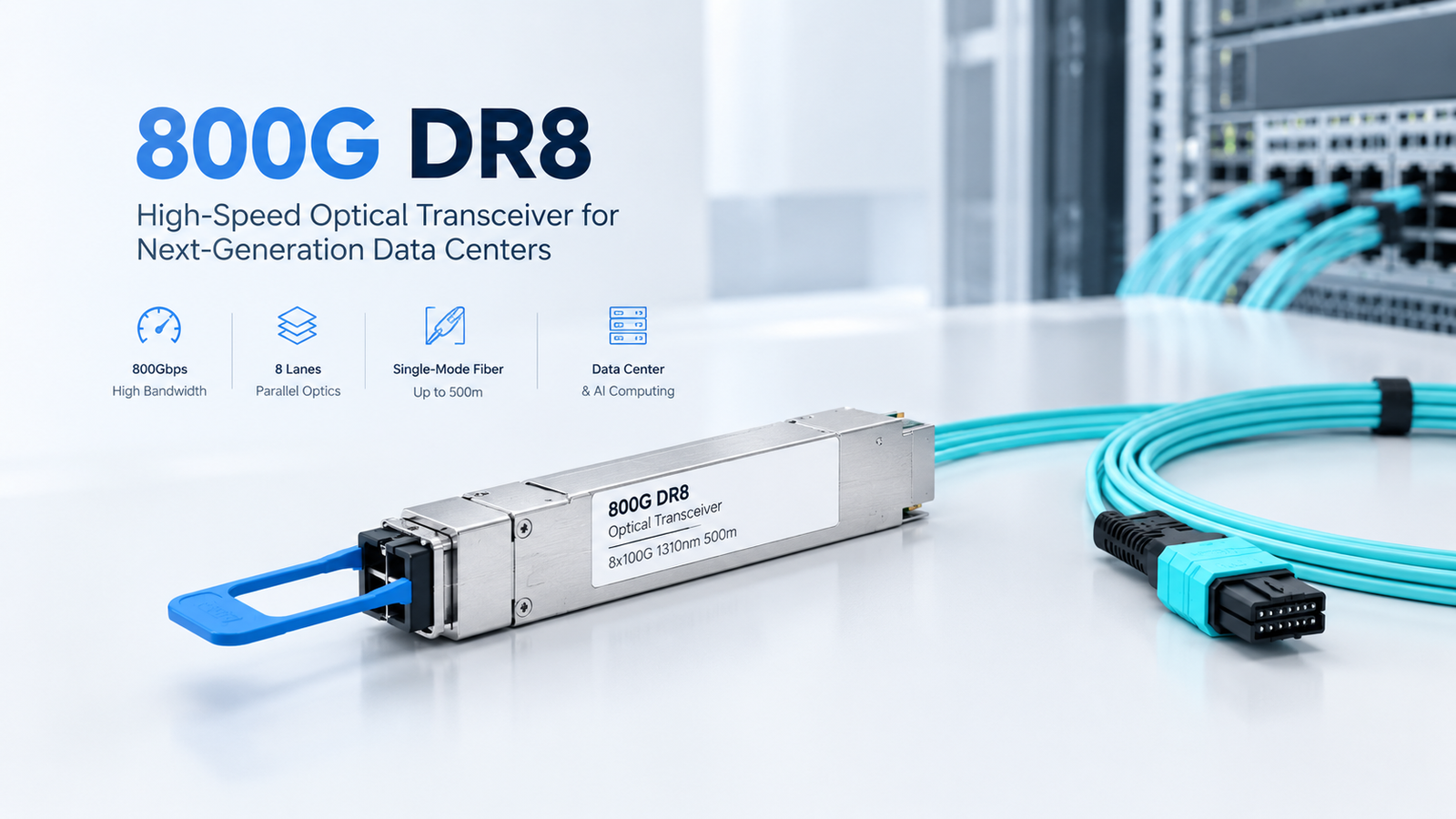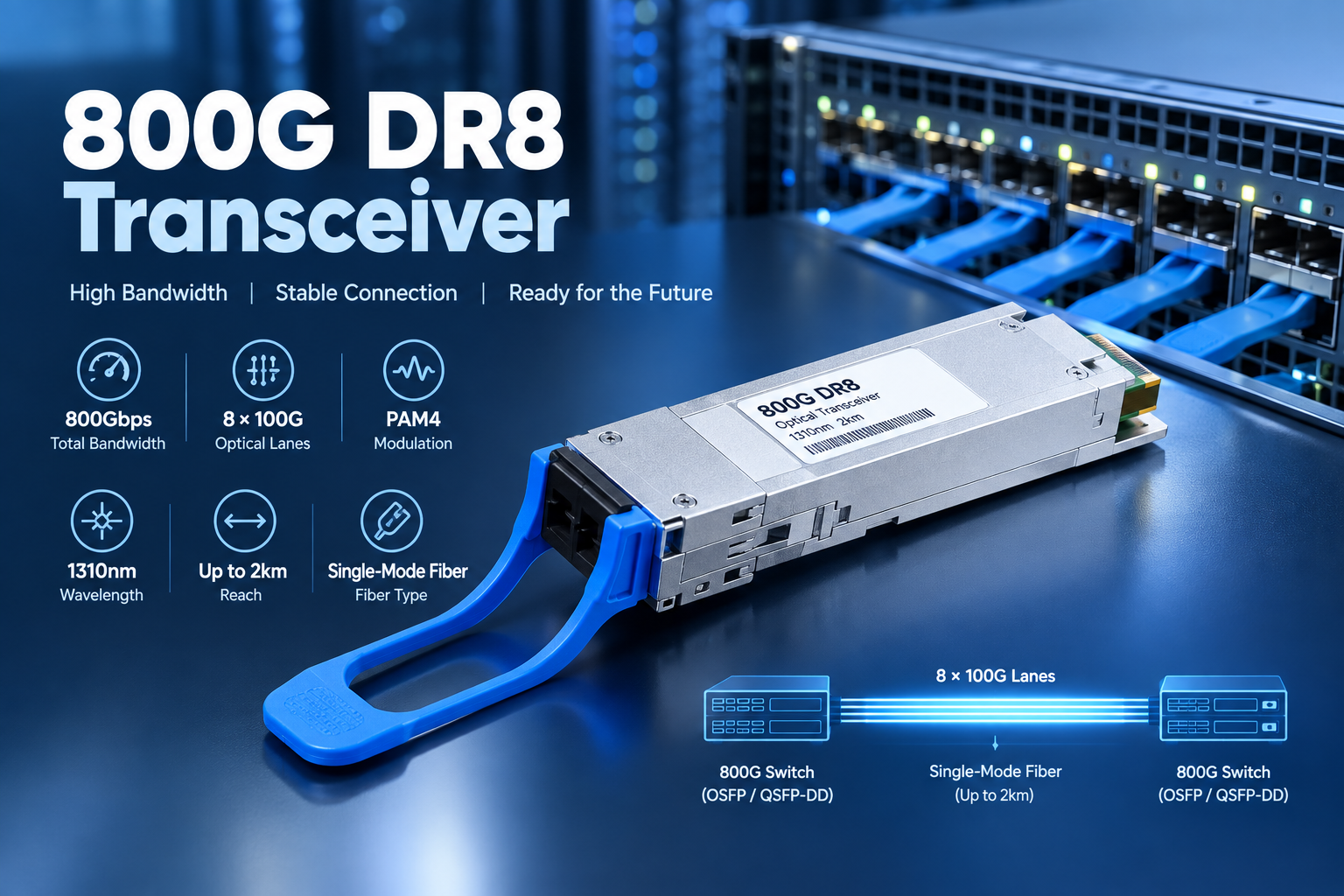
As AI clusters, cloud platforms, and high-performance computing systems continue to grow, network bandwidth has become a critical part of modern data center infrastructure. The 800g dr8 transceiver is designed to address this demand by providing an 800Gbps optical connection in a compact, high-density form factor.
Compared with earlier 400G solutions, an 800g dr8 transceiver can provide twice the aggregate bandwidth while maintaining a practical optical architecture for short- and medium-distance data center links. Moreover, the DR8 design uses multiple 100G optical lanes, making it suitable for high-speed connections between switches, servers, and AI infrastructure.
However, 800G technology can appear complicated at first. Terms such as PAM4, DR8, DSP, FEC, OSFP, QSFP-DD, and single-mode fiber are often used together. Therefore, this guide explains the technology in simple language and shows how an 800g dr8 transceiver can fit into modern data center networks.
What Is an 800G DR8 Transceiver?
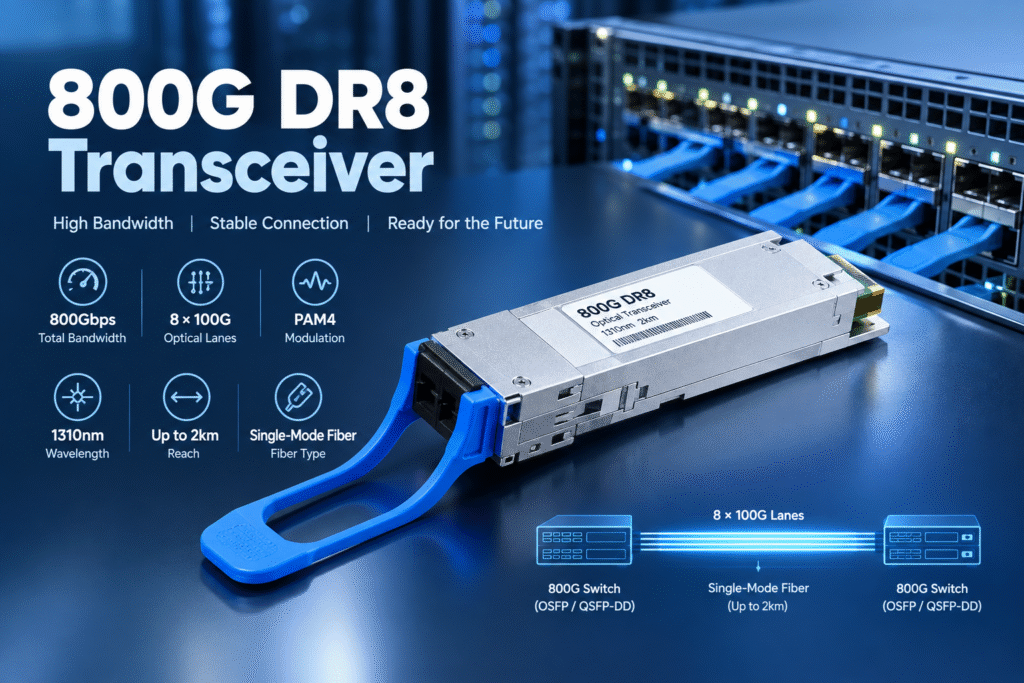
An 800g dr8 transceiver is an optical networking module designed to transmit and receive data at an aggregate rate of 800Gbps.
The name can be understood in two parts:
800G means the total data rate is approximately 800Gbps.
DR8 refers to eight optical lanes, with each lane operating at approximately 100Gbps.
In a typical architecture, eight 100G optical lanes are combined to provide the overall 800G capacity.
This approach is particularly useful for modern data centers because it increases bandwidth without requiring eight separate lower-speed optical modules.
How Does 800G DR8 Work?
The basic concept is relatively simple.
An electrical signal from a switch or network processor is divided into multiple high-speed lanes. The module then converts these electrical signals into optical signals. After transmission through single-mode fiber, the receiving module converts the optical signals back into electrical signals.
A simplified data path looks like this:
Switch → Electrical Lanes → DSP/Optical Engine → 8 Optical Lanes → Fiber → Receiving Module
PAM4 modulation is commonly used for high-speed 800G optical interfaces. Compared with traditional NRZ signaling, PAM4 carries more information per symbol, allowing higher data rates to be achieved without simply doubling the signaling frequency.
As a result, an 800g dr8 transceiver can support very high bandwidth while using a practical number of optical channels.
Key Specifications of an 800G DR8 Transceiver
The exact specification can vary between manufacturers and product designs. Nevertheless, a typical 800G DR8 solution is built around several common characteristics.
| Feature | Typical Value |
| Aggregate data rate | 800Gbps |
| Optical architecture | 8 × 100G optical lanes |
| Modulation | PAM4 |
| Wavelength | Around 1310nm |
| Fiber type | Single-mode fiber |
| Typical reach | Up to 2km for DR8 designs |
| Application | Data center and AI networks |
| Host interface | OSFP or QSFP-DD/related 800G form factors |
| Electrical interface | High-speed PAM4 lanes |
| Management | Digital monitoring and module management |
It should be noted that exact electrical architecture, power consumption, FEC requirements, connector configuration, and host compatibility should always be checked against the manufacturer’s datasheet.
Why Is 800G DR8 Important for Modern Data Centers?
Modern data centers are moving rapidly toward higher network speeds.
For example, AI servers can generate enormous amounts of traffic when models are trained across hundreds or thousands of GPUs. The network connecting these systems must therefore provide high bandwidth and low latency.
An 800g dr8 transceiver can be used as part of this high-speed optical infrastructure.
Instead of using several lower-speed connections, network designers can deploy 800G interfaces to increase the bandwidth available between switches and compute systems.
Furthermore, higher-speed interfaces can help simplify network architectures in environments where port density and rack space are important.
800G and AI Infrastructure
AI workloads are especially demanding because GPUs frequently exchange large amounts of data.
During distributed training, for example, multiple GPUs may need to exchange model parameters and intermediate data. If the network becomes a bottleneck, expensive computing resources may not be fully utilized.
Therefore, high-speed optical connections are increasingly important in AI clusters.
An 800g dr8 transceiver can provide a high-bandwidth optical path between network devices, helping data move efficiently between different parts of the cluster.
800G DR8 Transceiver and PAM4 Technology
One of the most important technologies behind modern 800G optics is PAM4.
PAM4 stands for Pulse Amplitude Modulation with four levels. Instead of using two signal levels like traditional NRZ, PAM4 uses four amplitude levels.
In simple terms:
| Technology | Signal Levels | Bits per Symbol |
| NRZ | 2 | 1 |
| PAM4 | 4 | 2 |
Because PAM4 carries two bits per symbol, a higher data rate can be achieved without requiring the same increase in baud rate.
However, PAM4 also introduces additional signal challenges. The four signal levels are closer together than the two levels used by NRZ. Consequently, the system becomes more sensitive to noise, distortion, and signal loss.
This is one reason why DSP, equalization, and FEC are important in modern 800G optical systems.
The Role of DSP in 800G DR8
A Digital Signal Processor, or DSP, can be used to process high-speed electrical and optical signals inside the module.
For an 800g dr8 transceiver, the DSP may perform functions such as:
Signal equalization
Compensation for channel loss
PAM4 signal processing
Clock and data recovery functions
Transmitter optimization
Receiver signal processing
Monitoring and diagnostics
The exact implementation depends on the module architecture.
In addition, the DSP can help compensate for signal impairments introduced by the host electrical channel and optical transmission path.
This is particularly important at 800G because the signal margin is more demanding than it was at earlier Ethernet generations.
What Does DR8 Mean?
The term DR8 is sometimes confusing because it combines a reach classification with the number of optical lanes.
The DR designation is commonly associated with 500-meter-class or 2km-class single-mode optical applications depending on the specific Ethernet generation and implementation. For 800G DR8 products, the optical architecture generally uses eight parallel optical lanes.
In practical product discussions, 800G DR8 commonly refers to an 800G module using eight 100G optical channels for a short-reach single-mode connection, often around 2km.
Therefore, buyers should not look only at the word “DR8.” The complete product specification should be checked, including:
Transmission distance
Optical wavelength
Fiber type
Lane rate
Connector
Host form factor
FEC requirements
Power consumption
Operating temperature
800G DR8 vs 800G DR4
One of the most common questions is the difference between DR8 and DR4.
Both technologies can provide 800Gbps aggregate bandwidth, but their optical lane structures are different.
| Feature | 800G DR8 | 800G DR4 |
| Total bandwidth | 800G | 800G |
| Optical lanes | 8 | 4 |
| Typical lane rate | 100G | 200G |
| Modulation | PAM4 | PAM4 |
| Fiber | Single-mode | Single-mode |
| Optical complexity | More lanes | Higher per-lane speed |
| Typical use | High-density 800G links | High-speed 800G links |
The most important difference is the lane rate.
An 800G DR8 design generally distributes the total bandwidth across eight 100G optical lanes. By comparison, DR4 distributes the bandwidth across four higher-speed optical lanes.
This difference affects optical components, electrical interfaces, signal processing, fiber connectivity, and system design.
Neither architecture should be selected based only on the total bandwidth. The switch port, cabling architecture, transceiver compatibility, and network topology must also be considered.
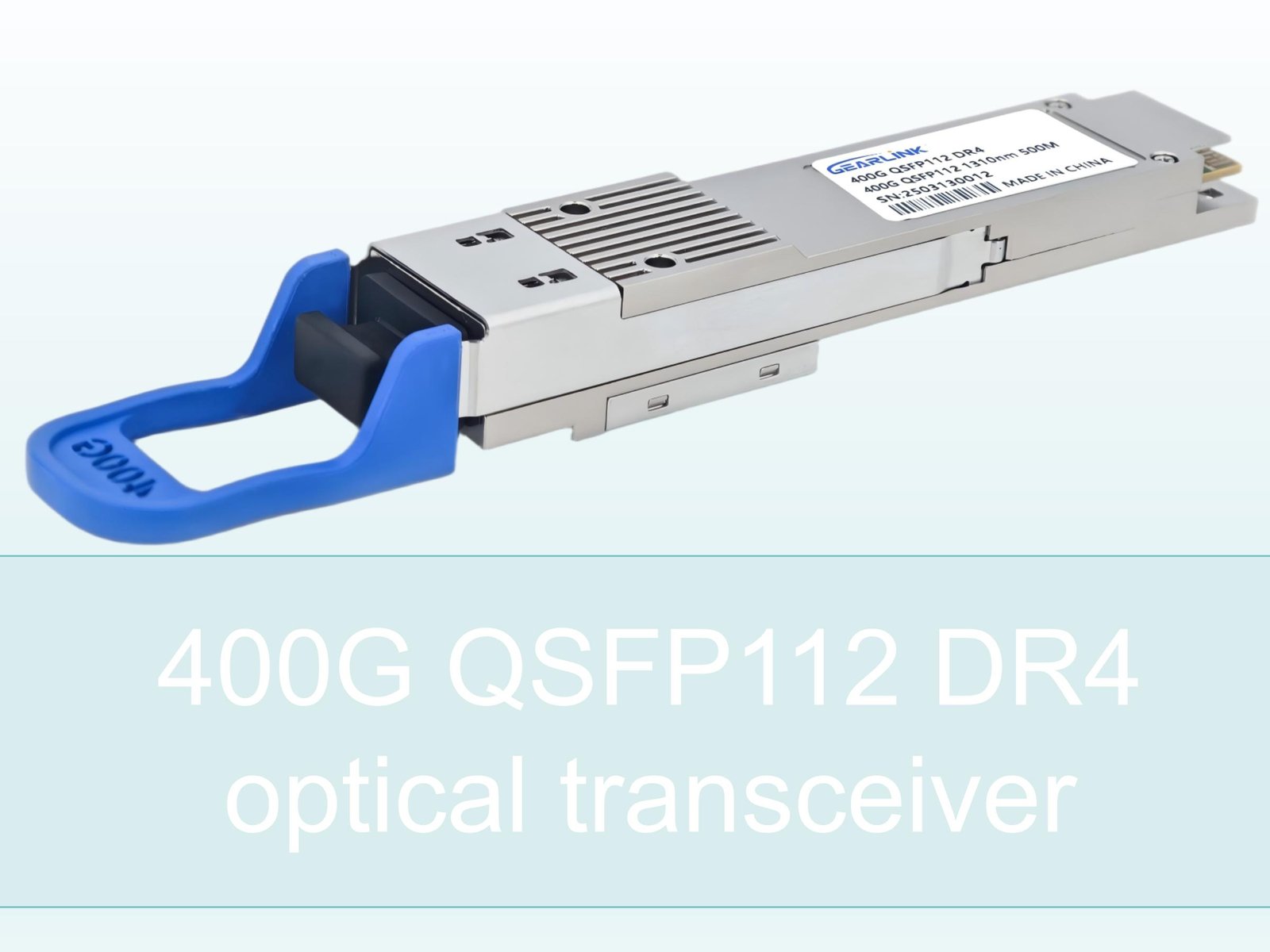
800G DR8 vs 400G Optical Transceivers
The move from 400G to 800G represents an important increase in network capacity.
| Feature | 400G Transceiver | 800G DR8 Transceiver |
| Aggregate bandwidth | 400G | 800G |
| Typical application | Data center | AI/HPC/data center |
| PAM4 | Common | Common |
| Fiber | MMF or SMF depending on design | Primarily SMF for DR8 |
| Optical lane architecture | Varies | 8 × 100G |
| Port bandwidth | Lower | Higher |
| Network density | High | Very high |
However, upgrading to 800G is not simply a matter of replacing a 400G module.
The switch platform must support the required 800G interface. The host electrical interface must also be compatible. In addition, the optical connector and fiber infrastructure must match the selected module.
Therefore, compatibility should always be verified before purchasing.
800G DR8 Transceiver Form Factors
An 800G optical module can be available in different form factors depending on the target platform.
Two important form-factor families in the 800G market are OSFP and QSFP-DD.
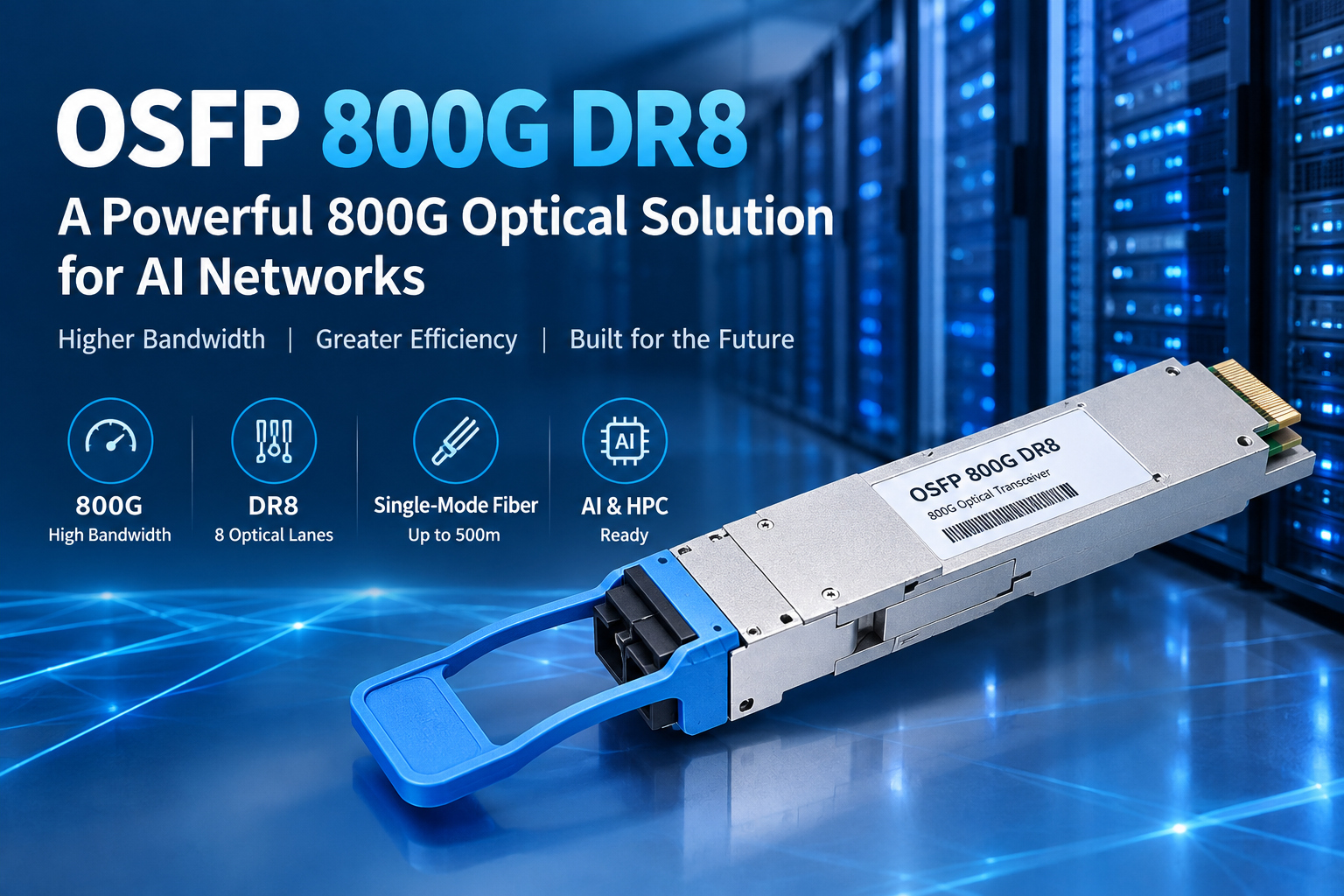
OSFP 800G
OSFP has been widely adopted for high-speed networking platforms because its larger physical size can provide additional thermal and electrical design space.
An OSFP-based 800g dr8 transceiver can therefore be designed for high-performance switching and AI networking environments.
QSFP-DD 800G
QSFP-DD is another important high-density form factor.
The exact electrical lane configuration and optical architecture depend on the specific implementation. Therefore, a QSFP-DD module should not be assumed to have identical internal architecture to an OSFP module simply because both support 800G.
Before deployment, the host switch manufacturer’s compatibility list should be checked.
Fiber Requirements for 800G DR8
Fiber selection is another important consideration.
DR8 solutions generally use single-mode fiber (SMF) because the optical transmission distance and wavelength architecture are designed around single-mode transmission.
A typical installation may include:
800G Switch → 800G DR8 Module → SMF Cable → 800G DR8 Module → 800G Switch
The fiber and connector configuration must match the selected transceiver.
Poor-quality or incorrectly configured fiber can result in:
High insertion loss
Poor optical margin
Link instability
Increased error rates
Failure to establish the link
Therefore, the transceiver and fiber system should be considered as one complete optical link rather than as separate products.
Where Is an 800G DR8 Transceiver Used?
The main application areas are environments where large amounts of data must be moved quickly.
AI and GPU Clusters
AI clusters are one of the most important application areas.
Large GPU systems require high-speed communication between compute nodes and network switches. As a result, 800G optical connectivity can help support the bandwidth requirements of distributed AI workloads.
Data Center Spine Networks
In large data centers, spine switches aggregate traffic from multiple leaf switches.
Because these links carry traffic from many servers and racks, higher-speed optical interfaces can be valuable.
An 800g dr8 transceiver can be considered for high-bandwidth connections within these network architectures.
High-Performance Computing
Scientific computing, simulation, financial modeling, and other HPC applications can generate large volumes of data.
Higher-speed optical links can reduce network bottlenecks and support faster communication between computing nodes.
Cloud Infrastructure
Cloud service providers continuously increase server and switch density.
Consequently, 800G connectivity is becoming increasingly relevant in large-scale cloud environments where thousands of servers may be connected through high-speed switching fabrics.
Important Factors When Choosing an 800G DR8 Transceiver
Choosing an optical module should not be based only on the headline speed.
Several technical parameters should be evaluated.
| Selection Factor | Why It Matters |
| Data rate | Confirms the required network bandwidth |
| Form factor | Must match the host switch |
| Optical reach | Determines whether the module fits the link distance |
| Wavelength | Must match the optical architecture |
| Fiber type | DR8 generally requires SMF |
| Connector | Must match the installed cabling |
| Power consumption | Important for high-density systems |
| Temperature range | Important for different deployment environments |
| FEC | Must be compatible with the network platform |
| DSP | Influences signal processing and module performance |
| DOM/DDM | Helps monitor module operating conditions |
| Vendor compatibility | Prevents unexpected interoperability problems |
Check Switch Compatibility First
The first question should be:
Does the switch support the selected 800G module?
Even when two modules have the same nominal 800G speed, their electrical interface, coding, firmware expectations, management interface, or form factor may differ.
Therefore, the switch model and original optical part number should be confirmed before ordering.
Check FEC Requirements
FEC is especially important for high-speed PAM4 networks.
Forward Error Correction adds information that allows the receiver to detect and correct certain transmission errors.
The exact FEC mode required by the switch depends on the platform and network architecture.
For this reason, buyers should verify the required FEC type rather than assuming that every 800G module will work with the same settings.
800G DR8 and Network Monitoring
Modern optical modules commonly provide digital monitoring functions.
Depending on the module and host system, parameters such as the following may be monitored:
Module temperature
Supply voltage
Transmitter optical power
Receiver optical power
Laser operating conditions
Module status
Alarm information
These functions can be valuable when troubleshooting high-speed links.
For example, if a link becomes unstable, the network engineer can check optical power and temperature readings before replacing hardware.
Therefore, DOM/DDM support can be an important feature for data center maintenance.
Common Deployment Challenges
Although 800G provides significant bandwidth, deployment requires careful planning.
Thermal Management
Higher-speed modules generally generate more heat than older low-speed modules.
Because many 800G modules may be installed in the same switch, airflow and thermal design become increasingly important.
The module’s specified operating temperature should therefore be considered together with the switch’s cooling architecture.
Power Consumption
Power consumption is another major consideration.
A data center may contain thousands of optical modules. Even a small difference in power consumption per module can become significant when multiplied across a large installation.
For this reason, module efficiency can affect both operating cost and system thermal requirements.
Signal Integrity
At 800G, signal integrity becomes more challenging.
High-speed electrical traces, connectors, host interfaces, and optical components all need to work together correctly.
Consequently, an optical module should be evaluated as part of the complete system rather than as an isolated component.
800G DR8 Deployment Example
Consider a data center that needs to connect two high-speed switches over a 1km single-mode fiber link.
A simplified architecture could be:
| Network Side A | Transmission | Network Side B |
| 800G switch | SMF | 800G switch |
| 800G DR8 module | Optical link | 800G DR8 module |
| 8 × 100G optical lanes | Up to typical DR8 reach | 8 × 100G optical lanes |
Before deployment, the network engineer would normally verify:
Both switches support the required 800G interface.
The module form factor is supported.
The optical reach is sufficient.
The fiber is single-mode.
The connector configuration matches.
FEC settings are compatible.
Power and thermal requirements are acceptable.
DOM/DDM monitoring works correctly if required.
This checklist can significantly reduce compatibility problems during installation.
How 800G DR8 Supports Future Network Growth
Network bandwidth requirements are continuing to increase.
A server that previously generated a relatively small amount of traffic may now be connected to multiple high-performance accelerators. Meanwhile, AI training clusters can contain thousands of compute devices.
As a result, network architectures are moving toward 400G, 800G, and eventually even higher-speed interfaces.
The 800g dr8 transceiver represents one practical step in this evolution.
Its eight-lane optical architecture provides a way to reach 800Gbps while using established PAM4-based technologies and single-mode optical transmission.
Furthermore, the technology can fit into high-density switching environments where space, power, and cooling must all be considered carefully.
Frequently Asked Questions About 800G DR8 Transceiver
1. What is an 800g dr8 transceiver?
An 800g dr8 transceiver is an 800Gbps optical module that typically uses eight 100G optical lanes. It is designed for high-speed data center, AI, cloud, and HPC networking applications.
2. What fiber is used with an 800g dr8 transceiver?
An 800g dr8 transceiver generally uses single-mode fiber. The exact connector and cabling configuration should be confirmed from the product datasheet before deployment.
3. What is the typical reach of an 800G DR8 module?
Many 800G DR8 implementations are designed for links of up to approximately 2km. However, the actual reach depends on the module specification, optical budget, fiber, connectors, and system requirements.
4. What is the difference between 800G DR8 and 800G DR4?
The main difference is the optical lane structure. DR8 generally uses eight 100G optical lanes, while DR4 uses four higher-speed optical lanes. Both can provide an aggregate 800Gbps connection.
5. Can an 800g dr8 transceiver be used for AI networking?
Yes. An 800g dr8 transceiver can be used in high-bandwidth AI and GPU networking environments when the switch, host interface, FEC, fiber, and module specifications are compatible.
Conclusion
The 800g dr8 transceiver is an important optical solution for the next generation of high-bandwidth data center networks. By combining eight high-speed optical lanes, PAM4 signaling, single-mode fiber, and advanced signal processing, it can provide an 800Gbps connection for demanding networking environments.
More importantly, the value of 800G is not simply the higher number on the product label. Successful deployment depends on the complete optical and electrical system.
Before selecting an 800g dr8 transceiver, buyers should carefully review the switch compatibility, form factor, transmission distance, fiber type, connector, FEC requirements, power consumption, thermal conditions, and monitoring capabilities.
As AI, cloud computing, and high-performance computing continue to expand, higher-speed optical connectivity will become increasingly important. For data center operators and network engineers, understanding the architecture and practical requirements of 800G DR8 can make the transition to higher network speeds much easier.