In the relentlessly accelerating landscape of modern data communications, where demands for higher bandwidth and greater reach seem to perpetually outpace existing infrastructure, the choice of cabling is a critical, often underestimated, factor. For professionals heavily invested in the performance of optical transceiver products—the indispensable core of high-speed networks—a pivotal question emerges: Is the active fiber optic cable (AOC) not merely an option, but a mandatory upgrade? This comprehensive article will delve into the profound technical and operational advantages of AOCs, specifically analyzing why this integrated technology has become the preferred interconnection solution within data centers and high-performance computing (HPC) environments, especially for those utilizing advanced optical modules.
The transition from traditional Direct Attach Copper (DAC) cables to active fiber optic cable assemblies signifies a major evolution in short-to-medium reach interconnects. At its foundation, an AOC is an assembly that integrates optical transceivers into both ends of a standard optical fiber cable. Crucially, these integrated transceivers perform the necessary electrical-to-optical (E/O) and optical-to-electrical (O/E) conversion within the cable connector itself. This design allows the cable to accept the same electrical input as a copper cable but transmit data as light over the fiber, merging the benefits of optical fiber with the simplicity of a plug-and-play electrical interface. Consequently, the user is afforded the robust performance of fiber optics without the complexities of managing separate transceiver modules and patch cables.
The Architectural and Performance Edge of Active Fiber Optic Cable
The introduction of active electronics into the cable assembly provides an immediate and substantial leap in performance metrics that are paramount for optical module users. The inherent limitations of copper cabling—specifically, its inability to sustain high data rates over increasing distances without significant signal degradation—are completely circumvented by the AOC design.
Achieving Superior Bandwidth and Unprecedented Reach
The most compelling argument for adopting active fiber optic cable is its ability to handle immense bandwidth over longer distances than passive alternatives. Whereas copper cables struggle to reliably reach beyond five or seven meters at speeds of 100Gbps and higher, AOCs are routinely designed to achieve stable, low-latency transmission up to 100 meters, and often further, depending on the specific application and fiber type utilized (typically multimode fiber). This extended reach is achieved because the signal is transmitted as light, which experiences significantly less attenuation and dispersion over distance compared to electrical signals traveling over copper wires.
This factor is particularly relevant for network architects designing large-scale data center fabrics or interconnecting distant racks. By seamlessly extending the reliable reach of a connection, AOCs allow for far greater flexibility in equipment placement and cable routing, a significant advantage when deploying high-density optical modules such as QSFP-DD or OSFP. Furthermore, since the transceivers are permanently tuned and integrated, the performance of the entire link is predictable and consistent, simplifying the qualification process for high-speed protocols.
Mitigating Signal Integrity and Electromagnetic Interference (EMI)
Signal integrity is an enduring challenge in high-speed electrical systems. With copper cables, the electrical signal is highly susceptible to inter-symbol interference (ISI) and crosstalk, which leads to a higher Bit Error Rate (BER). Active fiber optic cable assemblies, however, convert the signal into a light pulse. As a dielectric medium, optical fiber is completely immune to electromagnetic interference (EMI) and radio-frequency interference (RFI). This fundamental physical difference ensures that the data being transmitted is not corrupted by noise from adjacent high-power servers, switches, or other cables within a densely populated rack.
For users of sensitive optical transceiver modules, the low BER delivered by AOCs is a non-negotiable requirement. The reliability gained translates directly into fewer packet retransmissions, reduced network latency, and consequently, a massive boost in overall network efficiency and stability—a core value proposition for critical data center operations.
Operational and Logistical Advantages for Data Center Deployment

Beyond the raw performance statistics, the use of active fiber optic cable also brings profound practical benefits that impact the day-to-day operation and management of data center infrastructure, particularly for organizations managing large inventories of optical components.
Enhanced Port Density and Superior Airflow Management
Copper cables, especially the thicker gauges required for high-speed direct attach cables (DACs), are voluminous and rigid. This bulk creates immediate challenges in high-density environments. The connectors are large, and the stiffness makes tight bends and cable management difficult, which invariably reduces achievable port density on networking equipment.
In stark contrast, active fiber optic cable is dramatically thinner and more flexible than its copper counterpart. This reduced diameter and increased pliability result in cleaner, easier-to-manage cable runs, which allows for maximum utilization of switch and router ports. Moreover, the significantly smaller volume of AOCs drastically improves airflow within racks and cabinets. Better airflow means more efficient cooling, which is essential for maintaining the operational lifespan and thermal stability of expensive components, including the host-side optical transceiver modules. Lower cooling requirements ultimately contribute to a measurable reduction in overall data center power consumption.
Simplified Procurement and Inventory Management
One subtle but powerful advantage of the active fiber optic cable is the simplification it introduces to the procurement process. An AOC is a single, integrated product that guarantees compatibility between the fiber and the optical components. This eliminates the potential for mismatch issues that can arise when a user attempts to pair separate, third-party optical modules and fiber patch cables—for instance, mismatching fiber types (OM3/OM4) or connector qualities.
For the optical module user, this integration means less troubleshooting and fewer points of failure. The product is a tested, end-to-end link. It becomes a straightforward “plug-and-play” solution, greatly easing installation and reducing the complexity of inventory management, as a single AOC assembly replaces the need to track two transceivers and one separate patch cable.
Active Fiber Optic Cable Applications in Optical Module Ecosystems
The functional design of the active fiber optic cable makes it an ideal complement to various high-speed optical module form factors. Its primary utility is concentrated in inter-rack and intra-rack connections where high bandwidth is mandatory but the distance exceeds the reliable reach of copper.
Interconnecting High-Density Switches and Servers
In cloud computing and hyper-scale data centers, AOCs are indispensable for connecting top-of-rack (ToR) switches to spine switches or for connecting high-speed network interface cards (NICs) in servers to the distribution layer switches. Available in key industry standards such as SFP+, SFP28, QSFP+, QSFP28, and QSFP-DD, the active fiber optic cable ensures the seamless high-rate link required for tasks like virtualization, distributed storage, and big data processing. The low power consumption of the integrated optics at each end is a critical feature, especially when deploying hundreds or thousands of cables, allowing for greater power budget allocation to the core processing equipment.
High-Performance Computing (HPC) and Storage Networks
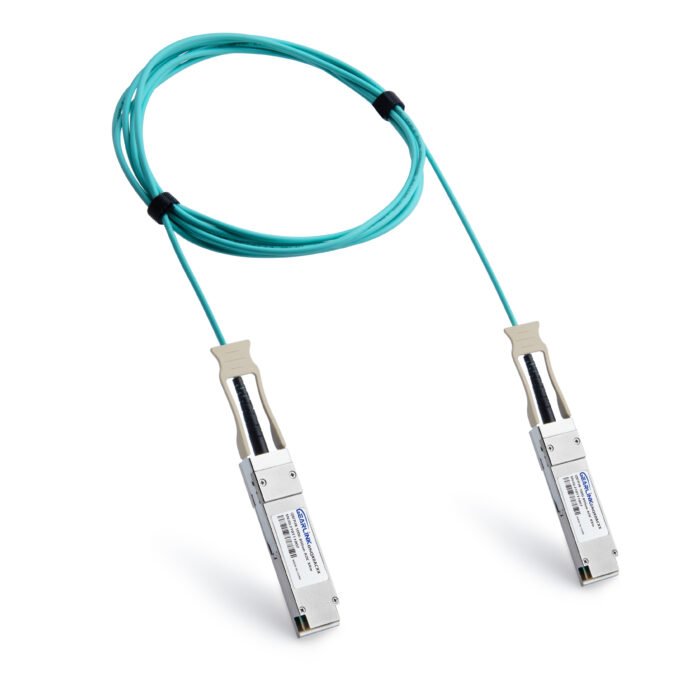
100G QSFP28 Active Optical Cable
Discover QSFP 100G AOC3M active optical cable: 3 m length, 100 Gb/s speed, Cisco-compatible, low power, ultra-thin. Perfect for intra-rack and rack-to-rack 100G connections. Explore details now.
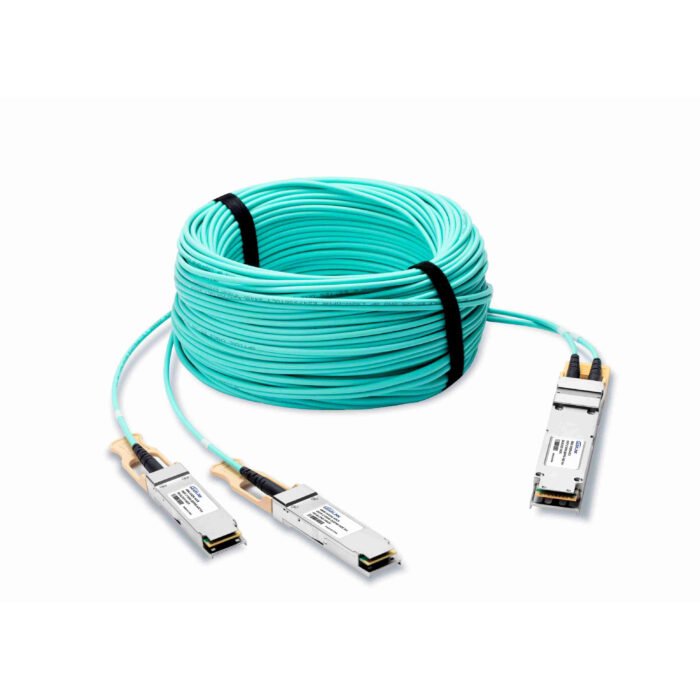
400G OSFP Finned Top to 2 x 200G QSFP56 Active Optical Breakout Cable
High-performance 400G OSFP to 2×200G QSFP56 AOC breakout cable. Low-latency OSFP cable for 200G QSFP56 AOC connections in high-speed networks.
HPC clusters and modern Storage Area Networks (SANs) rely on extremely low-latency, high-throughput connections. Protocols like InfiniBand and high-speed Ethernet are common in these environments. The consistent, high-fidelity signal transmission provided by the active fiber optic cable is perfectly suited for these demanding applications. The lightweight nature of the cable also makes it the preferred option for high-speed breakout applications (e.g., 40G QSFP+ to 4x10G SFP+ or 100G QSFP28 to 4x25G SFP28), simplifying the fan-out connections from higher-speed switch ports to lower-speed server ports without sacrificing performance.
Ethical Commitment and Future Outlook
The prevailing trend towards active fiber optic cable technology is driven not only by performance but also by the industry’s ethical commitment to sustainability and progress. By enabling networks to carry exponentially more data with greater energy efficiency per bit, AOCs contribute to a smaller overall carbon footprint for data centers compared to the perpetual signal conditioning and heat dissipation associated with comparable high-speed copper alternatives. This move represents a positive step toward more responsible technological growth.
Looking ahead, as data rates continue their ascent to 400G and 800G, the need for robust, interference-free, and extended-reach connectivity will only intensify. The active fiber optic cable, with its integrated and highly optimized optoelectronics, is perfectly positioned as the bridging technology that connects sophisticated optical transceiver modules to the underlying fiber infrastructure, ensuring that the relentless demand for instantaneous data transfer can be met reliably and efficiently. The time for optical transceiver users to fully embrace this enabling technology is now.
Frequently Asked Questions (FAQ)
What is the main difference between Active Fiber Optic Cable (AOC) and Direct Attach Copper (DAC)?
The primary distinction lies in the transmission medium and method. DAC uses electrical signals over copper wire, limiting its distance to about 5-7 meters at high speeds and making it susceptible to EMI. Conversely, an active fiber optic cable (AOC) converts the electrical signal to a light signal and transmits it over fiber optic cable, which extends its reliable reach significantly (often up to 100m) and provides complete immunity to electromagnetic interference, all while being lighter and thinner.
Are Active Fiber Optic Cables interchangeable with standard optical transceivers?
No, AOCs are not fully interchangeable with standard optical transceivers. An AOC is a complete, fixed-length cable assembly with integrated transceivers permanently attached at both ends. It plugs directly into the same port (e.g., QSFP28) as a standalone transceiver module, but you cannot separate the module from the cable or change the cable length. They are intended for point-to-point connections where a fixed, reliable link is desired.
Where are AOCs most commonly used in a data center environment?
Active fiber optic cable assemblies are predominantly utilized for high-speed, short-to-medium distance interconnects within data centers, typically between racks. Common applications include:
- Connecting Top-of-Rack (ToR) switches to End-of-Row (EoR) or Spine switches.
- Interconnecting high-speed servers or storage arrays.
- High-speed breakout applications (e.g., 100G to 4x25G) over short distances.