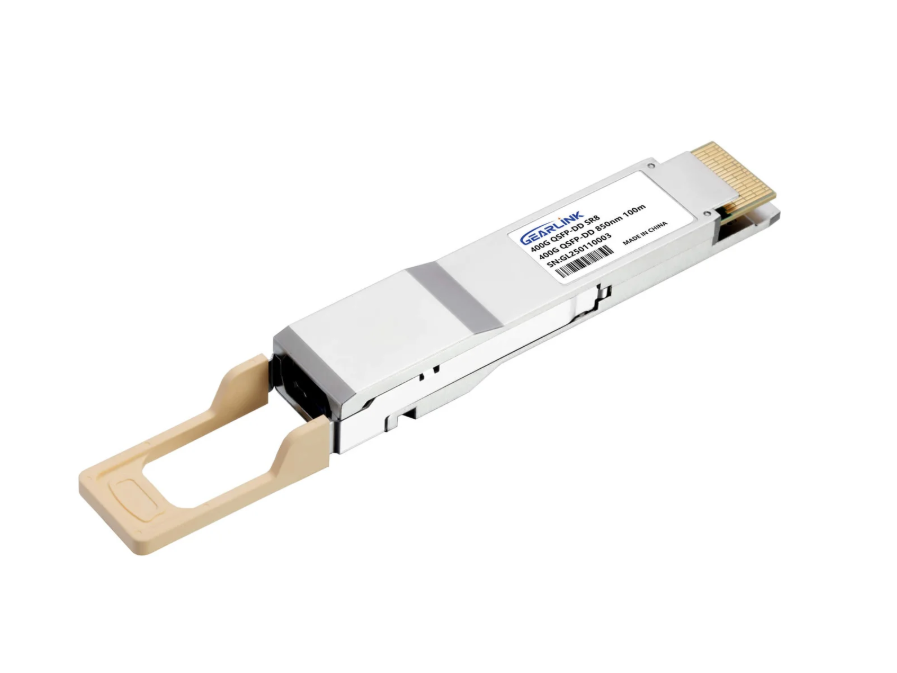
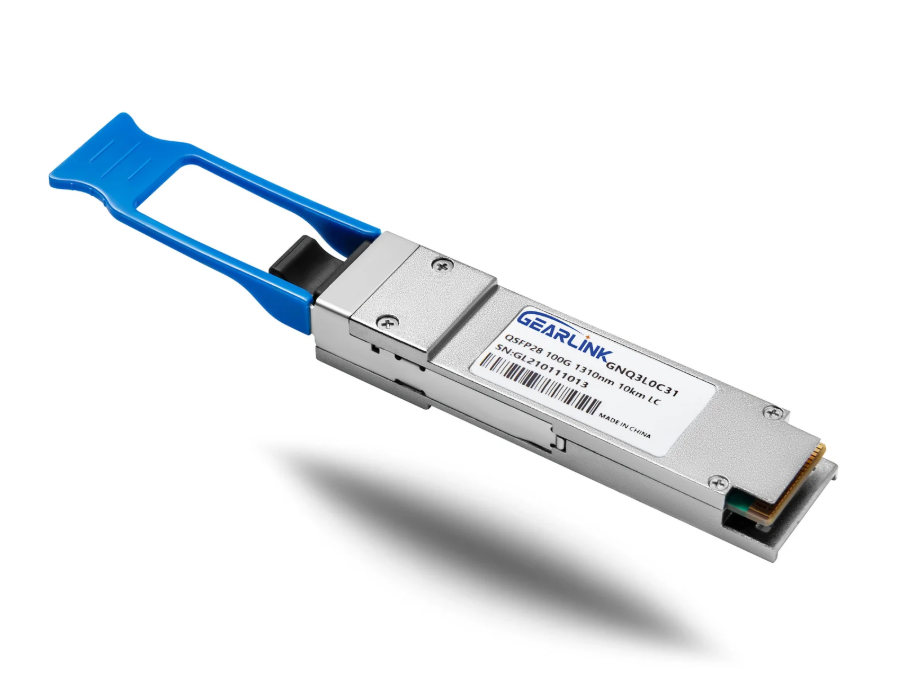
In today’s fast-evolving networking world, the terms QSFP 40G SR4 and 40GBASE SR4 are frequently used to describe one of the most widely deployed 40-gigabit optical transceivers. These two names actually represent the same product, although the naming conventions are slightly different. The first focuses on the form factor, while the second emphasizes the optical standard. Nevertheless, both refer to the same module that enables 40-gigabit short-reach transmission over multimode fiber.
From the earliest stages of network design to the final implementation, the QSFP 40G SR4 module has become essential across data centers, cloud infrastructure, and enterprise networks. Consequently, understanding how this module works—and why it remains a trusted option—is important for professionals seeking reliable performance. Additionally, since the 40GBASE SR4 standard continues to be used in thousands of deployments worldwide, a clear explanation can help reduce confusion for beginners.
To simplify this topic, this guide uses easy-to-read language, consistent transitions, and structured explanations. Moreover, throughout the article, both QSFP 40G SR4 and 40GBASE SR4 will be repeated to strengthen search relevance, because this helps readers and search engines understand the connection between these two terms.
Understanding the Basic Concept Behind QSFP 40G SR4 & 40GBASE SR4
Before learning why these modules are so widely used, it is helpful to begin with the basic idea. Although the two terms are often used interchangeably, each one reveals something different.
What QSFP 40G SR4 Represents in Optical Networking
The term QSFP stands for Quad Small Form-Factor Pluggable. When combined with 40G SR4, it means the module uses:
Four optical lanes for transmitting data
Four optical lanes for receiving data
Each lane running at 10 Gbps
A total speed that reaches 40 Gbps
Therefore, the name QSFP 40G SR4 mainly reflects the module’s physical form factor and the number of lanes used.
Because of its compact size, simple installation process, and strong interoperability, the QSFP 40G SR4 has been widely adopted in data center environments. Furthermore, it fits into standard QSFP+ ports, which were created specifically for high-density 40-gigabit applications.
What 40GBASE SR4 Represents in Network Standards
On the other hand, the term 40GBASE SR4 comes from IEEE standards.
“40GBASE” refers to the data rate and electrical interface
“SR” stands for Short Reach
“4” indicates the number of lanes
So the name 40GBASE SR4 focuses more on technical protocol and optical behavior rather than the physical module shape.
Even though the two names differ, both refer to the exact same technology. As a result, users often see the terms QSFP 40G SR4 and 40GBASE SR4 listed together in product descriptions.
Why QSFP 40G SR4 & 40GBASE SR4 Remain Popular
Even with the growth of 100G, 200G, and 400G technologies, the QSFP 40G SR4 module still plays a vital role. Many networks continue to rely on 40GBASE SR4 because of its cost advantages and stable performance. Because of this, it remains an excellent option for data center upgrades, aggregation layers, and short-distance spine-leaf architecture.
Below are the major reasons why the QSFP 40G SR4 module is still widely used.
1. Simple Installation and High Compatibility
One of the biggest benefits is that the QSFP 40G SR4 module is designed for easy deployment.
It can be inserted into any QSFP+ port without the need for special tools, adapters, or software.
Furthermore, because 40GBASE SR4 follows strict IEEE standards, a high level of interoperability is ensured across manufacturers.
2. Short-Reach Efficiency
The SR in 40GBASE SR4 stands for short reach, which means the module is optimized for distances such as:
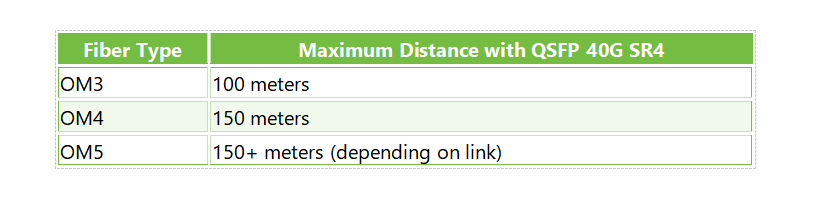
This distance range is ideal for rack-to-rack and zone-to-zone data center links.
3. Cost-Effective High-Speed Connectivity
Compared with long-reach solutions or modules using single-mode fiber, the QSFP 40G SR4 module is significantly more affordable. This is mainly because it uses:
Multimode fiber (low cost)
VCSEL laser technology
Standard MPO/MTP connectors
Therefore, the 40GBASE SR4 standard provides high performance at a very reasonable cost.
4. Strong Scalability and Flexibility
Because the QSFP 40G SR4 module uses four 10-Gbps lanes, it can also support breakout applications. For example:
1 × 40G port → 4 × 10G ports
40GBASE SR4 → 10GBASE SR
This makes it easy for a data center to upgrade gradually without replacing existing hardware.
Technical Specifications of QSFP 40G SR4 / 40GBASE SR4
To gain a deeper understanding, the following table summarizes the essential technical details.
Comprehensive Specification Table
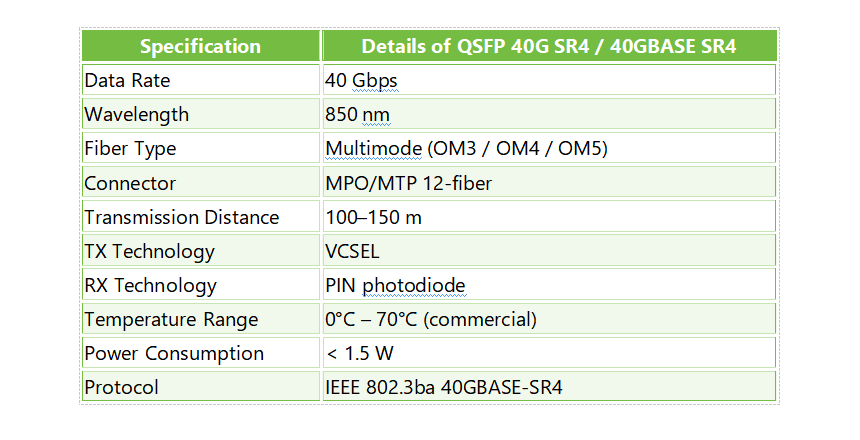
This table clearly demonstrates why the QSFP 40G SR4 module has become one of the most reliable short-distance optical solutions.
Deployment Scenarios for QSFP 40G SR4 & 40GBASE SR4
Although the module is simple in design, its applications are extremely wide.
Data Center Spine-Leaf Architecture
This is the most common use case. The QSFP 40G SR4 module provides stable 40G interconnection between:
Spine switches
Leaf switches
ToR switches
Additionally, because spine-leaf networks require high bandwidth with low latency, the 40GBASE SR4 standard fits perfectly.
Campus Network Aggregation
Many enterprise networks use QSFP 40G SR4 modules in their aggregation layers because:
The distance is short
The fiber cost is low
The bandwidth demand is growing
Early adopters of 10G can easily upgrade to 40G by installing 40GBASE SR4 transceivers.
Breakout Applications
Many network operators use the module in 1×40G → 4×10G breakout mode.
This is particularly useful in situations where gradual upgrades are required.
Advantages of QSFP 40G SR4 & 40GBASE SR4 Compared to Other 40G Modules
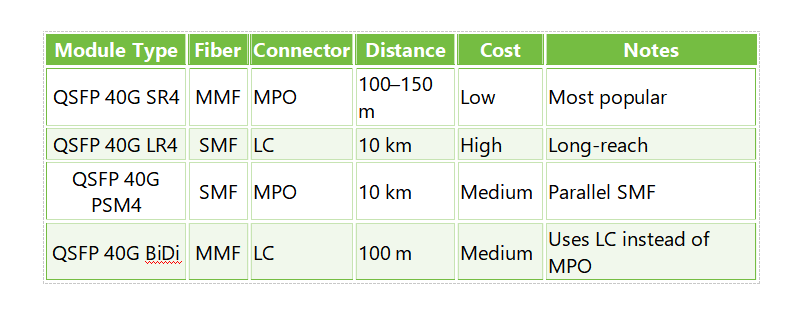
By comparison, QSFP 40G SR4 remains the simplest and most cost-effective solution for short-distance links.
How to Choose the Right QSFP 40G SR4 / 40GBASE SR4 Module
Choosing the correct module is essential. Even though many brands offer QSFP 40G SR4, not all modules are identical. Therefore, you should consider the following:
Compatibility
Always verify that the module supports your switch brand, such as:
Cisco
Arista
Juniper
H3C
Huawei
Dell
Since 40GBASE SR4 is standardized, compatibility is usually strong.
Fiber Type
Ensure your data center uses:
OM3 for 100 m
OM4 for 150 m
OM5 for extended performance
Connector Quality
High-quality MPO/MTP connectors reduce signal loss and improve performance.
Breakout Requirements
If you plan to split 40G into four 10G ports, make sure to choose a module labeled as breakout-capable.
Installation Tips for QSFP 40G SR4
Even though installing the module is simple, the following steps ensure the best performance
Installation Checklist
Clean the MPO connector
Insert the module gently—do not force it
Verify that the switch recognizes the module
Monitor optical power levels
Test the link with known-good patch cables
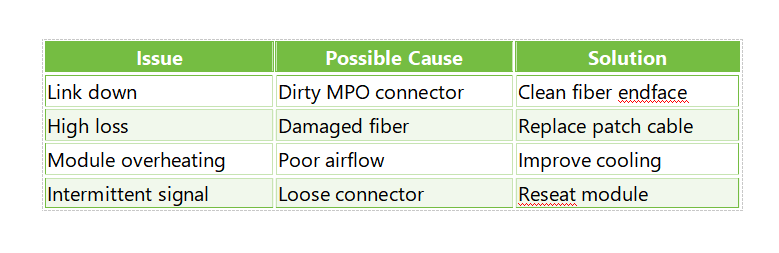
Troubleshooting QSFP 40G SR4 & 40GBASE SR4
When problems occur, the following table may help.
Common Issues and Solutions
Future Outlook for QSFP 40G SR4 & 40GBASE SR4
Although higher-speed technologies continue to grow, the demand for QSFP 40G SR4 remains steady. Many organizations still need reliable 40G links, especially when upgrading from 10G. As a result, the 40GBASE SR4 standard will continue to provide value for years to come.
Conclusion: Why QSFP 40G SR4 & 40GBASE SR4 Still Matter
In summary, the QSFP 40G SR4 and 40GBASE SR4 modules offer a powerful combination of:
Simplicity
Cost-effectiveness
Reliability
Flexibility
Future-proof scalability
These advantages make them essential for short-distance 40G network deployments. Consequently, whether you are upgrading an existing network, building a new system, or expanding data center capacity, the QSFP 40G SR4 module remains a trustworthy and practical solution.
FQA
Q1: What is the difference between QSFP 40G SR4 and 40GBASE SR4?
A1: They refer to the same product. QSFP 40G SR4 describes the form factor, while 40GBASE SR4 refers to the IEEE optical standard.
Q2: How far can a QSFP 40G SR4 / 40GBASE SR4 module transmit?
A2: The QSFP 40G SR4 module supports up to 100 m on OM3 fiber and up to 150 m on OM4, following the 40GBASE SR4 standard.
Q3: Is QSFP 40G SR4 compatible with all QSFP+ ports?
A3: Yes, almost all QSFP+ ports support QSFP 40G SR4 modules because they follow the 40GBASE SR4 specification.
Q4: Can QSFP 40G SR4 be used for breakout connections?
A4: Yes. A QSFP 40G SR4 port can break out into 4×10G links, matching the 40GBASE SR4 lane structure.
Q5: Why do data centers prefer QSFP 40G SR4 over other 40G modules?
A5: Because QSFP 40G SR4 offers lower cost, easier deployment, and strong performance for short-reach links under the 40GBASE SR4 standard.