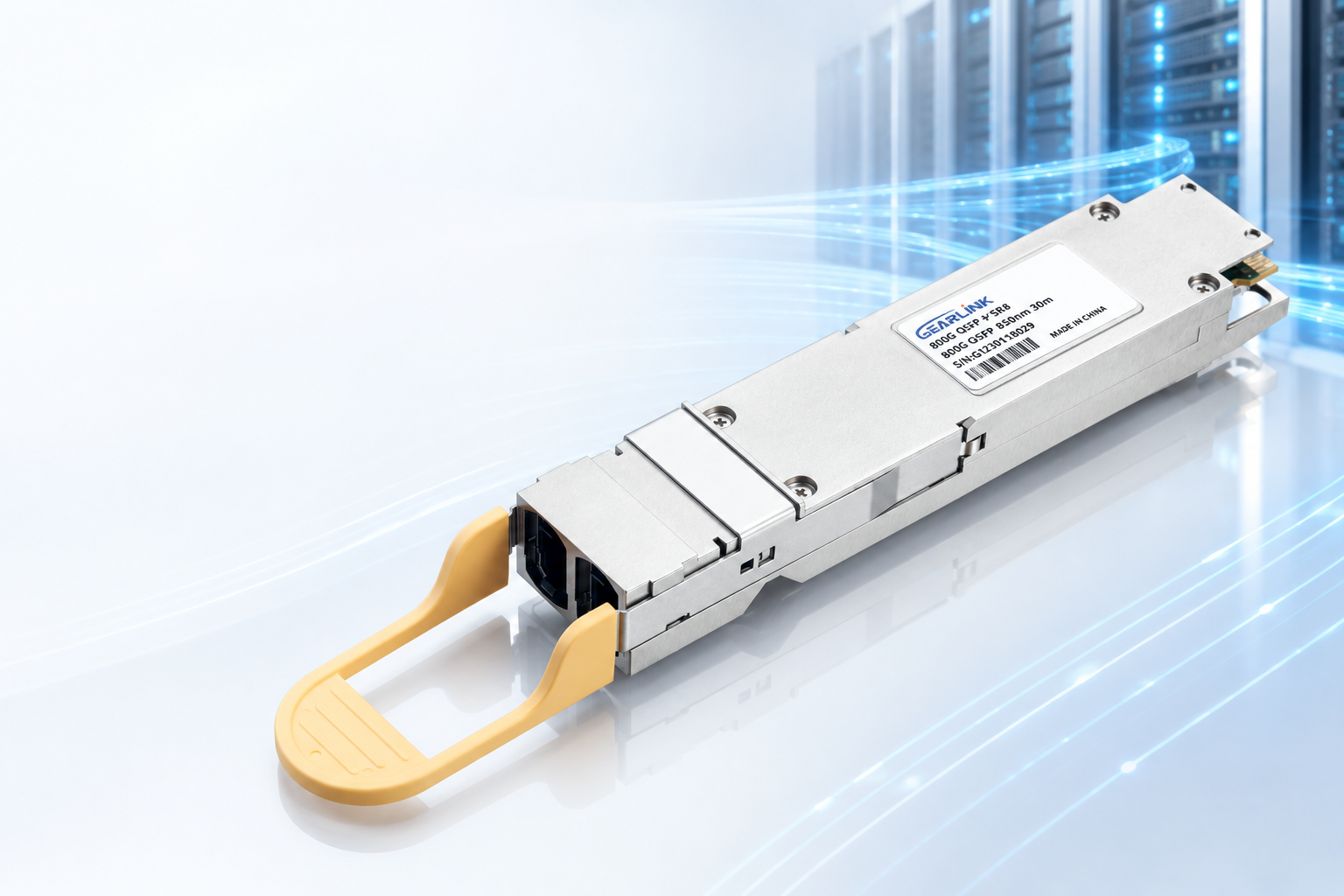
As AI clusters, cloud platforms, and high-performance computing systems continue to grow, network traffic is increasing rapidly. To handle this demand, data centers are moving toward higher-speed optical connectivity. An 800g sr8 transceiver provides a practical solution for short-distance 800G connections by combining eight optical channels with parallel multimode fiber transmission.
Unlike long-reach optical modules that are designed for single-mode fiber, the 800G SR8 solution is optimized for short-range data center links. It is particularly useful where high bandwidth, low latency, and efficient cabling are required.
This article explains how an 800g sr8 transceiver works, where it is used, how it compares with other 800G technologies, and what network designers should consider before deployment.
What Is an 800g SR8 Transceiver?
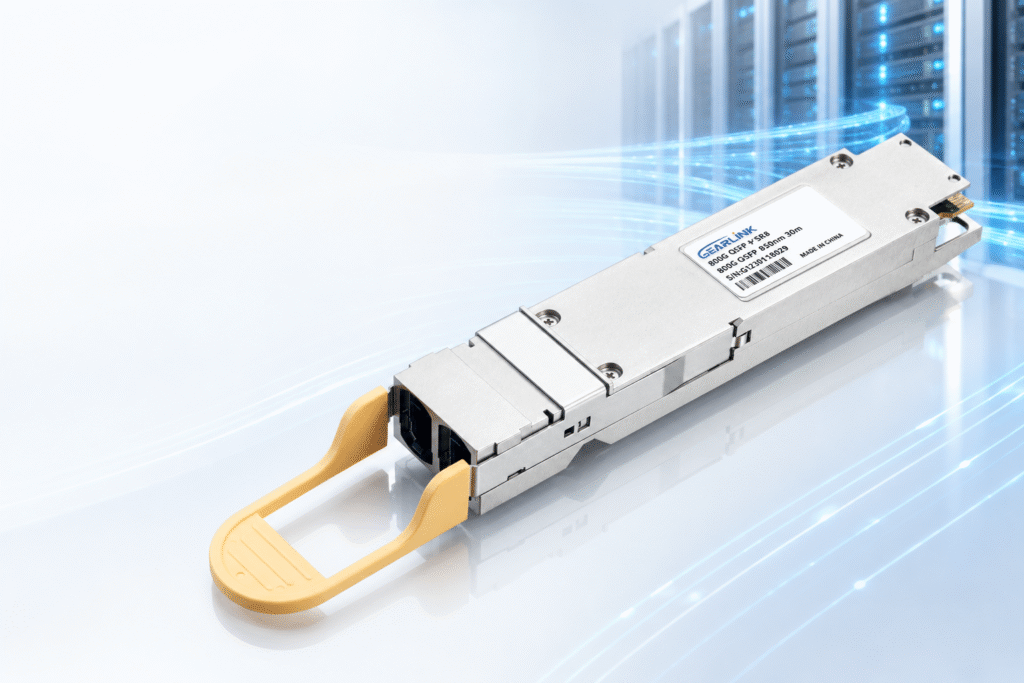
An 800g sr8 transceiver is an 800Gb/s optical module designed primarily for short-reach data center connections. The “800G” indicates the total data rate, while “SR8” generally refers to short-reach transmission using eight parallel optical lanes.
In a typical implementation, the electrical interface is divided into eight high-speed lanes. On the optical side, eight multimode fiber lanes are used for transmission and reception.
Therefore, the basic architecture can be summarized as:
| Feature | Typical 800G SR8 Configuration |
| Total data rate | 800Gb/s |
| Optical lanes | 8 |
| Lane speed | 100Gb/s |
| Fiber type | Multimode fiber |
| Typical wavelength | 850nm |
| Application | Short-reach data center links |
| Modulation | PAM4 |
| Typical connector | MPO/MTP |
| Primary environment | AI, HPC, cloud data centers |
Because eight optical lanes are operated in parallel, the module can deliver extremely high bandwidth without requiring a single optical channel to carry the entire 800Gb/s signal.
How Does an 800G SR8 Transceiver Work?
An 800g sr8 transceiver converts electrical signals from a network switch, server, or accelerator into optical signals. At the receiving end, the optical signals are converted back into electrical signals.
The process can be simplified into four stages:
Electrical data enters the optical module.
The module processes and converts the electrical signals.
Eight optical lanes transmit the data through multimode fiber.
The receiving module converts the optical signals back into electrical data.
PAM4 modulation is commonly used because it can transmit two bits per symbol. This makes it possible to achieve 100Gb/s per optical lane without requiring an extremely high symbol rate.
As a result, eight 100G optical lanes can provide an aggregate 800Gb/s connection.
800G SR8 Transceiver Architecture
The architecture of an 800g sr8 transceiver is relatively straightforward when compared with some longer-reach 800G solutions.
A simplified link looks like this:
800G Switch → 800G SR8 → MPO/MTP Multimode Fiber → 800G SR8 → 800G Switch
Each side uses a parallel optical interface. Consequently, the link can support very high bandwidth while remaining suitable for short data center distances.
8×100G Parallel Optical Transmission
The main characteristic of the 800G SR8 architecture is its eight-lane design.
| Optical Lane | Data Rate | Typical Function |
| Lane 1 | 100G | Data transmission |
| Lane 2 | 100G | Data transmission |
| Lane 3 | 100G | Data transmission |
| Lane 4 | 100G | Data transmission |
| Lane 5 | 100G | Data transmission |
| Lane 6 | 100G | Data transmission |
| Lane 7 | 100G | Data transmission |
| Lane 8 | 100G | Data transmission |
| Total | 800G | Aggregate bandwidth |
This parallel structure also explains why MPO/MTP connectivity is commonly associated with 800g sr8 transceiver deployments.
Instead of using a duplex LC connection, multiple optical fibers are combined into a single high-density connector. Consequently, rack space and cable management can be improved in high-density environments.
Why PAM4 Matters in 800G SR8
PAM4 is one of the key technologies behind modern 800G optical modules.
Traditional NRZ signaling uses two signal levels and carries one bit per symbol. PAM4 uses four signal levels, allowing two bits to be transmitted per symbol.
| Signaling | Signal Levels | Bits per Symbol |
| NRZ | 2 | 1 |
| PAM4 | 4 | 2 |
Therefore, PAM4 makes higher data rates possible without simply doubling the signaling frequency.
However, PAM4 also introduces additional signal-quality challenges. The distance between signal levels is smaller, so the system becomes more sensitive to noise, insertion loss, crosstalk, and other impairments.
For this reason, high-speed electrical and optical components must be carefully designed and tested.
800G SR8 Transceiver and Multimode Fiber
An important advantage of the 800g sr8 transceiver is its use of multimode fiber for short-distance connections.
Multimode fiber is widely deployed inside data centers because it can provide high bandwidth over relatively short distances while keeping the optical infrastructure practical and cost-effective.
OM3 and OM4 multimode fiber are commonly found in high-speed data center environments.
| Fiber Type | Typical Use | General Advantage |
| OM3 | Data center short links | Mature and widely deployed |
| OM4 | High-speed data center links | Improved bandwidth performance |
| OM5 | Higher-density multimode environments | Designed for wider wavelength operation |
The exact supported distance depends on the transceiver specification, fiber type, connector quality, and link budget. Therefore, the module datasheet should always be checked before deployment.
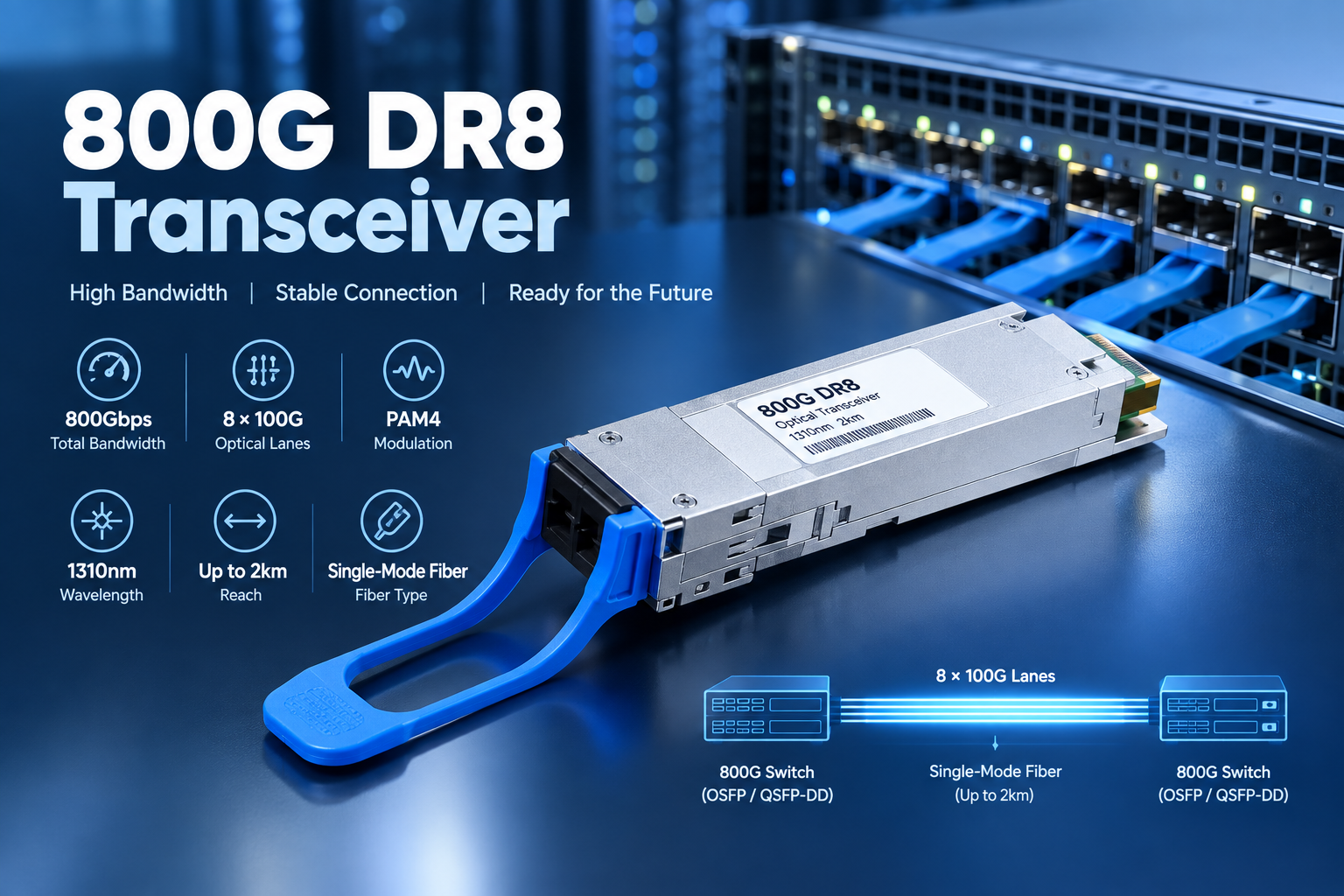
800G SR8 vs. 800G DR8
Although both technologies provide 800Gb/s connectivity, they are designed for different transmission environments.
An 800g sr8 transceiver is generally intended for short-reach multimode applications, while 800G DR8 is designed for longer-distance single-mode fiber connections.
| Characteristic | 800G SR8 | 800G DR8 |
| Fiber | Multimode | Single-mode |
| Typical wavelength | 850nm | Around 1310nm |
| Optical lanes | 8 | 8 |
| Lane rate | 100G | 100G |
| Typical application | Short-reach data center links | Longer data center links |
| Connector | MPO/MTP | MPO/MTP |
| Cost structure | Generally optimized for short reach | Generally higher optical cost |
| Deployment focus | Intra-rack / short links | Longer rack-to-rack or row links |
The correct choice should therefore be based on distance, fiber infrastructure, power requirements, and system architecture rather than data rate alone.
800G SR8 Transceiver vs. 800G SR8 OSFP
The optical technology and the module form factor are two different concepts.
For example, an 800G SR8 optical design may be packaged in an OSFP form factor depending on the platform.
An 800g sr8 transceiver can therefore be discussed in terms of both its optical architecture and its physical package.
OSFP is widely used in high-performance networking because its larger physical size allows more room for thermal management and high-speed electrical interfaces.
However, compatibility must always be confirmed at the switch level.
| Item | What It Describes |
| SR8 | Optical transmission architecture |
| 800G | Aggregate data rate |
| OSFP | Physical form factor |
| PAM4 | Electrical/optical signaling technology |
| MPO/MTP | High-density fiber connection |
This distinction is important when selecting an optical module for a specific switch or accelerator platform.
Key Applications of an 800G SR8 Transceiver
The demand for 800g sr8 transceiver solutions is closely connected with the growth of AI and high-performance computing.
Modern AI clusters can generate enormous amounts of east-west traffic. GPUs and accelerators must exchange data quickly, so network bandwidth can become a critical part of overall system performance.
AI Data Centers
AI training systems often connect large numbers of GPUs or other accelerators.
In these environments, short-reach optical connections can be used inside high-density racks and between closely located network devices.
Because the connection provides 800Gb/s of aggregate bandwidth, fewer physical ports may be required to achieve a given network capacity.
High-Performance Computing
HPC systems also require high-bandwidth communication between compute nodes.
For these systems, low-latency optical links can help support distributed workloads, storage traffic, and interconnect architectures.
Cloud Data Centers
Cloud service providers continuously increase network capacity to support virtualization, storage, AI services, and large-scale applications.
An 800g sr8 transceiver can be used in high-density switching environments where the required distance is relatively short.
Advantages of 800G SR8
Several factors make 800G SR8 technology attractive for modern data centers.
High Bandwidth Density
The most obvious advantage is the 800Gb/s aggregate capacity.
Compared with lower-speed optical modules, fewer ports may be needed for the same total bandwidth.
Efficient Short-Reach Connectivity
Because SR8 is designed for short-distance applications, it can provide a practical solution for connections where long-reach single-mode optics are unnecessary.
Multimode Fiber Compatibility
Existing multimode fiber infrastructure can potentially be reused when it meets the required optical specifications.
This can simplify upgrades in some data center environments.
High-Density Cabling
MPO/MTP connectivity allows multiple optical lanes to be grouped into a compact connector.
Consequently, cable density can be managed more efficiently in high-speed network racks.
Important Factors When Choosing an 800G SR8 Transceiver
Before purchasing an 800g sr8 transceiver, several technical factors should be reviewed.
1. Switch Compatibility
The optical module must be compatible with the target switch or networking platform.
Check:
Form factor
Port type
Electrical interface
Firmware compatibility
Supported optical module coding
Operating temperature
Power consumption
A module that has the correct optical specifications may still be unsuitable if the host platform does not support it.
2. Fiber Compatibility
The fiber type should match the module requirements.
For example, if an 800g sr8 transceiver is specified for multimode fiber, the deployed fiber and connector system should be checked carefully.
3. Transmission Distance
Do not select a module only because it supports 800G.
Instead, compare the required link distance with the rated reach of the module.
A short-reach module may be unsuitable for a longer interconnection even if the data rate is correct.
4. Connector Configuration
MPO/MTP connector polarity and fiber count should be confirmed before installation.
Incorrect polarity can prevent the optical link from coming up.
5. Power Consumption and Thermal Design
800G modules generate more heat than many lower-speed modules.
Therefore, switch airflow, module power consumption, rack density, and operating temperature should all be considered.
800G SR8 Transceiver Specification Checklist
The following checklist can help network engineers compare different products.
| Specification | What to Check |
| Data rate | 800Gb/s |
| Form factor | OSFP or supported platform format |
| Optical technology | SR8 |
| Fiber | Multimode |
| Wavelength | Product-specific |
| Modulation | PAM4 |
| Optical lanes | 8 |
| Connector | MPO/MTP |
| Maximum reach | Product-specific |
| Power consumption | Product-specific |
| Operating temperature | Commercial / industrial options |
| DOM/DDM | Confirm according to product |
| Host compatibility | Verify before purchase |
Because specifications can vary between manufacturers, the product datasheet should be used as the final reference.
Troubleshooting an 800G SR8 Link
If an 800g sr8 transceiver does not establish a stable connection, troubleshooting should be performed systematically.
First, check whether the switch recognizes the module. Next, verify the optical module coding and supported firmware.
After that, inspect the MPO/MTP connection and fiber polarity.
The following table provides a basic troubleshooting guide:
| Problem | Possible Cause | Suggested Check |
| Link remains down | Fiber polarity | Check MPO polarity |
| Module not recognized | Compatibility | Check switch support |
| High error rate | Fiber or connector issue | Clean and inspect connectors |
| Link instability | Signal quality | Check DOM and optical parameters |
| Excessive temperature | Cooling issue | Check airflow and rack environment |
| Short optical reach | Incorrect fiber | Verify multimode fiber type |
Importantly, fiber cleanliness should not be overlooked. At 800G speeds, even relatively small optical impairments can become more significant.
Future Development of 800G Optical Connectivity
The development of 800G networking is closely connected with AI infrastructure and next-generation data centers.
As accelerator clusters become larger, 800G connections are increasingly being deployed in high-bandwidth network architectures. At the same time, the industry is moving toward 1.6T and other higher-speed optical technologies.
Nevertheless, 800G remains an important transition point because it provides a significant increase in bandwidth while using technologies that are already becoming mature.
For short-reach applications, an 800g sr8 transceiver can continue to play an important role where multimode fiber and high-density parallel optics are appropriate.
How to Select the Right 800G Optical Solution
There is no single 800G module that is suitable for every application.
Instead, selection should begin with the network requirements.
A practical process is:
Determine the required bandwidth.
Measure the actual transmission distance.
Identify the existing fiber type.
Confirm the switch or accelerator platform.
Select the appropriate form factor.
Check connector and polarity requirements.
Compare power consumption.
Verify operating temperature.
Confirm firmware and interoperability.
Test the complete link before large-scale deployment.
This approach can reduce compatibility problems and make future network expansion easier.
Conclusion
An 800g sr8 transceiver is designed for high-bandwidth, short-reach optical networking, especially in modern data centers, AI clusters, and high-performance computing environments. By using eight parallel 100G optical lanes, the architecture can deliver an aggregate 800Gb/s connection while remaining suitable for multimode fiber applications.
At the same time, successful deployment depends on more than bandwidth. Fiber type, connector polarity, switch compatibility, thermal conditions, power consumption, and optical performance must all be considered.
For short-distance 800G connections, SR8 provides a practical architecture that fits the high-density requirements of next-generation data center networks. As network speeds continue to increase, understanding the differences between SR8, DR8, OSFP, and other optical solutions will become increasingly important for efficient network design.