Introduction to QSFP 40 100 SRBD in Modern Networks
In today’s rapidly evolving data center environment, high-speed optical interconnects are no longer optional—they are essential. Among the emerging solutions, qsfp 40 100 srbd has gained increasing attention due to its flexibility, cost-efficiency, and compatibility across multiple network speeds.
To begin with, it is designed to support both 40G and 100G Ethernet applications over multimode fiber. This dual-rate capability allows network operators to simplify infrastructure upgrades while maintaining backward compatibility. As a result, deployment costs can be reduced, and scalability can be significantly improved.
Moreover, as enterprises and cloud providers continue to demand higher bandwidth, solutions like qsfp 40 100 srbd are being widely adopted in data centers, enterprise networks, and high-performance computing environments.
What is QSFP 40 100 SRBD and How Does It Work?
Understanding QSFP 40 100 SRBD Technology
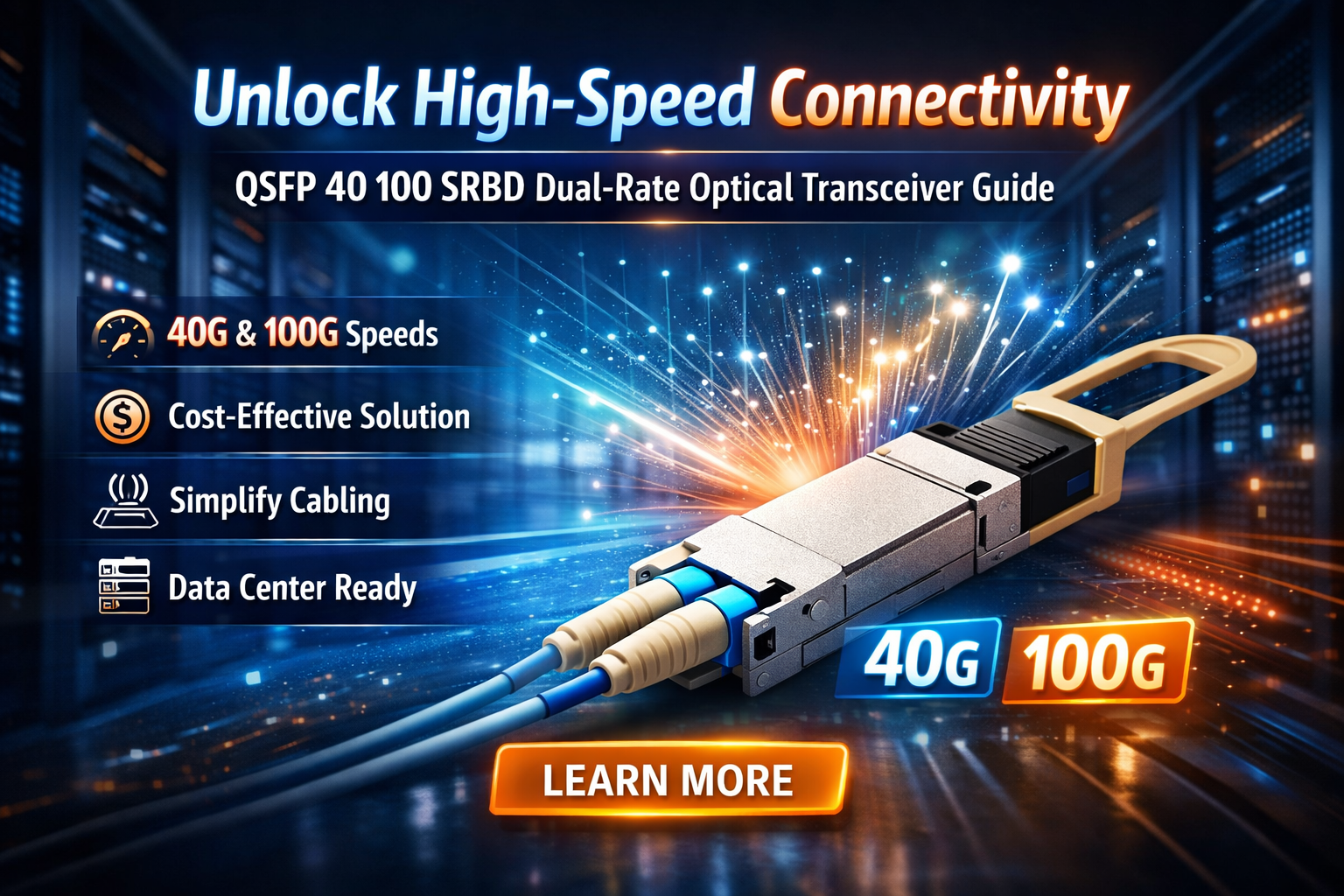
The term qsfp 40 100 srbd refers to a Quad Small Form-factor Pluggable optical transceiver that supports both 40Gbps and 100Gbps transmission using Short Reach Bi-Directional (SRBD) technology.
Unlike traditional SR4 modules that require multiple fibers, qsfp 40 100 srbd operates over duplex multimode fiber, which makes cabling simpler and more cost-effective.
Core Working Principle
At its core, it uses:
Bi-directional transmission on two fibers
Multiple wavelengths transmitted simultaneously
Parallel optical lanes internally
Consequently, data is transmitted and received over the same fiber pair, reducing fiber usage by up to 75% compared to SR4 modules.
Key Features of QSFP 40 100 SRBD
1. Dual-Rate Capability
One of the most significant advantages of qsfp 40 100 srbd is its ability to support both 40G and 100G speeds. Therefore, it enables seamless migration between different network generations.
2. Reduced Fiber Complexity
Traditional 100G SR4 modules require 8 fibers, while qsfp 40 100 srbd uses only 2 fibers. As a result:
Cabling infrastructure is simplified
Installation costs are lowered
Maintenance becomes easier
3. High Compatibility
In addition, the modules are designed to be compatible with a wide range of switches and routers. They can be deployed in mixed-speed environments without major configuration changes.
4. Cost Efficiency
Because fewer fibers and connectors are required, overall deployment costs are significantly reduced. Furthermore, existing duplex fiber infrastructure can be reused.
QSFP 40 100 SRBD vs Traditional Modules
Comparison Table
| Feature | QSFP 40 100 SRBD | QSFP+ SR4 | QSFP28 SR4 |
| Data Rate | 40G / 100G | 40G | 100G |
| Fiber Type | Duplex MMF | MPO 12 | MPO 12 |
| Fiber Count | 2 fibers | 8 fibers | 8 fibers |
| Transmission Distance | Up to 100m | Up to 150m | Up to 100m |
| Upgrade Flexibility | High | Low | Medium |
| Cost Efficiency | High | Medium | Medium |
From the table above, it can be clearly seen that those module offers a strong balance between performance and cost.
Applications of QSFP 40 100 SRBD
1. Data Centers
First and foremost, it is widely used in data centers where high-density and high-speed connections are required. It allows operators to maximize port utilization while minimizing cabling complexity.
2. Enterprise Networks
In enterprise environments, qsfp 40 100 srbd is often deployed to connect core switches and aggregation layers. Consequently, network performance is improved without requiring a complete infrastructure overhaul.
3. Cloud Computing
Cloud service providers benefit greatly from qsfp 40 100 srbd, as it supports scalable and flexible network architectures.
4. High-Performance Computing (HPC)
In HPC environments, where low latency and high throughput are critical, it provides reliable and efficient connectivity.
Advantages of QSFP 40 100 SRBD
Improved Scalability
As network demands grow, it allows for easy upgrades from 40G to 100G without replacing existing cabling systems.
Simplified Deployment
Because duplex LC connectors are used, installation becomes more straightforward compared to MPO-based solutions.
Lower Power Consumption
In many cases, power consumption is optimized, which contributes to reduced operational costs.
Enhanced Flexibility
Additionally, qsfp 40 100 srbd supports multiple deployment scenarios, making it a versatile choice for various network designs.
Deployment Considerations for QSFP 40 100 SRBD
Fiber Compatibility
Before deploying qsfp 40 100 srbd, it is important to ensure that the existing fiber infrastructure supports multimode operation (OM3/OM4).
Distance Limitations
Although qsfp 40 100 srbd provides many benefits, transmission distance is typically limited to 70–100 meters.
Switch Compatibility
It should be verified that the target switch supports both 40G and 100G modes for qsfp 40 100 srbd modules.
Best Practices for Using QSFP 40 100 SRBD
1. Plan for Future Growth
When designing networks, qsfp 40 100 srbd should be considered for its upgrade flexibility.
2. Optimize Cable Management
Since fewer fibers are required, cable management can be significantly improved.
3. Test Before Deployment
It is recommended that modules be tested in a controlled environment before large-scale deployment.
Common Challenges and Solutions
| Challenge | Solution |
| Limited transmission distance | Use single-mode alternatives if needed |
| Compatibility issues | Verify switch firmware and support |
| Heat management | Ensure proper airflow in racks |
Future Trends of QSFP 40 100 SRBD
Looking ahead, qsfp 40 100 srbd is expected to play a crucial role in transitional network architectures. While 400G and 800G technologies are emerging, 40G and 100G solutions remain highly relevant.
Furthermore, hybrid solutions that combine cost efficiency and performance will continue to be favored. Therefore, qsfp 40 100 srbd is likely to remain a practical choice for many organizations.
Conclusion
In summary, qsfp 40 100 srbd provides a powerful, flexible, and cost-effective solution for modern networking needs. By enabling dual-rate operation and reducing fiber requirements, it simplifies infrastructure while maintaining high performance.
Whether used in data centers, enterprise networks, or cloud environments, qsfp 40 100 srbd stands out as a smart investment for scalable connectivity.
FAQ
1. What is QSFP 40 100 SRBD?
QSFP 40 100 SRBD is a dual-rate optical transceiver that supports both 40G and 100G speeds over duplex multimode fiber.
2. How does QSFP 40 100 SRBD reduce costs?
QSFP 40 100 SRBD reduces costs by using fewer fibers and allowing existing duplex infrastructure to be reused.
3. Where is QSFP 40 100 SRBD commonly used?
QSFP 40 100 SRBD is widely used in data centers, enterprise networks, and cloud computing environments.
4. What is the maximum distance of QSFP 40 100 SRBD?
QSFP 40 100 SRBD typically supports transmission distances up to 100 meters over multimode fiber.
5. Is QSFP 40 100 SRBD suitable for upgrades?
Yes, QSFP 40 100 SRBD is ideal for upgrading from 40G to 100G networks without replacing existing cabling.