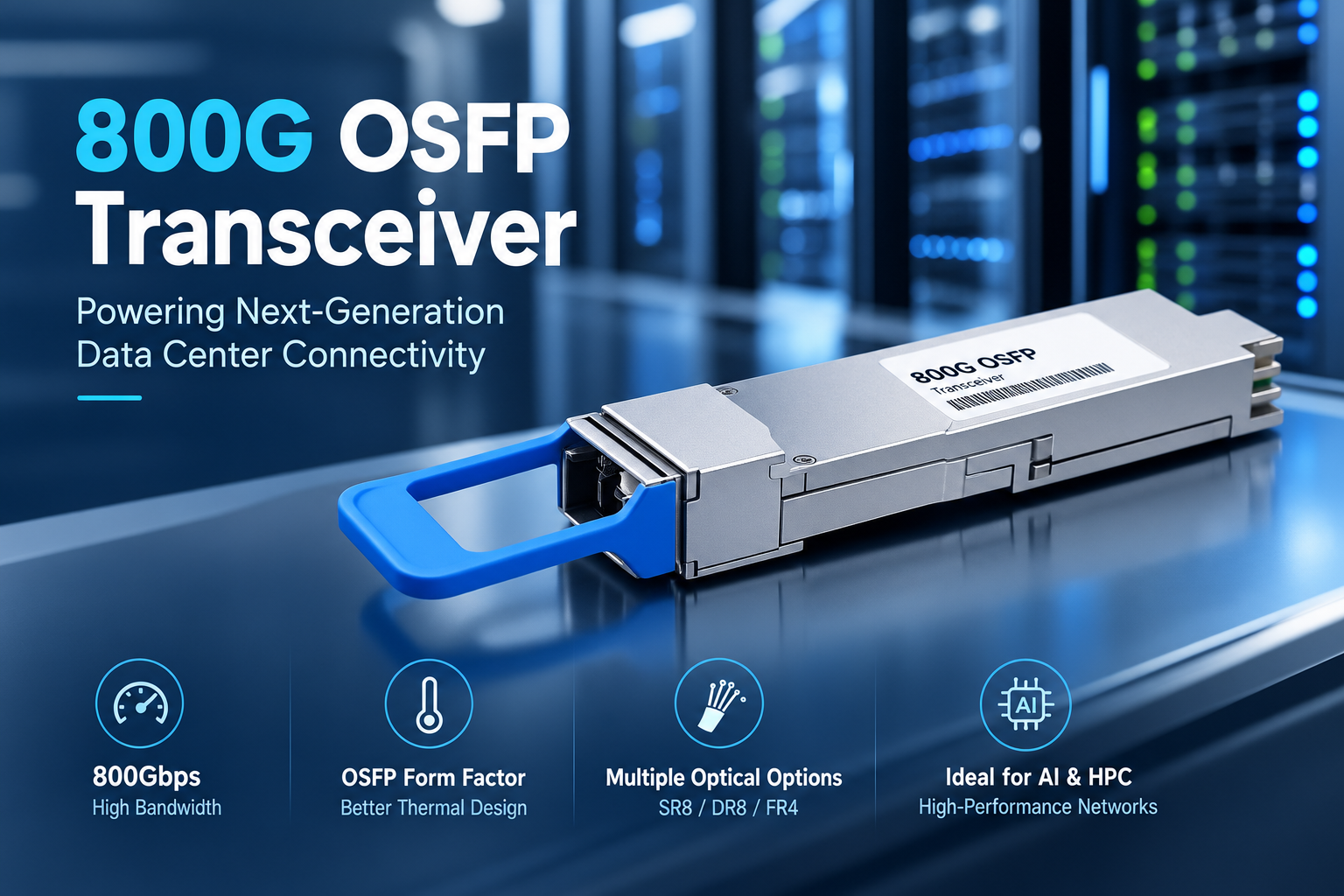
As AI clusters, high-performance computing, and cloud data centers continue to expand, network traffic is growing faster than ever. To handle this demand, higher-speed optical connectivity is becoming essential. The
has therefore emerged as an important solution for next-generation data center networks, especially where high bandwidth, efficient thermal management, and reliable short-reach connectivity are required.
Unlike traditional 100G and 400G optical modules, an 800G optical transceiver is designed to support significantly higher data rates while maintaining a compact front-panel footprint. In addition, the OSFP form factor provides a practical platform for high-speed optical applications because it offers more space for thermal management and advanced optical components.
This guide explains how an 800g osfp transceiver works, what technologies are used inside it, how it compares with other 800G form factors, and where it can be deployed.
What Is an 800G OSFP Transceiver?
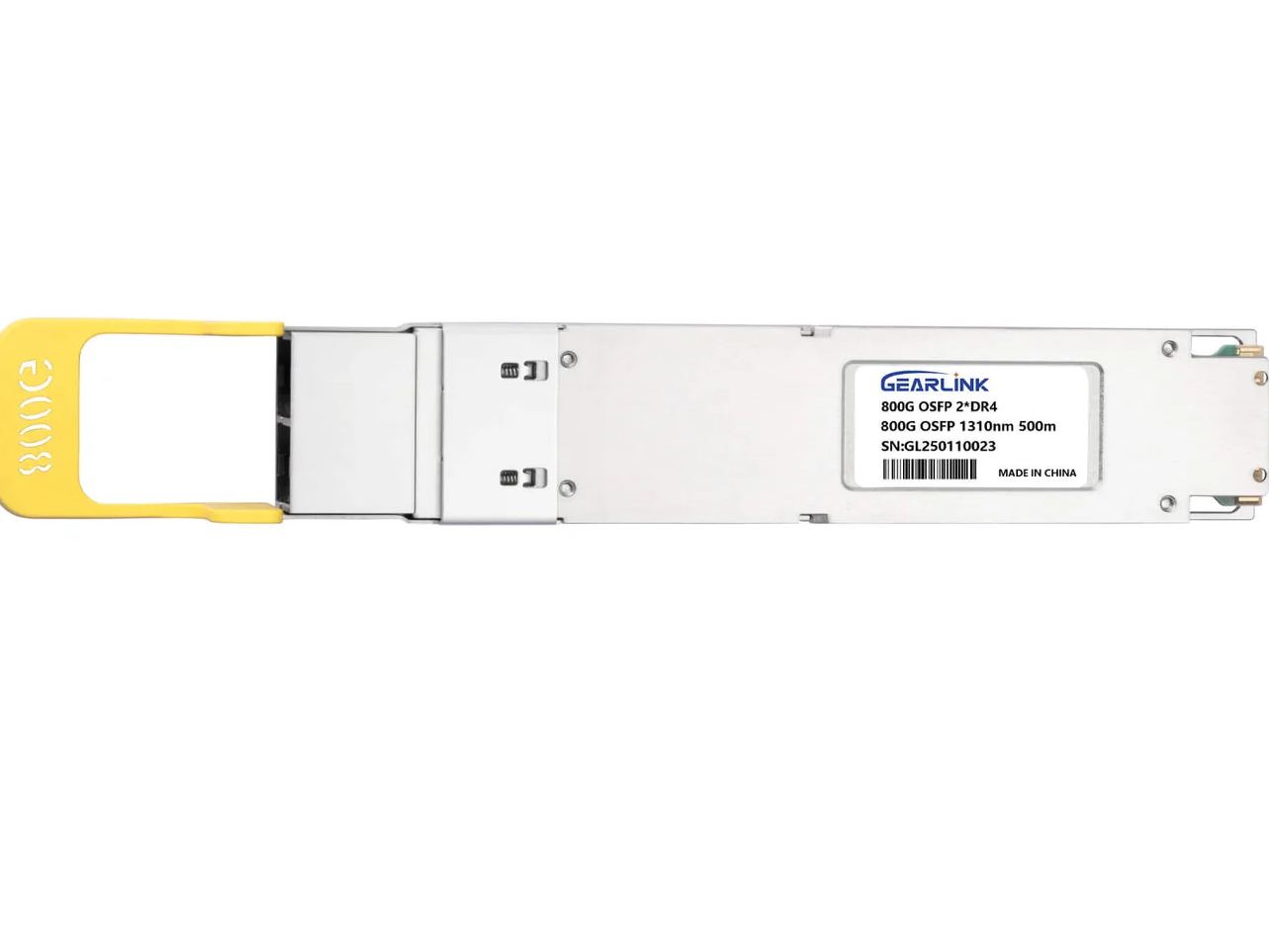
An 800g osfp transceiver is a high-speed optical module designed to provide up to 800Gbps of aggregate data transmission. OSFP stands for Octal Small Form-factor Pluggable. The form factor was developed to support next-generation networking equipment that requires higher bandwidth than traditional QSFP-based modules can provide.
Typically, an 800G OSFP module contains multiple high-speed electrical and optical lanes. Depending on the optical architecture, these lanes can be used to transmit data over multimode or single-mode fiber.
For example, an 800G module may use eight 100G PAM4 lanes on the optical side. In other designs, optical lanes may be combined through parallel optics, wavelength multiplexing, or other optical architectures.
Why Is 800G Important?
The growth of AI and machine learning has created a major increase in east-west traffic inside data centers. GPU servers frequently communicate with other GPUs, switches, storage systems, and computing nodes.
As a result, network interfaces must move increasingly large amounts of data with low latency.
The progression can be summarized as follows:
| Network Generation | Typical Port Speed | Common Applications |
| 100G | 100Gbps | Enterprise and data center networks |
| 200G | 200Gbps | High-performance networks |
| 400G | 400Gbps | Cloud and modern data centers |
| 800G | 800Gbps | AI clusters and large-scale data centers |
| 1.6T | 1.6Tbps | Emerging next-generation networks |
Therefore, the 800g osfp transceiver is increasingly being considered for high-density switching platforms and AI infrastructure.
How Does an 800G OSFP Transceiver Work?
Although the internal architecture can vary, the basic operating principle is relatively easy to understand.
The electrical signal from a switch ASIC is first delivered to the optical module. Inside the module, a DSP and optical components process the signal before it is converted into an optical signal.
The optical signal is then transmitted through fiber to another transceiver.
At the receiving end, the optical signal is converted back into an electrical signal and passed to the network device.
A simplified signal path looks like this:
Switch ASIC → Electrical Interface → DSP → Optical Engine → Fiber → Optical Engine → DSP → Electrical Interface → Switch ASIC
PAM4 Technology
Most modern 800G optical solutions use PAM4 signaling.
PAM4 stands for four-level pulse amplitude modulation. Instead of using only two signal levels, PAM4 uses four different amplitude levels.
This allows two bits of information to be carried by each symbol.
| Signaling | Signal Levels | Bits per Symbol |
| NRZ | 2 | 1 |
| PAM4 | 4 | 2 |
Consequently, PAM4 can provide a higher data rate without requiring the same proportional increase in baud rate.
However, PAM4 also introduces more sensitivity to noise and signal distortion. Therefore, advanced DSP and forward error correction are commonly used in high-speed optical systems.
800G OSFP Transceiver Form Factor
The OSFP form factor is particularly important because thermal management becomes increasingly challenging as optical module speeds increase.
An 800g osfp transceiver generally has a larger physical envelope than a QSFP-based module. This provides additional space for heat dissipation.
That advantage becomes important in high-density switching systems.
OSFP vs QSFP-DD
Both OSFP and QSFP-DD can be used for high-speed optical networking. However, they have different mechanical designs.
| Feature | 800G OSFP | 800G QSFP-DD |
| Form Factor | OSFP | QSFP-DD |
| Typical Application | AI and high-density data centers | Data centers and networking |
| Thermal Capacity | High | High |
| Port Density | High | Very high |
| Backward Compatibility | Platform dependent | Strong QSFP ecosystem |
| Typical 800G Architecture | 8 × 100G | 8 × 100G |
| Common Use | High-performance switching | Broad data center deployment |
Neither form factor should be selected based on speed alone. Instead, the switch platform, cage design, thermal requirements, electrical interface, and optical reach should all be considered.
Common 800G OSFP Optical Configurations
Different network architectures require different optical reaches.
Therefore, several 800G OSFP configurations are available or being adopted for different applications.
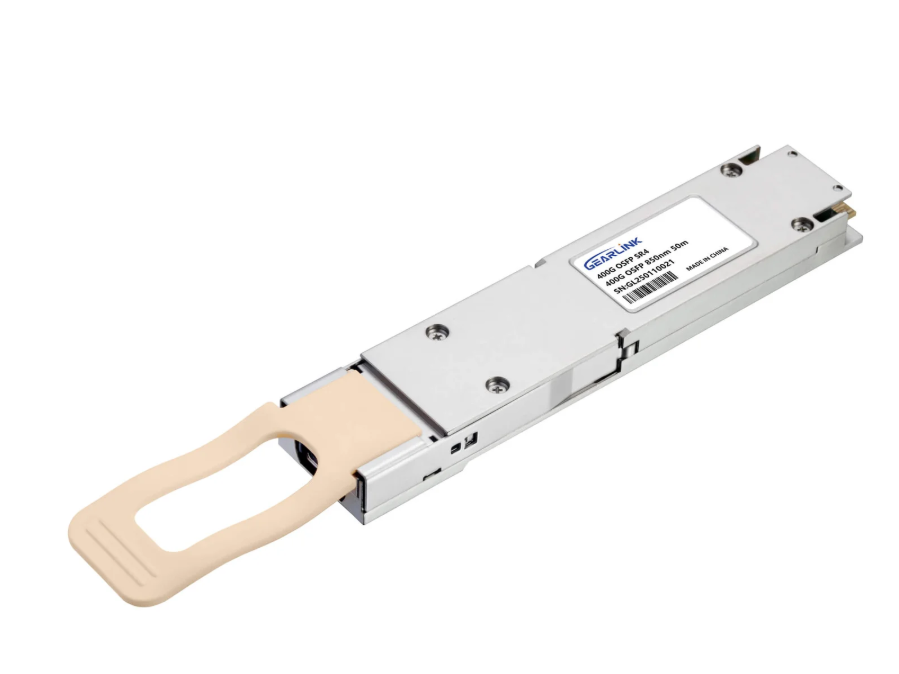
800G OSFP SR8
The 800G SR8 architecture is designed primarily for short-distance connections over multimode fiber.
A typical configuration uses eight optical lanes, with each lane operating at 100Gbps.
For example:
8 × 100G = 800G
SR8 can be attractive for connections within a data center because multimode fiber can provide a cost-effective solution for short distances.
Typical applications include:
AI GPU clusters
Top-of-rack connections
Leaf-to-spine networking
High-density switch interconnects
Short server-to-switch links
800G OSFP DR8
An 800G DR8 module is generally designed for single-mode fiber connections.
The optical architecture commonly uses eight parallel optical lanes, with each lane operating around 100G.
Compared with SR8, DR8 is intended for longer reach and single-mode infrastructure.
A typical application is a data center fabric where higher-speed switches must be connected across longer fiber paths.
800G OSFP 2×FR4
Another approach is to combine two 400G FR4 optical paths into an 800G solution.
FR4 uses four optical wavelengths in the 1310nm region and is generally designed for single-mode fiber.
This architecture can provide a useful balance between reach, optical complexity, and network flexibility.
The exact implementation depends on the switch and module design.
800G OSFP Transceiver Optical Reach
Optical reach is one of the most important factors when selecting an 800G module.
Different module types are designed for different distances.
| Module Type | Fiber Type | Typical Reach | Typical Application |
| 800G SR8 | Multimode | Short reach | Intra-rack / short data center links |
| 800G DR8 | Single-mode | Up to around 500m | Data center fabric |
| 800G 2×FR4 | Single-mode | Around 2km | Data center interconnection |
| 800G 2×LR4 | Single-mode | Longer reach | Extended data center links |
The actual transmission distance should always be confirmed against the manufacturer’s datasheet, fiber quality, connector loss, and operating conditions.
Why Choose an 800G OSFP Transceiver?
The increasing adoption of an 800g osfp transceiver is driven by several practical requirements.
1. Higher Bandwidth
An 800G interface can move twice as much data as a 400G interface.
This makes it possible to reduce the number of physical interfaces required for certain network architectures.
For example:
2 × 400G = 800G
Instead of deploying two separate 400G interfaces, a network designer may use one 800G interface where the platform supports it.
2. Better Thermal Design
High-speed optical modules generate significant heat.
The larger OSFP housing provides more room for thermal management compared with smaller form factors.
As a result, OSFP has become an important form factor for high-performance switches.
3. AI Network Compatibility
AI clusters often generate extremely high internal traffic.
GPU-to-GPU communication can become a major networking bottleneck. Therefore, 800G optical connectivity is increasingly being used in high-performance AI infrastructure.
4. High-Density Network Architecture
Higher port speeds can simplify network design.
For example, an 800G switch can provide a large amount of aggregate bandwidth without requiring an excessive number of physical ports.
This can help reduce:
Cable volume
Rack space requirements
Power consumption per transported bit
Network complexity
800G OSFP Transceiver and AI Data Centers
AI infrastructure is one of the most important application areas for 800G networking.
Modern GPU clusters can contain thousands of accelerators. These GPUs must communicate with each other rapidly to distribute workloads and exchange data.
Therefore, the network connecting these GPUs must provide:
High bandwidth
Low latency
Reliable transmission
High port density
Efficient thermal management
An 800g osfp transceiver can address these requirements when it is paired with compatible switches, fiber systems, and network architectures.
In particular, OSFP is widely associated with high-performance switching platforms where thermal capacity and high-speed electrical signaling are critical design considerations.
800G OSFP Transceiver vs 400G Optical Modules
The transition from 400G to 800G does not simply mean doubling the transmission speed.
The entire network architecture must be considered.
| Factor | 400G | 800G |
| Aggregate Speed | 400Gbps | 800Gbps |
| Typical Electrical Lanes | 4 × 100G | 8 × 100G |
| DSP Requirements | High | Very High |
| Thermal Challenge | High | Higher |
| AI Application | Increasing | Strong |
| Network Density | High | Very High |
Because of the higher bandwidth, 800G designs require careful attention to signal integrity, power consumption, cooling, FEC, and optical performance.
Key Components Inside an 800G OSFP Transceiver
An 800G module is a sophisticated optical system rather than simply a connector with optical components.
The major components may include:
DSP
The digital signal processor manages high-speed electrical and optical signal processing.
It may perform functions such as:
Equalization
Signal recovery
PAM4 processing
Clock recovery
Forward error correction support
Monitoring
Optical Engine
The optical engine converts electrical signals into optical signals and vice versa.
Depending on the design, it may include VCSELs, EMLs, silicon photonics, photodiodes, drivers, and other optical components.
TIA
A transimpedance amplifier converts the small electrical current generated by the photodiode into a usable voltage signal.
Laser Driver
The laser driver controls the optical transmitter and provides the required electrical drive signal.
FEC
Forward Error Correction helps improve the reliability of high-speed data transmission.
Because PAM4 has smaller signal-level differences than NRZ, error management becomes increasingly important at 800G speeds.
How to Select an 800G OSFP Transceiver
Choosing the correct module requires more than checking whether the module supports 800Gbps.
Before purchasing, network engineers should verify the following specifications.
| Selection Factor | What to Check |
| Form Factor | OSFP |
| Data Rate | 800Gbps |
| Optical Interface | MPO/MTP, dual CS, LC, etc. |
| Fiber Type | MMF or SMF |
| Wavelength | 850nm, 1310nm, or specified wavelengths |
| Reach | Required transmission distance |
| Electrical Interface | Host switch compatibility |
| FEC | Required host-side FEC |
| Temperature | Commercial or industrial range |
| DOM/DDM | Required monitoring functions |
| Power Consumption | Platform power budget |
| Coding | Vendor or MSA compatibility |
Compatibility should always be verified before deployment.
For branded switches, the exact switch model and firmware version can sometimes affect module interoperability.
800G OSFP Transceiver Compatibility
High-speed modules require close cooperation between the optical module and the host switch.
A module may meet the basic 800G specification but still require additional compatibility verification.
For example, engineers should confirm:
Switch port type
OSFP cage specification
Host electrical signaling
FEC configuration
Firmware support
Optical lane mapping
Module EEPROM information
DOM/DDM support
Therefore, cross-reference testing is recommended when third-party modules are used.
800G OSFP Transceiver Power and Thermal Management
Power consumption is an increasingly important consideration.
At 800G speeds, the DSP and optical components can generate substantial heat. When hundreds of modules are installed in a large data center, even a small increase in power per module can create a significant cooling requirement.
For this reason, modern optical module development focuses not only on transmission speed but also on:
Power efficiency
DSP optimization
Optical engine efficiency
Heat dissipation
System-level cooling
The actual power consumption of an 800g osfp transceiver varies by optical architecture and manufacturer. Therefore, the datasheet should be checked for the exact maximum and typical power values.
Common Applications for 800G OSFP
The applications of an 800g osfp transceiver are expanding as 800G switching becomes more widely deployed.
Typical applications include:
| Application | Why 800G Is Useful |
| AI Clusters | High GPU-to-GPU bandwidth |
| Cloud Data Centers | Higher network capacity |
| HPC | Fast data exchange |
| Spine Networks | High aggregate bandwidth |
| Leaf-Spine Networks | High-density uplinks |
| Data Center Interconnect | Efficient high-speed links |
As AI workloads continue to increase, higher-speed optical connectivity will remain an important part of network infrastructure.
Future Development of 800G OSFP Transceiver Technology
The optical industry is already moving beyond conventional 800G architectures.
Research and development are focusing on technologies such as:
1.6T optical modules
Linear-drive optics
Linear pluggable optics
Co-packaged optics
Higher-speed electrical lanes
Advanced silicon photonics
Lower-power DSPs
200G-per-lane signaling
Consequently, today’s 800g osfp transceiver technology can also be viewed as a bridge toward the next generation of optical networking.
The industry is gradually moving from 100G-per-lane architectures toward 200G-per-lane technologies. This transition will require improvements across electrical signaling, optical components, packaging, thermal management, and system design.
Frequently Asked Questions About 800G OSFP Transceiver
1. What is an 800g osfp transceiver?
An 800g osfp transceiver is a pluggable optical module designed to provide up to 800Gbps of aggregate network bandwidth. It uses the OSFP form factor and is commonly designed for high-performance data center and AI networking.
2. What fiber does an 800g osfp transceiver use?
The fiber type depends on the optical variant. SR8 typically uses multimode fiber, while DR8 and FR4-based solutions generally use single-mode fiber.
3. What is the difference between 800G OSFP and 800G QSFP-DD?
Both can support 800G networking, but their mechanical form factors and thermal characteristics differ. OSFP generally provides a larger module envelope, while QSFP-DD maintains a strong connection with the established QSFP ecosystem.
4. Can an 800g osfp transceiver be used with any 800G switch?
No. Compatibility depends on the switch platform, OSFP cage, electrical interface, firmware, FEC configuration, and optical architecture. The exact switch model should be checked before deployment.
5. Is an 800g osfp transceiver suitable for AI data centers?
Yes. 800G optical connectivity is designed for high-bandwidth environments such as AI clusters, cloud data centers, and high-performance computing networks. However, the module type should be selected according to the required reach, fiber infrastructure, and switch compatibility.
Conclusion
The 800g osfp transceiver represents an important step in the evolution of high-speed data center networking. By combining 800Gbps bandwidth with the OSFP form factor, it can support demanding applications that require high capacity, efficient thermal management, and dense network connectivity.
Furthermore, different optical architectures such as SR8, DR8, and FR4-based solutions allow network designers to select modules according to transmission distance and fiber infrastructure.
For AI clusters, cloud computing platforms, and high-performance data centers, 800G connectivity is becoming increasingly important. Nevertheless, successful deployment requires more than selecting a module based on speed. Optical reach, fiber type, FEC, power consumption, thermal conditions, switch compatibility, and firmware support should all be evaluated.
As network speeds continue to move toward 1.6T and beyond, the technologies developed for 800G will provide an important foundation for the next generation of optical communication systems.