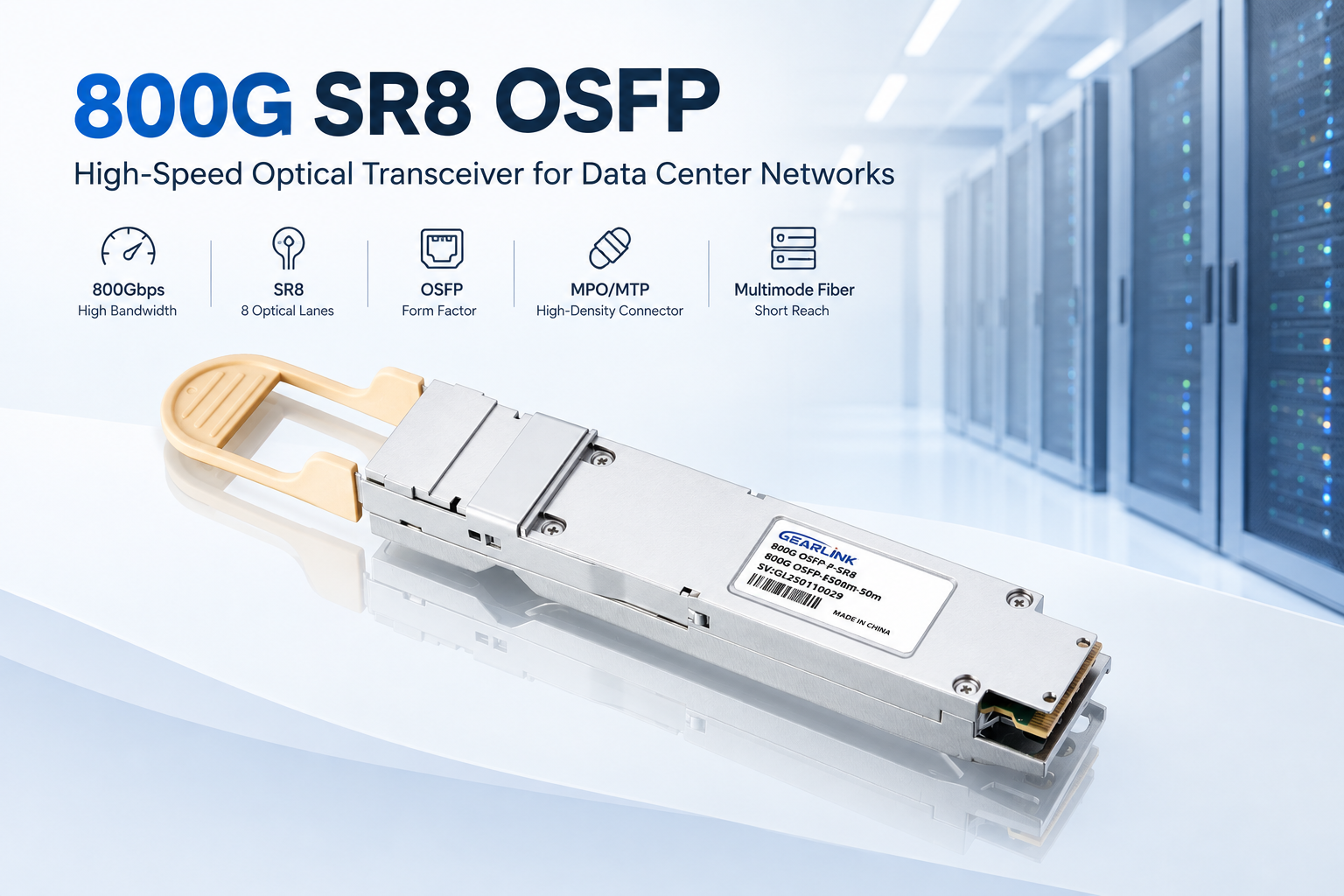
As AI workloads, cloud computing, and high-performance computing continue to expand, data center networks require much higher bandwidth and better port density. In this environment, the 800g sr8 osfp transceiver has become an important option for short-reach 800G optical connectivity. It combines an 800Gbps data rate, an OSFP form factor, and eight parallel optical channels to support high-bandwidth connections inside modern data centers.
Unlike traditional lower-speed optical modules, an 800G solution must handle significantly higher electrical and optical bandwidth. Therefore, the optical interface, modulation technology, thermal design, host compatibility, and fiber infrastructure all become important considerations.
This guide explains how 800g sr8 osfp technology works, where it is used, how it compares with other 800G transceiver options, and what network engineers should consider before deployment.
What Is 800G SR8 OSFP?
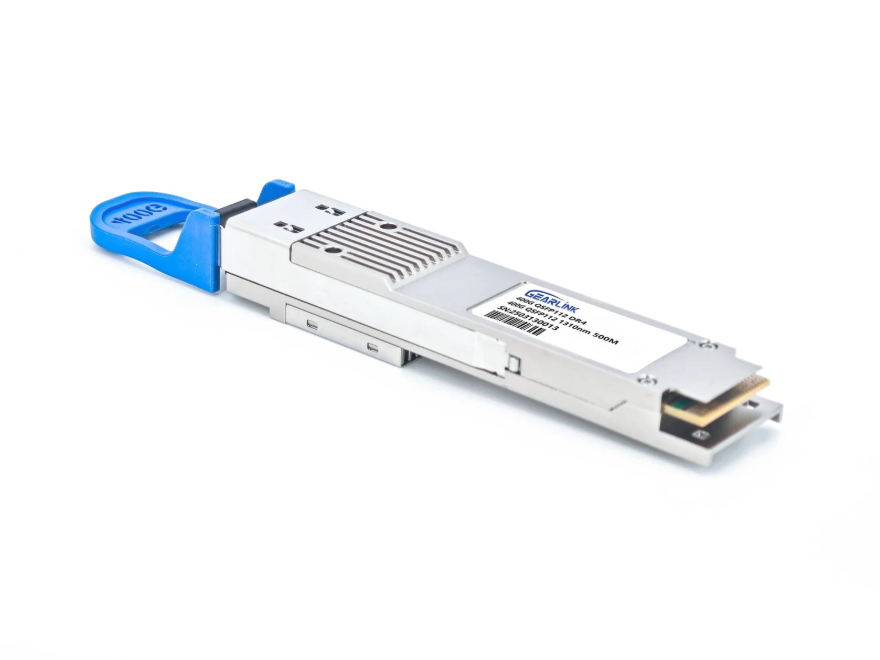
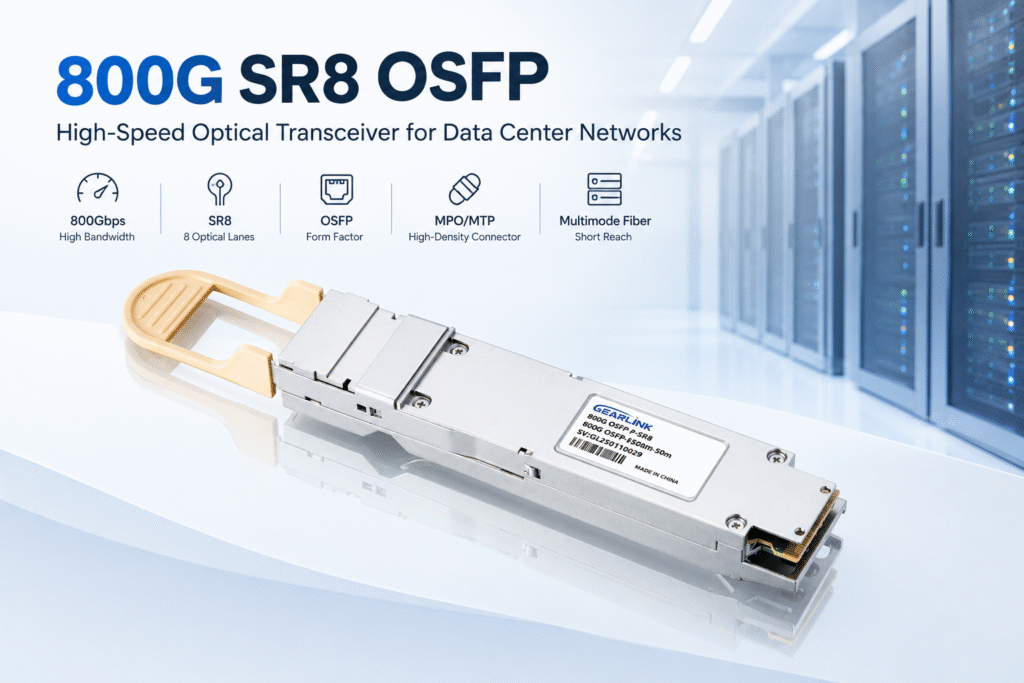
The 800g sr8 osfp is an 800Gbps short-reach optical transceiver based on the OSFP form factor. The term “SR8” generally refers to a short-reach architecture using eight optical lanes.
In a typical implementation, the module provides:
| Parameter | Typical Specification |
| Data Rate | 800Gbps |
| Form Factor | OSFP |
| Optical Type | SR8 |
| Optical Wavelength | Around 850nm |
| Optical Technology | VCSEL-based multimode optics |
| Optical Lanes | 8 lanes |
| Electrical Interface | 8 × 100G |
| Optical Interface | 8 × 100G |
| Fiber Type | Multimode fiber |
| Connector | Usually dual-row MPO/MTP |
| Typical Application | Data center short-reach links |
| Transmission Distance | Depends on fiber type and implementation |
The exact specifications can vary between manufacturers and product generations. Consequently, engineers should always verify the datasheet before selecting a module for a specific switch, NIC, GPU platform, or optical system.
The main advantage is straightforward: eight optical lanes can collectively provide 800Gbps bandwidth while maintaining a relatively short optical path.
Why 800g sr8 osfp Matters for AI Data Centers
Modern AI clusters generate enormous amounts of east-west traffic. GPU servers frequently exchange model parameters, training data, and intermediate results across high-speed network connections.
As a result, network bandwidth can become a major factor in overall cluster performance.
The 800g sr8 osfp architecture addresses this requirement by increasing bandwidth per optical port. Instead of deploying multiple lower-speed ports for the same aggregate bandwidth, a single 800G interface can consolidate the connection.
This approach can provide several practical benefits:
Higher bandwidth per port
Reduced port count for equivalent aggregate capacity
Better rack-level network density
Efficient short-distance optical connectivity
Compatibility with high-performance data center architectures
A path toward higher-speed Ethernet and InfiniBand environments
Furthermore, 800G connectivity is increasingly relevant to GPU clusters and AI infrastructure because modern accelerator systems can generate traffic at a much higher rate than conventional enterprise servers.
How Does 800g sr8 osfp Work?
The basic operating principle is easier to understand if the module is divided into electrical and optical sides.
On the host side, an 800G switch or network device sends high-speed electrical signals into the transceiver. The optical module converts these electrical signals into optical signals.
The optical signals then travel through multimode fiber to the receiving module. At the destination, photodetectors convert the optical signals back into electrical signals.
A simplified signal path looks like this:
Switch → Electrical Lanes → Optical Transmitter → Multimode Fiber → Optical Receiver → Electrical Lanes → Switch
For an eight-lane design, the aggregate bandwidth is achieved through parallel lanes rather than through one extremely high-speed optical channel.
8 × 100G Lane Architecture
A common architecture uses eight 100G lanes:
| Lane | Electrical Side | Optical Side |
| Lane 1 | 100G | 100G |
| Lane 2 | 100G | 100G |
| Lane 3 | 100G | 100G |
| Lane 4 | 100G | 100G |
| Lane 5 | 100G | 100G |
| Lane 6 | 100G | 100G |
| Lane 7 | 100G | 100G |
| Lane 8 | 100G | 100G |
| Total | 800G | 800G |
This parallel structure makes the design particularly suitable for short-distance data center connections.
800g sr8 osfp Uses Parallel Multimode Optics
One of the defining characteristics of an SR8 design is the use of multimode fiber for short-distance transmission.
Instead of relying on expensive long-distance single-mode optics, SR8 modules normally target connections within a data center or between closely located network devices.
VCSEL technology is widely associated with short-reach multimode optical communication because it can provide a practical balance between performance, cost, power consumption, and manufacturing complexity.
For example, an 850nm optical architecture can be paired with OM3 or OM4 multimode fiber.
| Fiber Type | Typical Use |
| OM3 | Short-reach data center links |
| OM4 | Higher-performance short-reach links |
| OM5 | Certain multimode applications requiring additional wavelength support |
However, the actual transmission distance depends on the complete optical budget, fiber quality, connector loss, and module specification.
Therefore, users should not select a fiber only by its category. The module’s official reach specification should always be checked.
800g sr8 osfp and MPO/MTP Connectivity
Fiber connectivity is another important part of an 800G SR8 deployment.
Because eight optical lanes are used, a high-density multi-fiber connector is normally required. MPO or MTP connectors are commonly used for this type of parallel optical connection.
A typical connection can be represented as:
800G SR8 OSFP → MPO/MTP Fiber → 800G SR8 OSFP
The connector provides multiple fiber positions in a compact footprint. This makes it possible to carry many optical lanes without requiring eight individual duplex connectors.
Nevertheless, connector polarity must be considered carefully.
Incorrect polarity can prevent the transmitter lanes from reaching the corresponding receiver lanes. Therefore, installation teams should verify the connector type, fiber polarity, key orientation, and lane mapping before deployment.
Key Technical Features of 800g sr8 osfp
The 800g sr8 osfp architecture combines several technologies that make high-speed short-reach networking practical.
1. 800Gbps Aggregate Bandwidth
The most obvious feature is the 800Gbps aggregate data rate.
This capacity is suitable for high-performance switching systems where conventional 100G, 200G, or 400G connections may no longer provide enough bandwidth per port.
2. Eight Optical Channels
Eight parallel optical channels distribute the total bandwidth across multiple lanes.
This approach simplifies the optical signaling requirements compared with trying to transmit the entire 800Gbps capacity through a single optical channel.
3. Multimode Fiber
SR8 solutions target short-reach applications, so multimode fiber is normally preferred.
The shorter transmission distance allows the system to use cost-effective optical components designed for data center environments.
4. OSFP Form Factor
OSFP was designed to support very high bandwidth while providing sufficient space for electrical and optical components.
Compared with smaller legacy form factors, OSFP provides a larger thermal and mechanical envelope, which is valuable for high-speed transceivers.
5. High Port Density
800G ports can reduce the number of physical interfaces required for a given amount of bandwidth.
Consequently, network architects can potentially simplify cabling and improve equipment-level bandwidth density.
800g sr8 osfp vs 800G DR8
The terms SR8 and DR8 describe different optical approaches.
The main difference is the fiber type and transmission distance.
| Feature | 800G SR8 | 800G DR8 |
| Fiber | Multimode | Single-mode |
| Typical Wavelength | ~850nm | ~1310nm |
| Optical Technology | VCSEL-based | Silicon photonics / EML-related implementations |
| Reach | Short | Longer |
| Typical Environment | Data center short links | Longer data center links |
| Fiber Cost | Generally lower | Generally higher |
| Typical Connector | MPO/MTP | MPO/MTP |
| Primary Advantage | Cost-effective short reach | Longer reach |
Therefore, these two products should not be viewed simply as competing versions of the same module.
SR8 is generally more appropriate when the optical path remains short and multimode infrastructure is already available. DR8, on the other hand, provides longer reach through single-mode fiber.
The correct choice depends heavily on physical topology.
800g sr8 osfp vs 800G 2×400G
Another interesting comparison involves 2×400G architectures.
A network designer may use one 800G interface or divide the connection into two 400G connections, depending on equipment architecture and upgrade requirements.
| Consideration | 800G SR8 | 2 × 400G |
| Aggregate Bandwidth | 800G | 800G |
| Port Structure | One 800G interface | Two 400G interfaces |
| Cabling | High-density | Potentially more connections |
| Port Density | Higher | Lower |
| Upgrade Flexibility | Depends on switch support | Can be easier in mixed-speed environments |
| Deployment | New high-speed platforms | Mixed or transitional networks |
In other words, the bandwidth may be identical, but the network architecture is different.
Engineers should therefore consider switch port availability, breakout requirements, cable infrastructure, and future upgrade plans rather than comparing bandwidth alone.
What Applications Use 800g sr8 osfp?
The 800g sr8 osfp is primarily designed for short-distance, high-bandwidth environments.
Typical applications include:
AI and GPU Clusters
AI training systems connect large numbers of GPUs and accelerators. These systems can generate extremely high east-west traffic.
High-speed optical links can help connect GPU servers, leaf switches, spine switches, and other networking equipment.
Data Center Switching
Modern data centers increasingly deploy 800G switching platforms to increase aggregate bandwidth while maintaining high rack density.
SR8 optics can be used where the physical distance fits within the short-reach optical budget.
High-Performance Computing
HPC systems require low-latency and high-throughput connections between compute nodes.
Therefore, high-speed optical modules can play an important role in cluster networking.
Cloud Infrastructure
Cloud providers operate large-scale server environments where bandwidth density and power efficiency are important.
An 800G architecture can support high-capacity network fabrics while reducing the number of physical ports required for a specific traffic volume.
How to Choose an 800g sr8 osfp Transceiver
Choosing an 800G module involves more than checking the advertised data rate.
Several technical factors should be reviewed.
Host Compatibility
First, verify that the target switch, NIC, GPU networking platform, or other host device supports the required OSFP specification.
A mechanically compatible module is not necessarily electrically compatible.
The host platform should be checked for:
OSFP support
800G interface support
Electrical lane configuration
Firmware requirements
FEC requirements
Module management support
Operating temperature range
Fiber Compatibility
Next, check the existing fiber infrastructure.
If the deployment uses OM3 or OM4 multimode fiber, confirm that the selected transceiver supports the intended fiber type and distance.
Also verify:
Connector type
Fiber polarity
Number of fibers
Insertion loss
Return loss
Cable length
Transmission Distance
Distance should always be evaluated using the actual optical budget.
For example, a module rated for a specific maximum reach should not automatically be assumed to support the same distance under every fiber and connector configuration.
Additional patch panels and connectors can increase optical loss.
Power Consumption
Power consumption becomes increasingly important as data center port speeds increase.
When hundreds or thousands of optical modules are deployed, even a small difference in module power can have a meaningful impact on total rack-level power consumption and cooling requirements.
Thermal Management
800G modules generate more heat than many lower-speed modules.
Therefore, airflow direction and switch thermal design must be considered.
The module should be compatible with the host platform’s cooling architecture. Otherwise, thermal issues may reduce system stability.
Common Deployment Challenges
Although 800G SR8 technology provides high bandwidth, several issues can occur during deployment.
Fiber Polarity Problems
MPO/MTP systems require correct polarity.
A polarity mismatch can result in a link failure even when both transceivers are functioning correctly.
Unsupported Host Platforms
Some 800G optical modules may use vendor-specific coding, EEPROM information, or compatibility requirements.
Therefore, users should verify the exact host device and firmware environment before placing a large order.
Insufficient Optical Budget
Longer fiber paths, patch panels, and additional connectors increase optical loss.
Consequently, a link that looks acceptable based only on cable length may still exceed the available optical budget.
Thermal Constraints
High-speed optics require adequate airflow.
If several 800G modules operate next to each other, the total thermal load can become significant.
This issue is especially important in densely populated switches.
800g sr8 osfp Compatibility Considerations
For buyers sourcing third-party or replacement modules, compatibility should be checked systematically.
A useful compatibility checklist includes:
| Item | What to Verify |
| Original Brand | Cisco, NVIDIA, Arista, Broadcom platform, etc. |
| Original Part Number | Complete manufacturer part number |
| Form Factor | OSFP |
| Speed | 800Gbps |
| Optical Type | SR8 |
| Fiber | Multimode |
| Connector | MPO/MTP |
| Distance | Required link distance |
| Host Platform | Exact switch/NIC model |
| Coding | Vendor-specific or generic |
| DOM/DDM | Required monitoring parameters |
| Temperature | Commercial or industrial range |
Providing the original manufacturer and complete part number can significantly improve the accuracy of cross-reference work.
This is especially important for large data center projects because a product that appears technically similar may still have differences in EEPROM coding, firmware behavior, management functions, or host compatibility.
Future Development of 800G Optical Networking
The move toward 800G is part of a broader increase in data center network speeds.
As AI infrastructure continues to scale, network interfaces will continue moving from 400G toward 800G and eventually higher speeds.
At the same time, optical technologies are also evolving.
Future architectures may increasingly combine:
800G Ethernet
1.6T optical connectivity
Co-packaged optics
Linear-drive optics
Higher-speed PAM4 signaling
Improved DSP technology
Higher-density fiber connectivity
However, not every data center needs the newest technology immediately.
For short-reach links, a mature SR architecture can remain attractive because it balances bandwidth, cost, fiber availability, and deployment simplicity.
Frequently Asked Questions About 800g sr8 osfp
1. What is 800g sr8 osfp used for?
The 800g sr8 osfp is mainly used for high-bandwidth, short-distance optical connections in data centers, AI clusters, HPC systems, and high-performance Ethernet networks. It normally works with multimode fiber and parallel optical lanes.
2. What fiber does 800g sr8 osfp use?
An 800g sr8 osfp module typically uses multimode fiber, such as OM3 or OM4, with an optical architecture around the 850nm wavelength range. The exact supported fiber and distance should be confirmed from the manufacturer’s datasheet.
3. What is the difference between 800G SR8 and DR8?
800G SR8 generally targets shorter distances over multimode fiber, while 800G DR8 normally uses single-mode fiber and provides a longer transmission reach. Both can provide an aggregate 800Gbps data rate, but they target different network topologies.
4. Does 800g sr8 osfp support MPO connectors?
Yes. High-density MPO/MTP connectivity is commonly used because the SR8 architecture relies on multiple parallel optical lanes. However, the exact connector configuration should always be confirmed for the specific transceiver.
5. How should I select an 800g sr8 osfp module?
Start with the host device and original part number. Then verify OSFP support, electrical lane configuration, optical reach, fiber type, connector polarity, power consumption, thermal requirements, management features, and vendor compatibility. For replacement projects, testing the module on the actual target platform is recommended before large-scale deployment.
Conclusion
The 800g sr8 osfp represents an important approach to short-reach 800G optical connectivity. By combining the OSFP form factor with eight parallel optical lanes and multimode fiber technology, it can provide high bandwidth for demanding data center applications.
Most importantly, the technology fits naturally into environments where short optical distances, high port density, and cost efficiency are priorities.
When evaluating an 800G SR8 solution, however, bandwidth should not be the only consideration. Host compatibility, fiber type, connector polarity, optical budget, power consumption, thermal conditions, and module coding can all influence the success of a deployment.
For AI clusters, cloud infrastructure, HPC systems, and high-density data center networks, a carefully selected SR8 solution can provide a practical path toward higher network capacity.
As data center bandwidth continues to grow, understanding the differences between SR8, DR8, 2×400G, and other 800G architectures will become increasingly important for network designers, system integrators, and optical transceiver buyers.