Introduction
The QSFP-DD MSA plays an important role in modern high-speed optical networking. As data centers, cloud platforms, and AI computing systems handle increasing amounts of traffic, network operators need compact, reliable, and scalable connectivity solutions. QSFP-DD technology helps meet these demands by supporting high bandwidth in a compact, pluggable form factor.
However, understanding QSFP-DD requires more than knowing its data rate. Buyers and network engineers also need to understand the Multi-Source Agreement (MSA), electrical interfaces, optical transceiver types, host compatibility, and differences between related module standards.
This guide explains the QSFP-DD MSA in simple terms. It also explores its technical features, practical applications, and selection criteria so that network professionals can make more informed purchasing decisions.
What Is the QSFP-DD MSA?
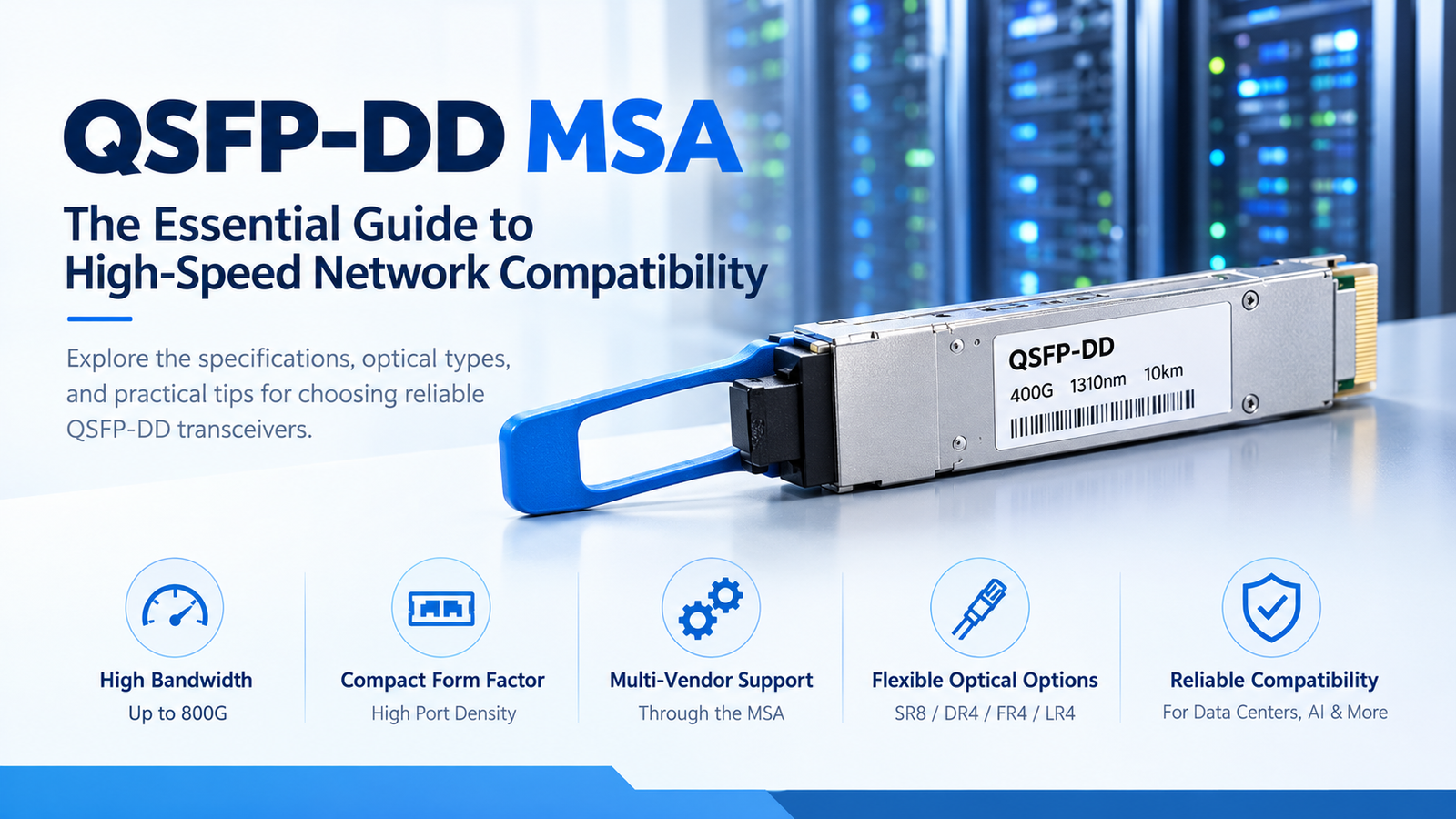
QSFP-DD stands for Quad Small Form-Factor Pluggable Double Density. The QSFP-DD MSA is an industry agreement that defines the module form factor and related interfaces, helping multiple suppliers develop products that follow a common specification.
In simple terms, an MSA provides a shared technical framework. Instead of relying on one manufacturer’s proprietary design, equipment vendors and transceiver suppliers can develop compatible products around an agreed interface.
The term double density refers to the additional electrical interface density compared with the original QSFP form factor. QSFP-DD uses eight electrical lanes on the host interface, enabling higher aggregate bandwidth within a compact module design.
Why Does the QSFP-DD MSA Matter?
Without shared specifications, network equipment manufacturers could face greater integration costs and compatibility challenges. A common interface helps reduce these problems.
The main benefits include:
Multi-vendor development: Different suppliers can develop modules around a common form-factor specification.
Higher bandwidth density: Eight electrical lanes support high aggregate data rates.
Compact design: The form factor helps data centers increase port density without requiring much more rack space.
Flexible optical choices: The platform supports different optical technologies, reach options, and fiber types.
Simplified sourcing: Buyers can evaluate products from multiple suppliers instead of depending on a single source.
Nevertheless, an MSA does not guarantee that every module will work in every switch or router. Device support, firmware, coding, optical specifications, and host implementation still matter.
Key Technical Features of the QSFP-DD MSA
To understand how this platform works, it helps to separate the mechanical design, electrical interface, and optical transmission technology.
1. Eight-Lane Electrical Interface
One of the main features associated with the QSFP-DD form factor is its eight-lane electrical interface. Each lane carries part of the total data stream between the host equipment and the transceiver.
Depending on the generation and implementation, the electrical lanes can use different signaling rates and modulation formats.
For example, 400G implementations commonly use eight electrical lanes operating at approximately 50 Gb/s with PAM4 signaling. PAM4 carries two bits per symbol, which allows higher data rates without requiring the same symbol rate as an equivalent NRZ interface.
However, lane rate alone does not determine the optical reach or fiber type. Those characteristics depend on the transceiver’s optical design.
2. High Port Density
Data centers need to connect large numbers of servers, switches, storage systems, and AI accelerators. Therefore, bandwidth per rack unit has become an important design consideration.
QSFP-DD allows high-speed ports to fit into a relatively compact footprint. As a result, switch designers can provide high aggregate capacity while managing rack space, cabling, power, and cooling.
3. Pluggable Optical Connectivity
QSFP-DD optical modules can be inserted into supported ports and replaced when necessary. This design makes maintenance and network upgrades easier than solutions that require the replacement of an entire line card or system.
In addition, different optical variants can serve different distances. Short-reach multimode modules suit certain data center links, while single-mode solutions support longer connections.
4. Thermal and Power Considerations
Higher bandwidth generally increases the complexity of signal processing and optical transmission. Consequently, power consumption and heat dissipation deserve careful attention.
System designers should check the host platform’s supported module power class, airflow direction, operating temperature, and thermal limits before deployment. A module that fits mechanically may still exceed the platform’s supported power or thermal budget.
QSFP-DD MSA and Supported Data Rates
The QSFP-DD form factor has supported several generations of high-speed connectivity. However, buyers should distinguish the original QSFP-DD platform from later implementations and related standards.
The following table provides a simplified overview.
| Data rate | Typical electrical architecture | Common application |
| 200G | 8 lanes at approximately 25 Gb/s | Selected data center and aggregation links |
| 400G | 8 lanes at approximately 50 Gb/s | High-density switches and cloud networks |
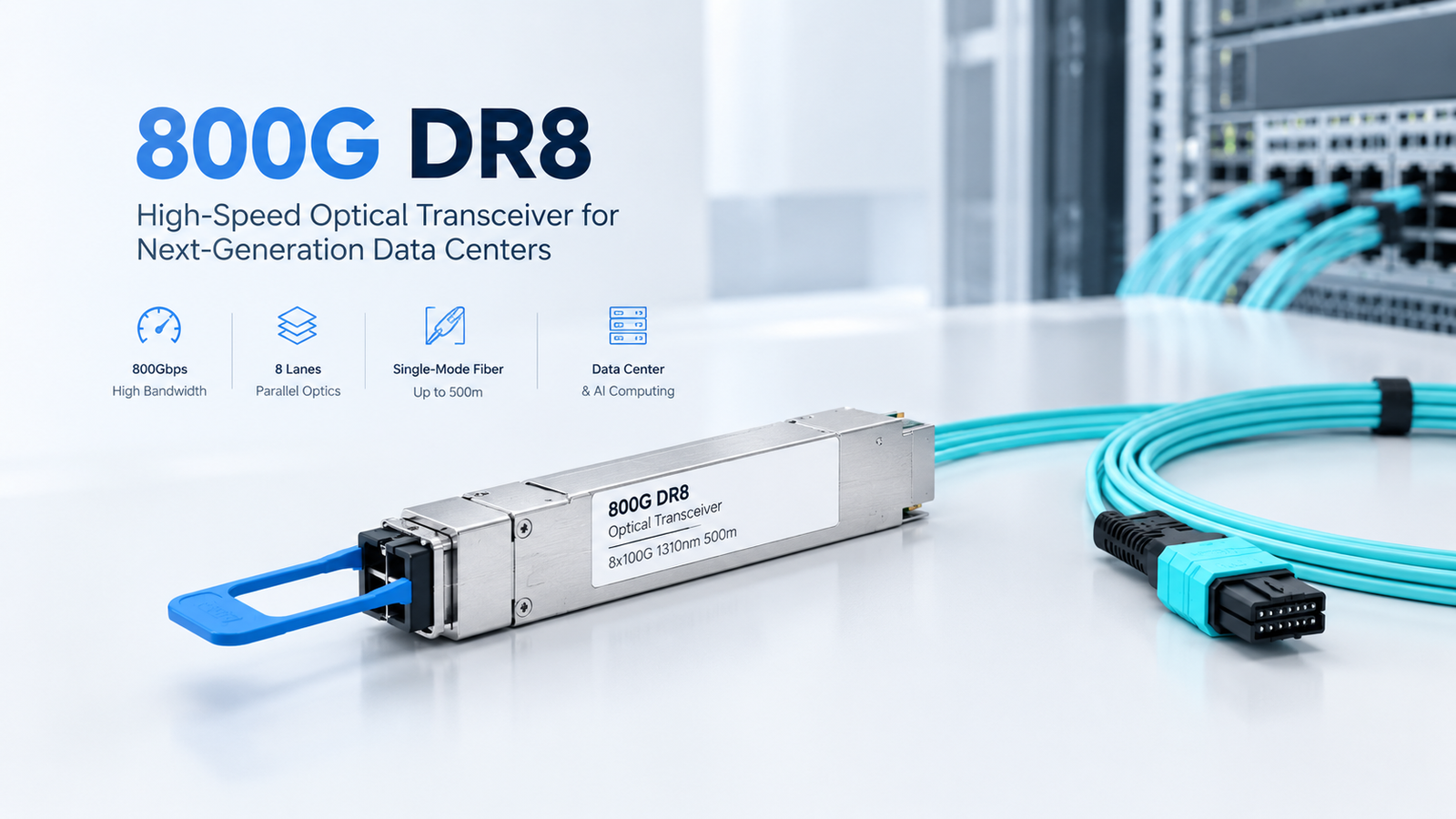
| 800G | Requires an appropriate higher-speed implementation, such as QSFP-DD800 | Next-generation AI and data center networks |
These figures describe representative architectures rather than every possible product. Exact lane rates, encoding, host interfaces, and compliance requirements depend on the applicable specification.
QSFP-DD vs. QSFP-DD800
Although their names look similar, QSFP-DD and QSFP-DD800 should not be treated as interchangeable labels.
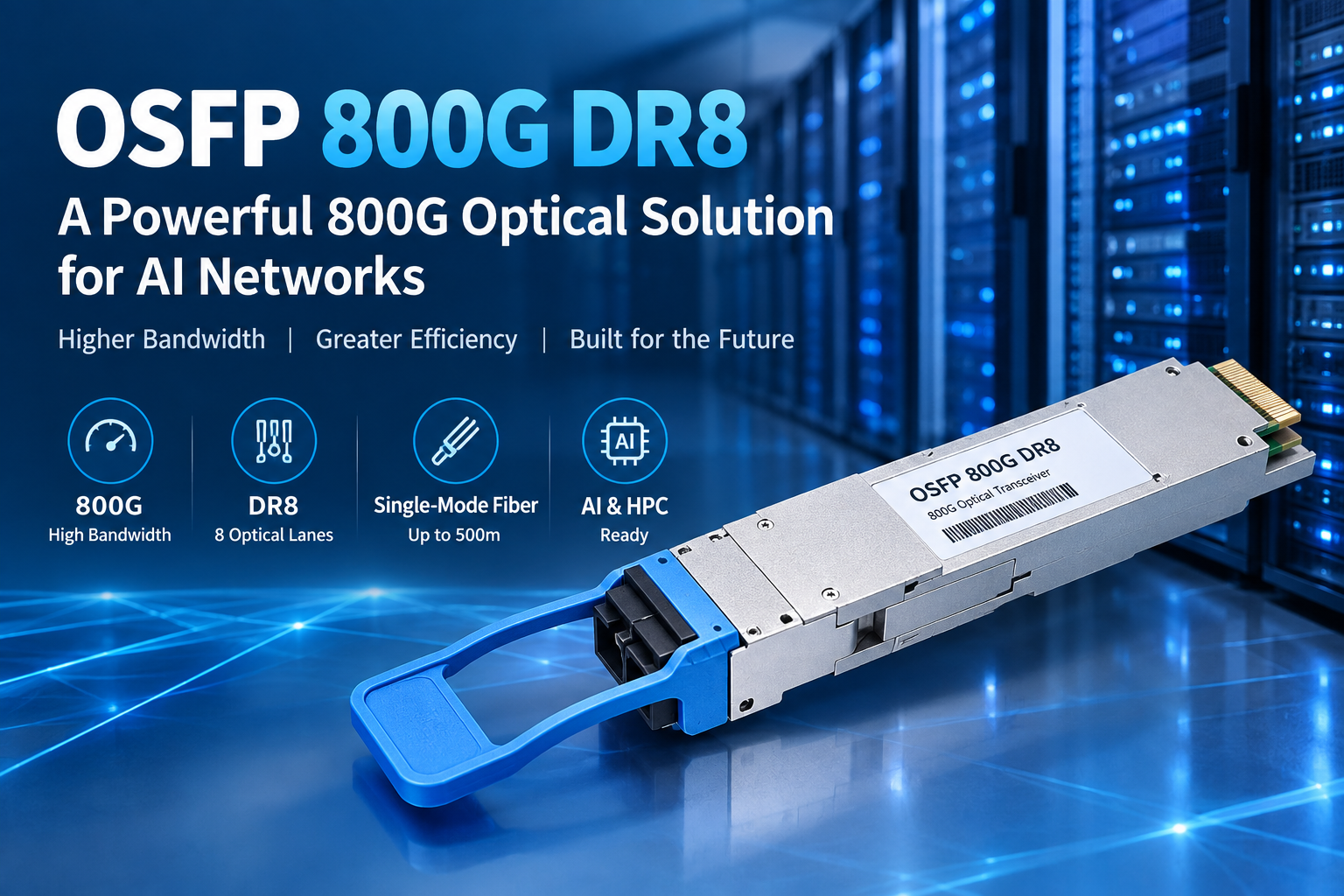
The original QSFP-DD platform supports high-speed implementations such as 400G. QSFP-DD800 extends the concept to an 800G class of connectivity with a corresponding higher-speed electrical interface.
Therefore, a buyer evaluating an 800G switch must verify the exact port specification. Physical resemblance does not establish electrical or protocol compatibility.
QSFP-DD MSA vs. Other Transceiver Standards
QSFP-DD is one of several form factors used in high-speed networking. The right option depends on port density, supported bandwidth, thermal limits, network architecture, and the equipment manufacturer’s design.
| Form factor | Typical bandwidth class | General characteristics | Common use |
| QSFP28 | 100G | Established four-lane architecture | 100G switching and server connectivity |
| QSFP56 | 200G | Higher-speed signaling in a QSFP-family form factor | 200G links |
| QSFP-DD | Up to 400G in common implementations | Eight electrical lanes and compact design | 400G data center networks |
| QSFP-DD800 | 800G class | Higher-speed implementation of the QSFP-DD family | High-capacity cloud and AI infrastructure |
| OSFP | 400G and 800G classes, depending on generation | Different mechanical design and thermal approach | High-density switching and AI clusters |
These are broad product categories, not universal compatibility guarantees. Actual capabilities depend on the module generation and host platform.
QSFP-DD vs. OSFP
Both QSFP-DD and OSFP address high-bandwidth networking, but their mechanical designs differ.
QSFP-DD builds on the QSFP ecosystem, which can make it attractive for equipment designs that prioritize a familiar port footprint. OSFP uses a different, slightly larger form factor that supports the thermal and electrical needs of high-speed modules.
Neither form factor is automatically better in every deployment. Network operators should compare switch support, module power limits, port density, cooling requirements, and the availability of compatible optics before making a decision.
Optical Types Used in QSFP-DD Networks
The MSA defines the module platform; it does not mean that every module uses the same optical specification. Optical interfaces follow their own applicable standards or specifications.
As a result, buyers must choose an optical variant that matches the required reach, fiber type, wavelength, and link architecture.
Common 400G Optical Options
| Optical type | Typical reach or use | Fiber | Connector or interface |
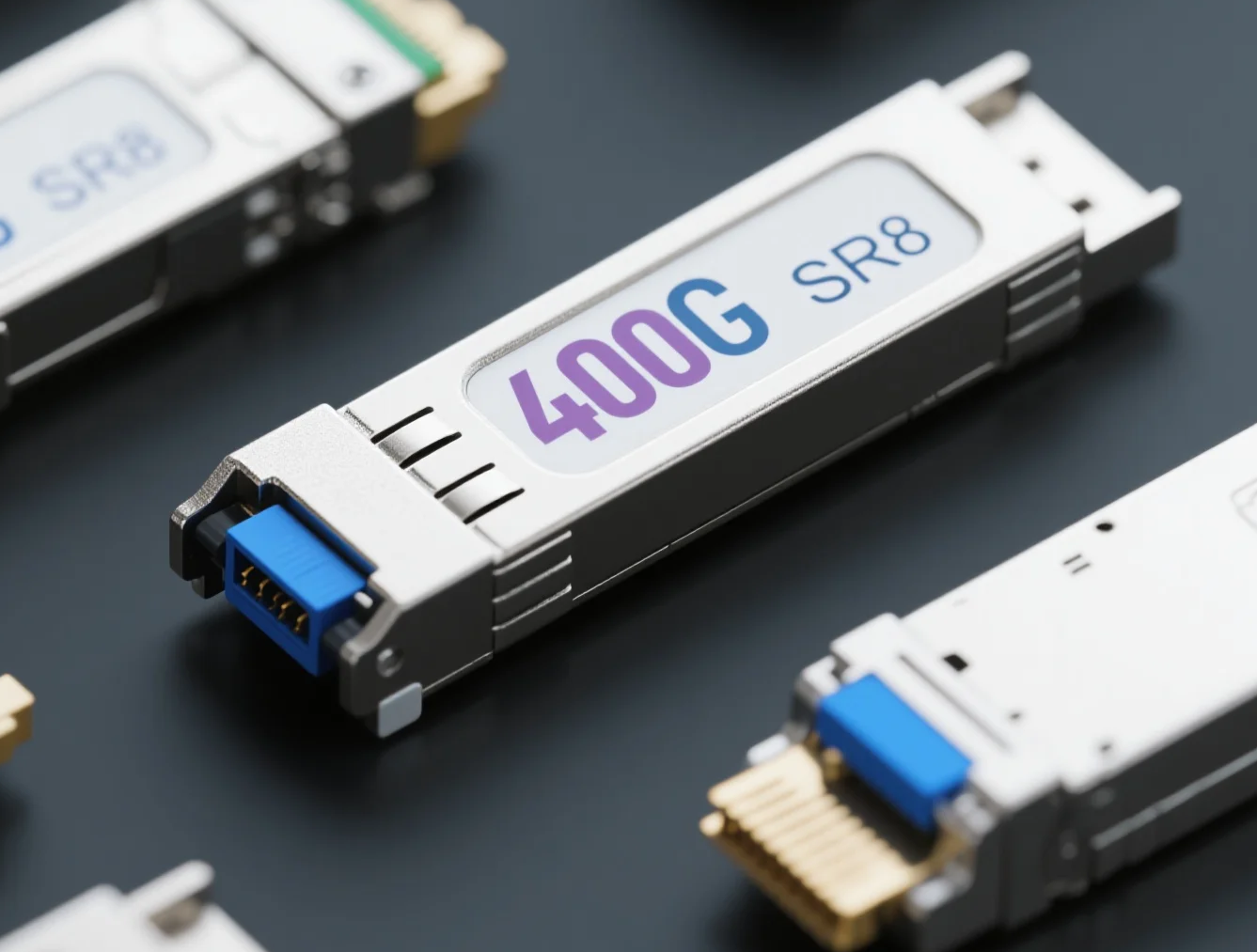
| 400G SR8 | Commonly up to 100 m on OM4 under applicable specifications | Multimode | MPO-16 or specified parallel-fiber interface |
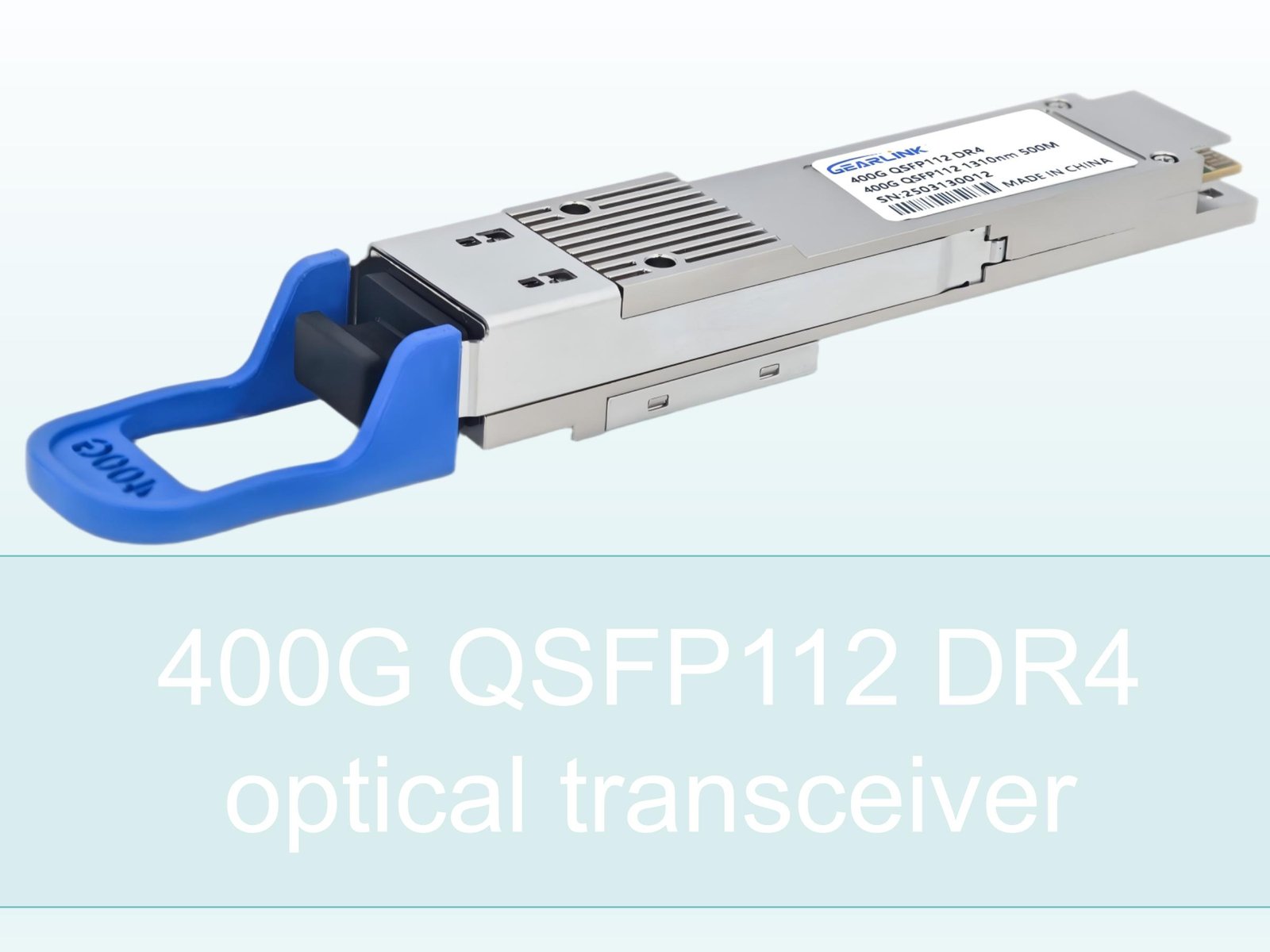
| 400G DR4 | Commonly up to 500 m | Single-mode | MPO-12 |
| 400G FR4 | Commonly up to 2 km | Single-mode | Duplex LC |
| 400G LR4 | Commonly up to 10 km in applicable implementations | Single-mode | Duplex LC |
These values represent common specifications, not every vendor’s product. Always check the product datasheet for the exact reach, connector, wavelength, and fiber requirements.
How Should Buyers Choose an Optical Variant?
First, determine the actual distance between the two network devices. Next, identify the available fiber infrastructure and connector type. Finally, verify the host port’s supported optical standard.
For example, a short in-rack connection may favor a multimode solution if the equipment and fiber plant support it. By contrast, a longer connection between data center areas may require single-mode fiber.
Furthermore, buyers should check whether the link uses parallel fibers or wavelength multiplexing. Two modules can both carry 400G yet use different optical architectures and connectors.
QSFP-DD MSA and Equipment Compatibility
Compatibility is one of the most important considerations when purchasing optical transceivers. Even when two products use the same form factor and data rate, their practical compatibility can differ.
1. Check the Host Port Specification
Start with the switch or router documentation. Confirm the supported form factor, data rate, optical standards, and port configuration.
Do not assume that a port supporting QSFP-DD at 400G also supports every 200G module or every 800G implementation.
2. Verify Vendor Coding and Firmware
Some network platforms use vendor identification or configuration checks to determine whether a transceiver is supported. Others may require a specific firmware version or approved compatibility profile.
Before placing a large order, confirm whether the target equipment accepts third-party modules and whether any configuration steps are necessary.
3. Match the Optical Interface
Check the wavelength, fiber type, reach, connector, and optical specifications at both ends of the link. The two modules must use compatible optical interfaces.
For example, a duplex-LC single-mode module cannot directly replace an MPO-based parallel-fiber module simply because both products support the same aggregate bandwidth.
4. Confirm Monitoring and Operating Limits
Digital diagnostics can provide useful information about temperature, voltage, optical transmit power, and receive power when supported by the module and host system.
Additionally, review operating temperature, power consumption, airflow direction, and any relevant interoperability requirements before deployment.
Practical Applications of QSFP-DD MSA Technology
The combination of high bandwidth and a compact form factor makes this technology useful across several networking environments.
Cloud Data Centers
Cloud operators connect large numbers of servers and storage systems through high-capacity switching fabrics. QSFP-DD-based modules can provide the bandwidth needed for aggregation and spine-leaf architectures.
AI and High-Performance Computing
AI training clusters generate substantial traffic between accelerators and network switches. High-speed optical links help support these workloads, especially when systems require large numbers of connections over different distances.
However, the module alone does not determine overall network performance. Switch architecture, congestion control, cabling, and the end-to-end topology also matter.
Enterprise and Telecom Networks
Large enterprises and telecom operators may use high-speed pluggable optics in core, aggregation, and data center interconnect environments. The specific optical variant depends on the required distance, infrastructure, and equipment support.
Network Upgrades
A modular optical platform can help operators expand capacity as demand grows. Nevertheless, any upgrade plan should account for host compatibility, port availability, cooling, fiber infrastructure, and the costs of replacing related network components.
How to Select a QSFP-DD Transceiver
The QSFP-DD MSA provides a common form-factor framework, but buyers still need to compare product-level specifications.
Use the following checklist when evaluating suppliers.
| Selection factor | What to verify |
| Data rate | Confirm the required 200G, 400G, or supported 800G implementation |
| Host compatibility | Check the exact switch or router model and software requirements |
| Transmission distance | Match the module reach to the real link distance |
| Fiber type | Confirm single-mode or multimode infrastructure |
| Connector | Verify LC, MPO, or another specified interface |
| Wavelength | Ensure the optical specifications match both ends |
| Power and cooling | Check the host’s power budget and airflow requirements |
| Diagnostics | Confirm support for DDM/DOM or the required monitoring functions |
| Compliance | Request applicable standards and product test information |
| Warranty and support | Review warranty terms, technical assistance, and replacement procedures |
For business-critical links, a small-scale compatibility test can reduce deployment risk. Test the module in the intended host, check link establishment, review diagnostic readings, and run traffic tests before expanding the installation.
Common Mistakes to Avoid
Several purchasing mistakes can create unnecessary costs or delays.
Mistake 1: Treating the MSA as an optical specification. The QSFP-DD MSA defines the platform and interfaces; it does not make every optical variant identical.
Mistake 2: Assuming all modules with the same connector are interchangeable. Wavelength, lane mapping, modulation, and reach may differ.
Mistake 3: Confusing QSFP-DD with QSFP-DD800. The names are related, but the supported electrical interface and data rate must match the host.
Mistake 4: Ignoring power and cooling. High-speed transceivers can have different power and thermal requirements, even when they share a similar appearance.
Mistake 5: Skipping compatibility checks. A datasheet review and a test in the target platform can prevent avoidable integration problems.
Conclusion
The QSFP-DD MSA provides an important foundation for high-density, high-speed networking by establishing a common form-factor framework for the industry. It supports the development of interoperable products while giving data center operators greater flexibility when planning network capacity.
At the same time, successful deployment requires more than selecting a module by name. Buyers must confirm the exact generation, data rate, optical interface, transmission distance, host support, and operating requirements.
By understanding these factors, network engineers and procurement teams can select transceivers with greater confidence, reduce compatibility risks, and plan scalable connectivity for evolving cloud, enterprise, and AI infrastructure.
Frequently Asked Questions
1. What does QSFP-DD MSA mean?
QSFP-DD MSA refers to the Multi-Source Agreement for the Quad Small Form-Factor Pluggable Double Density platform. It establishes shared specifications for the module form factor and related interfaces so that multiple suppliers can develop products around a common design.
2. Does the QSFP-DD MSA guarantee compatibility between all vendors?
No. The QSFP-DD MSA helps standardize the form factor and interfaces, but compatibility also depends on the host device, firmware, module coding, electrical interface, and optical specification. Buyers should verify support for the exact equipment model.
3. What is the difference between QSFP-DD and QSFP-DD800?
QSFP-DD commonly refers to implementations such as 400G, while QSFP-DD800 refers to the 800G class of implementations. Their electrical interfaces and host requirements differ, so buyers must check the relevant specifications before selecting a module.
4. Which optical types are available for QSFP-DD transceivers?
Common 400G optical options include SR8 for certain short-reach multimode links and DR4, FR4, and LR4 for different single-mode applications. The correct option depends on reach, fiber type, connector, and host support.
5. How can I choose a compatible QSFP-DD MSA transceiver?
Identify the host switch or router model, required data rate, transmission distance, fiber type, connector, and supported optical standard. Then review the supplier’s datasheet and test the module in the intended equipment before large-scale deployment.