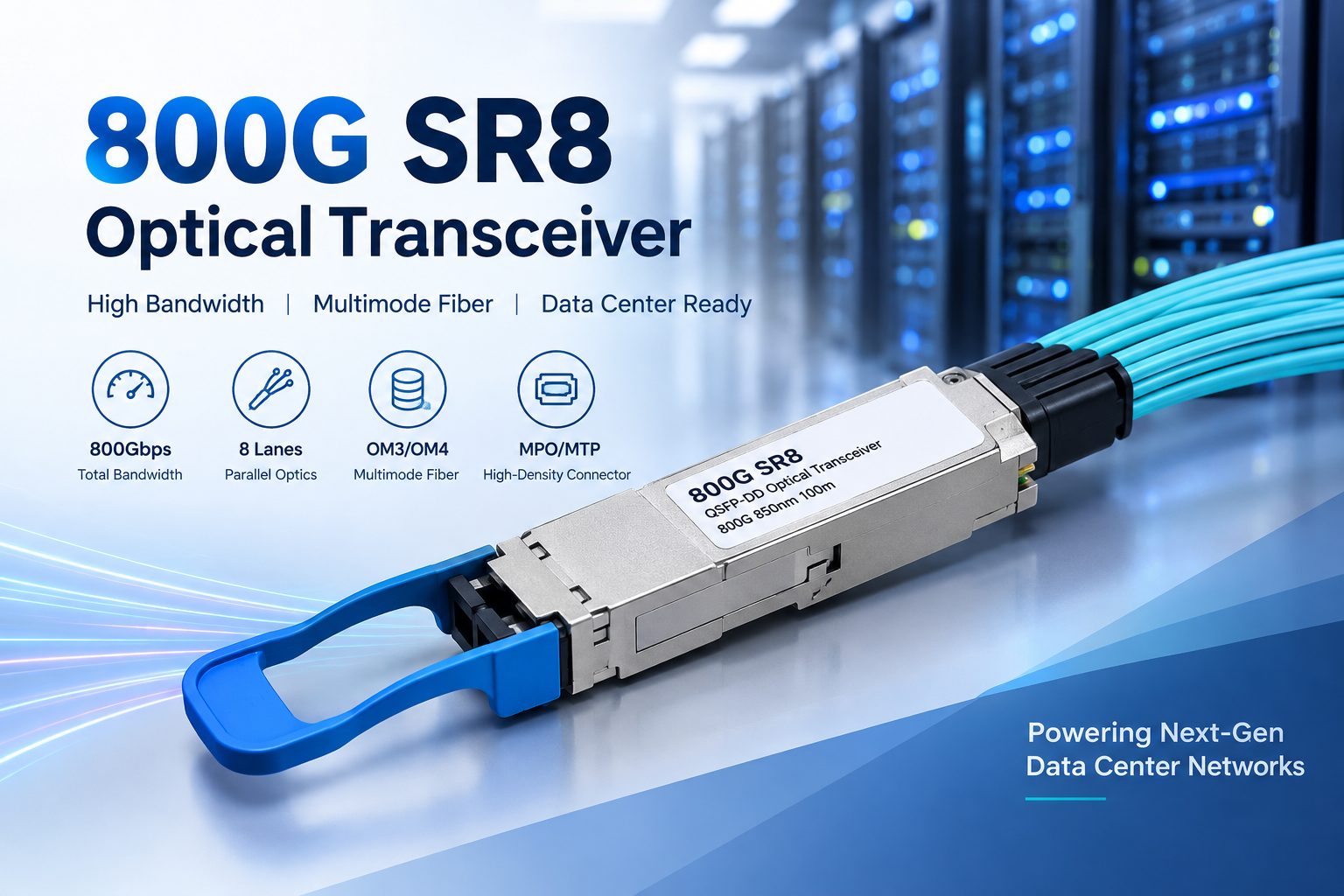
As data centers continue to handle AI workloads, cloud computing, and large-scale distributed applications, network bandwidth has become increasingly important. The 800g sr8 optical transceiver is designed for this environment, providing an 800Gbps connection over multimode fiber while keeping the optical architecture relatively simple.
Compared with earlier 400G solutions, 800G optical technology provides twice the bandwidth per port. At the same time, the use of parallel multimode transmission allows an 800g sr8 solution to support short-reach data center connections without requiring expensive single-mode fiber infrastructure.
For data center operators, network equipment manufacturers, system integrators, and optical transceiver buyers, understanding how this technology works is important. Therefore, this guide explains the optical design, fiber requirements, connector configuration, transmission distance, electrical interface, application scenarios, and key selection factors in simple terms.
What Is 800g sr8?
The 800g sr8 is an 800Gbps short-reach optical transceiver designed for high-speed data center interconnections. “800G” represents the total data rate, while “SR8” generally refers to short-reach transmission using eight parallel optical channels.
In a typical implementation, eight optical lanes are used for transmission. Each lane operates at approximately 100Gbps, resulting in:
| Parameter | Typical Description |
| Total data rate | 800Gbps |
| Optical lanes | 8 |
| Data rate per lane | 100Gbps |
| Fiber type | Multimode fiber |
| Typical wavelength | 850nm |
| Transmission type | Parallel optics |
| Application | Short-reach data center links |
| Typical connector | MPO/MTP |
| Common fiber | OM3 / OM4 |
| Module form factor | QSFP-DD 800G or OSFP, depending on design |
The exact electrical and mechanical implementation can vary between manufacturers. Nevertheless, the basic concept remains similar: multiple 100G optical lanes are combined to provide an aggregate 800G connection.
Because the solution is designed for short-distance transmission, it is particularly suitable for connections inside modern data centers.
How Does an 800g sr8 Transceiver Work?
To understand an 800g sr8 module, it helps to think of the transceiver as eight smaller optical connections working together.
Instead of sending the entire 800Gbps signal through a single optical channel, the data is divided into multiple lanes. Each lane carries part of the total information.
For example:
8 optical lanes × 100Gbps per lane = 800Gbps
At the transmitting side, the electrical data from the switch or network device is converted into optical signals. These signals are then transmitted through multiple multimode fiber cores.
At the receiving side, the optical signals are converted back into electrical data.
A simplified signal path looks like this:
Network Switch → Electrical Lanes → Optical Conversion → 8 Fiber Lanes → Optical Conversion → Electrical Lanes → Network Switch
This parallel architecture makes very high bandwidth possible while maintaining a relatively short optical reach.
800g sr8 Optical Lane Architecture
The optical architecture can be simplified as follows:
| Lane | Data Rate | Typical Wavelength | Fiber |
| Lane 1 | 100G | 850nm | MMF |
| Lane 2 | 100G | 850nm | MMF |
| Lane 3 | 100G | 850nm | MMF |
| Lane 4 | 100G | 850nm | MMF |
| Lane 5 | 100G | 850nm | MMF |
| Lane 6 | 100G | 850nm | MMF |
| Lane 7 | 100G | 850nm | MMF |
| Lane 8 | 100G | 850nm | MMF |
Therefore, the total optical capacity reaches 800Gbps.
This approach is easy to understand: rather than making one optical lane extremely fast, the system uses several high-speed lanes in parallel.
Why Is 800g sr8 Important for Modern Data Centers?
The rapid growth of artificial intelligence and cloud computing has changed the requirements of data center networks.
AI clusters, GPU servers, storage systems, and high-performance computing platforms can generate huge amounts of traffic. Consequently, traditional 100G and 400G connections are increasingly being replaced by 800G and higher-speed technologies.
The 800g sr8 solution can be useful in short-reach environments because it combines high bandwidth with multimode fiber.
Several benefits make this approach attractive.
Higher Port Bandwidth
An 800G port can carry twice the aggregate bandwidth of a 400G port.
As a result, fewer ports may be required to achieve the same total network capacity.
For example:
| Network Speed | Relative Bandwidth |
| 100G | 1× |
| 200G | 2× |
| 400G | 4× |
| 800G | 8× |
| 1.6T | 16× |
This increase is especially valuable in AI data centers where server-to-server traffic can be extremely high.
Efficient Short-Reach Connectivity
Many data center connections do not need to travel several kilometers.
Servers may be located within the same rack, adjacent racks, or nearby rows. In these cases, long-reach single-mode optics may provide more capability than necessary.
Instead, an 800g sr8 module can provide high bandwidth for short-reach multimode links.
Multimode Fiber Can Reduce Infrastructure Complexity
Multimode fiber has historically been widely used for short data center connections.
When OM3 or OM4 fiber infrastructure is already available, a compatible 800G multimode solution can potentially reduce the need for new single-mode cabling.
However, compatibility must always be checked against the specific module, switch, fiber type, and link budget.
800g sr8 and Multimode Fiber
One of the most important characteristics of 800g sr8 is its use of multimode fiber.
Multimode fiber is designed to carry multiple optical modes through a relatively large fiber core. It is commonly used for short-distance data center applications.
Two common fiber types are OM3 and OM4.
| Fiber Type | Typical Core | Common Application |
| OM3 | 50/125 μm | High-speed data center links |
| OM4 | 50/125 μm | Higher-performance MMF links |
OM4 generally provides better modal bandwidth performance than OM3. Therefore, depending on the required distance and optical specification, OM4 may provide more margin.
Importantly, the maximum supported distance should not be assumed only from the fiber category. The transceiver specification and complete optical link budget should always be checked.
OM3 vs OM4 for 800G SR8
For an 800g sr8 deployment, the choice between OM3 and OM4 should be based on the actual distance and system specification.
| Factor | OM3 | OM4 |
| Fiber type | Multimode | Multimode |
| Core size | 50/125 μm | 50/125 μm |
| Modal bandwidth | Lower | Higher |
| Short-reach data center use | Yes | Yes |
| Longer MMF reach | More limited | Better |
| Typical cost | Lower | Slightly higher |
For new installations, OM4 is often attractive because it provides additional performance margin. Nevertheless, OM3 can remain suitable for many short connections when the complete system specification allows it.
What Connector Is Used by 800g sr8?
An 800g sr8 module normally requires multiple optical fibers because eight optical lanes must be connected.
Therefore, a high-density MPO or MTP connector is commonly used.
A typical parallel-fiber arrangement can contain eight transmit or receive fibers, depending on the optical architecture and breakout configuration.
For example:
800G Transceiver → MPO/MTP Fiber → 8 Optical Channels
The connector itself is not simply an ordinary duplex LC connection. Instead, the high-density connector allows multiple fiber cores to be handled within a single interface.
Why MPO/MTP Is Useful
MPO/MTP connectors make high-density cabling easier to manage.
They are particularly useful when many 400G, 800G, and future higher-speed links are installed in a limited rack space.
However, polarity must be considered carefully. Incorrect polarity can prevent the optical link from operating.
Therefore, technicians should check:
MPO/MTP polarity
Fiber count
Connector type
Fiber gender
OM3 or OM4 compatibility
Transmit and receive lane mapping
Breakout configuration
A correct optical connection is just as important as selecting the correct transceiver.
800g sr8 vs 800G Single-Mode Solutions
Not every 800G application should use multimode fiber.
For longer-distance connections, single-mode optical technologies such as DR8 or 2×FR4 may be more appropriate.
The main difference is the fiber architecture.
| Feature | 800G SR8 | 800G DR8 |
| Fiber | Multimode | Single-mode |
| Typical wavelength | 850nm | Around 1310nm |
| Optical architecture | Parallel | Parallel |
| Reach | Short | Longer |
| Connector | Commonly MPO/MTP | Commonly MPO/MTP |
| Main environment | Data center short reach | Data center longer reach |
| Fiber cost | Generally lower | Generally higher |
In simple terms, SR8 is focused on short-reach multimode connections, while DR8 is intended for longer-reach single-mode connections.
Therefore, the right choice depends heavily on the physical distance between network devices.
800g sr8 vs 400G SR4
Another useful comparison is between 800g sr8 and 400G SR4.
The basic architecture is similar because both use parallel optical lanes. However, the total bandwidth and lane count are different.
| Feature | 400G SR4 | 800G SR8 |
| Total speed | 400Gbps | 800Gbps |
| Optical lanes | 4 | 8 |
| Approx. lane speed | 100G | 100G |
| Fiber | MMF | MMF |
| Wavelength | Typically 850nm | Typically 850nm |
| Connector | MPO/MTP | MPO/MTP |
| Primary use | Short-reach data center | High-density short-reach data center |
This comparison shows why 800G is not simply a faster version of 400G. The number of optical lanes and the overall system architecture must also be considered.
For networks moving from 400G to 800G, cabling design therefore becomes increasingly important.
What Equipment Can Use 800g sr8?
An 800g sr8 transceiver is normally used with high-speed Ethernet switches, network devices, and data center infrastructure designed for 800G connectivity.
Typical application environments include:
AI clusters
GPU data centers
Cloud computing infrastructure
High-performance computing
Data center spine networks
Leaf-spine architectures
High-speed server interconnects
Large-scale storage networks
However, a transceiver should not be selected based only on its speed.
The host device must support the appropriate optical module form factor, electrical interface, lane rate, FEC configuration, and management functions.
Switch Compatibility
Before purchasing an 800G module, buyers should confirm:
The switch supports 800G optical modules.
The module form factor is compatible.
The electrical lane configuration is supported.
The optical specification matches the switch.
The expected fiber type is supported.
The link distance falls within the optical budget.
DOM or DDM monitoring is supported if required.
Vendor coding or interoperability requirements are satisfied.
This is especially important for third-party optical modules.
800g sr8 Electrical Interface Considerations
Optical specifications are only one part of an 800G connection.
The electrical side is equally important.
An 800G module may use multiple high-speed electrical lanes between the host switch and the transceiver. Depending on the module generation and implementation, the electrical interface may be based on 100G-class PAM4 lanes.
PAM4 is important because it allows more data to be transmitted per electrical symbol than traditional NRZ signaling.
Instead of two signal levels, PAM4 uses four amplitude levels.
In simple terms:
NRZ → 2 signal levels
PAM4 → 4 signal levels
This allows higher data rates without simply doubling the physical signaling frequency.
However, PAM4 is also more sensitive to signal integrity and noise. Therefore, DSP, FEC, equalization, and high-quality PCB design become important in high-speed 800G systems.
The Role of DSP and FEC in 800G Optical Modules
Modern high-speed optical systems often rely on advanced signal processing.
DSP stands for Digital Signal Processor. It processes electrical and optical signals to help compensate for distortion and maintain reliable transmission.
FEC means Forward Error Correction.
Instead of simply detecting errors, FEC adds redundant information so that certain errors can be corrected at the receiving side.
For 800G systems, these technologies can be particularly important because the signaling speed is very high.
Therefore, when selecting an 800g sr8 module, it is useful to understand not only the optical specifications but also:
DSP architecture
PAM4 signaling
FEC requirements
Host electrical interface
Signal integrity
Firmware compatibility
Module management interface
These details can affect interoperability between a transceiver and a switch.
Key Specifications to Check Before Buying 800g sr8
Choosing the right 800g sr8 module requires more than checking the headline 800Gbps speed.
The following parameters should be reviewed carefully.
| Specification | Why It Matters |
| Form factor | Determines physical compatibility |
| Data rate | Confirms 800G operation |
| Optical lanes | Determines fiber architecture |
| Wavelength | Must match optical design |
| Fiber type | Determines suitable cabling |
| Transmission distance | Must cover the actual link |
| Connector | Must match the cable |
| Tx power | Important for link budget |
| Rx sensitivity | Determines receiving capability |
| Power consumption | Important for high-density switches |
| Operating temperature | Important for data center environments |
| DOM/DDM | Useful for monitoring |
| FEC | Important for interoperability |
| Host compatibility | Determines whether the switch can use the module |
For large-scale deployment, power consumption should receive special attention.
Thousands of high-speed optical modules can be installed in a large AI or cloud data center. Even a small difference in power consumption per module can therefore become significant at the system level.
800g sr8 Applications in AI and Cloud Networks
AI infrastructure is one of the major drivers behind the adoption of 800G networking.
Modern GPU clusters generate extremely high east-west traffic. GPUs frequently exchange model parameters, training data, and intermediate results with other GPUs.
As a result, network bandwidth can directly influence cluster efficiency.
An 800g sr8 solution can be used for short-reach connections where multimode fiber is appropriate.
For example:
GPU Server → High-Speed Switch → Spine Network → High-Speed Switch → GPU Server
When these connections are relatively short, SR-class optics can provide a practical approach to increasing bandwidth.
Furthermore, 800G ports can help reduce the number of physical ports required for a given aggregate bandwidth.
Installation Considerations for 800g sr8
A successful deployment requires attention to the complete optical link rather than the transceiver alone.
First, verify the fiber type. OM3 and OM4 are both multimode fibers, but their performance is different.
Next, check the connector and polarity.
Then, confirm the optical distance.
Finally, test the complete link after installation.
A simple installation checklist is shown below:
| Step | Check |
| 1 | Confirm 800G switch port support |
| 2 | Confirm module form factor |
| 3 | Verify SR8 optical specification |
| 4 | Select compatible OM3/OM4 fiber |
| 5 | Confirm MPO/MTP connector |
| 6 | Check polarity |
| 7 | Confirm transmission distance |
| 8 | Check optical power |
| 9 | Verify FEC and host compatibility |
| 10 | Test link stability |
By following these steps, many common installation problems can be avoided.
Common Problems With 800g sr8 Deployments
Although the technology is powerful, installation issues can still occur.
Link Does Not Come Up
A link may fail to establish because the switch does not support the specific transceiver, the fiber polarity is incorrect, or the module coding is incompatible.
High Optical Loss
Dirty connectors, excessive bends, poor-quality fiber, or unsuitable patch cables can increase insertion loss.
Therefore, connectors should be cleaned and inspected before installation.
Distance Exceeds the Specification
SR optics are designed for short-reach applications. If the fiber distance is too long, the received optical power may become insufficient.
In that case, a single-mode solution may be more appropriate.
Host and Module Interoperability
Different vendors may implement high-speed electrical interfaces and management functions differently.
Therefore, compatibility should be tested before large-scale deployment.
How to Choose the Right 800G Optical Solution
The best optical module depends on the network topology.
For very short multimode connections, an 800g sr8 module can be a strong option.
For longer single-mode connections, however, DR8, FR4, or other 800G technologies may be more appropriate.
A simple selection guide is shown below:
| Network Requirement | Recommended Direction |
| Short reach + MMF | 800G SR8 |
| Longer reach + SMF | 800G DR8 |
| Duplex LC connectivity | Consider 800G FR4 |
| Existing OM4 infrastructure | SR-class solution may be suitable |
| High-density AI network | 800G-class optics |
| Long-distance data center interconnect | Single-mode solution |
The final selection should always be based on the actual equipment, distance, cabling, and interoperability requirements.
Future Development of 800g sr8 Technology
The transition from 400G to 800G is part of a larger movement toward 1.6T and beyond.
As AI clusters become larger, the bandwidth required between switches and servers will continue to increase.
At the same time, optical modules are expected to become more power-efficient and easier to deploy.
Future developments may include:
Higher-speed electrical interfaces
Improved DSP efficiency
Lower-power optical engines
More advanced PAM4 technology
Linear-drive optical architectures
Co-packaged optics
Higher-density fiber connections
1.6T optical transceivers
Although higher-speed technologies are developing rapidly, 800G remains an important generation for current data center upgrades.
Final Thoughts on 800g sr8
The 800g sr8 optical transceiver provides a practical way to achieve 800Gbps connectivity over short-reach multimode fiber. By using eight parallel optical lanes, it delivers high bandwidth while fitting naturally into high-density data center environments.
More importantly, its value is not limited to raw speed. The combination of 800G bandwidth, parallel optics, multimode fiber, and high-density MPO/MTP connectivity makes this technology particularly relevant to AI clusters, cloud infrastructure, and modern Ethernet networks.
However, the right transceiver should always be selected according to the complete link design. Fiber type, distance, connector polarity, host compatibility, electrical interface, FEC, DSP, power consumption, and module coding can all affect actual network performance.
Therefore, when planning an 800G deployment, 800g sr8 can be considered an attractive option for short-reach multimode connections, while other 800G optical technologies should be evaluated when longer distances or different cabling architectures are required.
Frequently Asked Questions About 800g sr8
1. What is 800g sr8?
The 800g sr8 is an 800Gbps short-reach optical transceiver that typically uses eight parallel optical lanes and multimode fiber for high-speed data center connectivity.
2. What fiber is used with 800g sr8?
An 800g sr8 solution typically uses 50/125 μm multimode fiber, such as OM3 or OM4. The supported distance depends on the specific transceiver and fiber specification.
3. What connector does 800g sr8 use?
Because eight parallel optical lanes are used, 800g sr8 modules commonly use high-density MPO/MTP connectors. The exact connector configuration should be checked against the module datasheet.
4. What is the difference between 800g sr8 and 800G DR8?
The main difference is the fiber and reach. 800g sr8 is generally designed for short-reach multimode connections, while 800G DR8 is designed for longer-reach single-mode connections.
5. Is 800g sr8 suitable for AI data centers?
Yes. 800g sr8 can be suitable for short-reach connections in AI and high-performance data centers, especially where high bandwidth and existing multimode fiber infrastructure are important considerations.