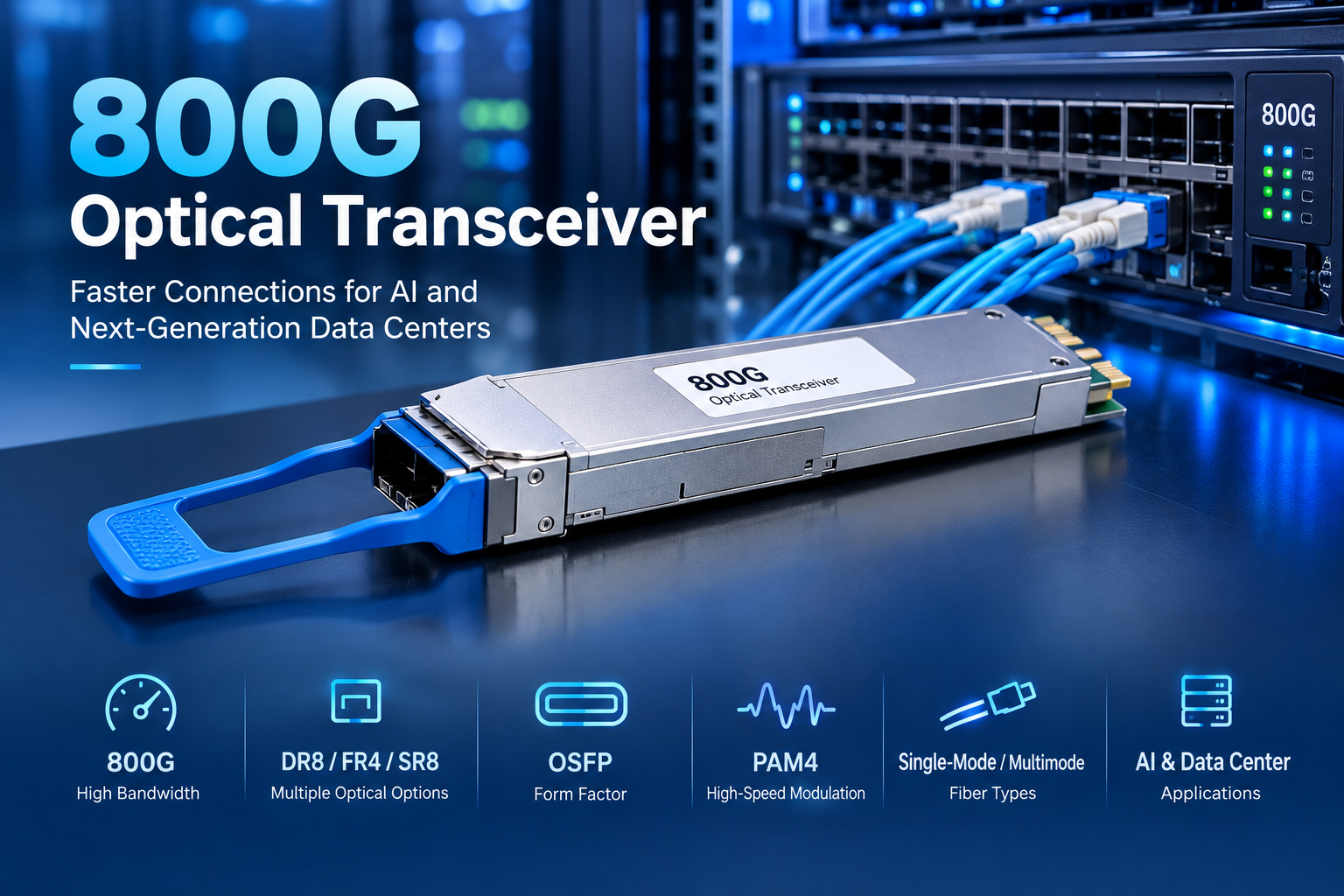
As AI computing, cloud services, and high-performance data centers continue to expand, network bandwidth has become a critical part of overall system performance. An 800G optical transceiver provides a practical way to move massive amounts of data between switches, servers, GPUs, and other high-speed networking equipment.
Compared with 400G solutions, an 800G optical transceiver can provide twice the nominal bandwidth in a single module. More importantly, it can help network operators increase port density without simply doubling the physical space used by optical interfaces.
Today, 800G connectivity is being adopted in AI clusters, hyperscale data centers, high-performance computing environments, and other bandwidth-intensive applications. At the same time, several optical architectures are available, including DR8, SR8, VR8, FR4, and 2×400G designs. Therefore, selecting the right solution requires more than looking at the transmission rate.
This guide explains how 800G optical transceiver technology works, the main form factors and optical architectures, typical applications, key specifications, and the practical factors that should be checked before deployment.
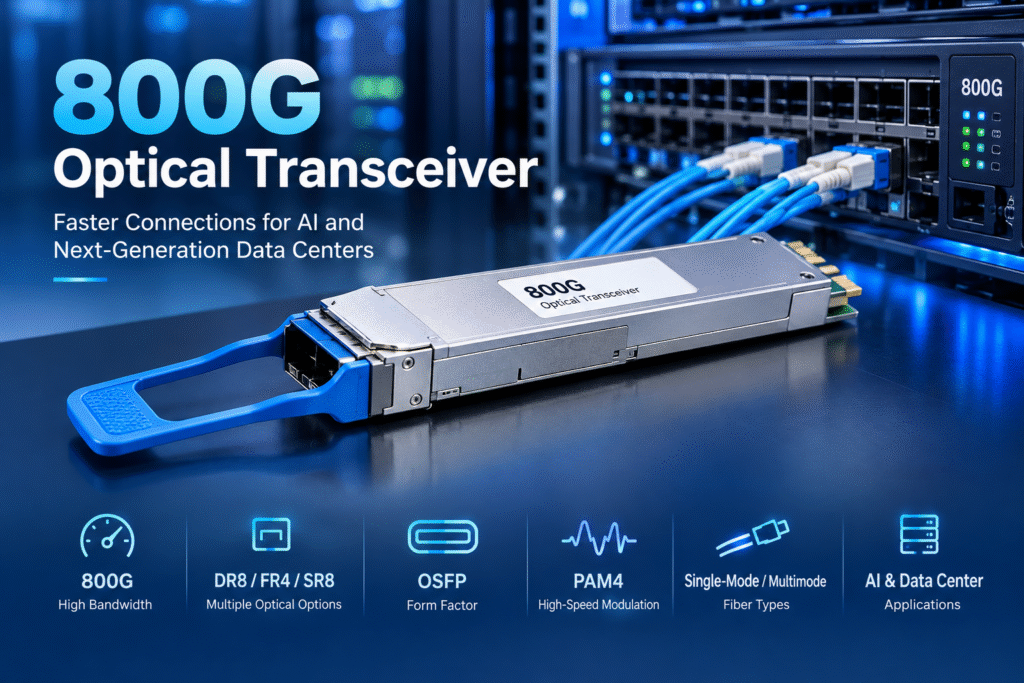
What Is an 800G Optical Transceiver?
An 800G optical transceiver is a high-speed networking module designed to transmit and receive up to 800 gigabits of data per second over optical fiber.
In simple terms, it works as a bridge between electrical signals inside a switch or server and optical signals traveling through fiber.
A typical optical link contains several important elements:
| Component | Main Function |
| Host electrical interface | Connects the module to the switch or NIC |
| DSP or signal processing | Manages high-speed electrical/optical signal processing |
| Optical transmitter | Converts electrical data into optical signals |
| Optical receiver | Converts optical signals back into electrical data |
| Fiber interface | Connects the module to the optical cable |
| Monitoring interface | Provides temperature, voltage and optical diagnostics |
The actual architecture varies between products. For example, some modules use eight optical lanes at approximately 100G per lane, while other designs divide the 800G capacity into two 400G optical interfaces.
Cisco’s current 800G portfolio includes 800GBASE-DR8 and 2×400G FR4 solutions, while NVIDIA offers 800G Twin-port OSFP products for both Ethernet and InfiniBand environments.
Therefore, 800G optical transceiver should be treated as a broad product category rather than one fixed optical specification.
Why 800G Optical Transceiver Technology Matters
The growth of generative AI and accelerated computing is changing the requirements of data center networks.
Modern GPU clusters can generate enormous amounts of east-west traffic. GPUs need to exchange model parameters, training data, intermediate results, and other information at very high speed. As a result, network bandwidth can become a limiting factor if the interconnect infrastructure does not scale at the same pace.
An 800G optical transceiver addresses this challenge by increasing the amount of data that can be transported through each high-speed optical port.
There are several important advantages.
Higher Bandwidth per Port
An 800G interface can provide twice the nominal bandwidth of a 400G interface.
This makes it possible to connect high-performance switches and network devices with fewer physical ports for the same aggregate capacity.
Higher Port Density
Data center operators are often limited by rack space, power consumption, cooling capacity, and switch port density.
Consequently, higher-speed optical interfaces can help deliver more network capacity within a similar physical footprint.
Better Support for AI Clusters
AI clusters often rely on large numbers of GPUs connected through high-speed networks.
An 800G optical transceiver can be used for switch-to-switch and switch-to-compute connectivity where very high throughput is required.
Easier Network Scaling
As network traffic increases, moving from 400G toward 800G can provide additional bandwidth without requiring a complete change in the overall optical networking concept.
Of course, compatibility with the switch ASIC, NIC, firmware, optical interface, and fiber infrastructure must still be confirmed.
How Does an 800G Optical Transceiver Work?
The basic working principle is easier to understand when the electrical and optical sides are separated.
First, a high-speed switch generates electrical signals. These signals are delivered to the transceiver through the host interface.
Next, the module processes the electrical signals and converts them into optical signals.
The optical signals then travel through one or more fiber channels.
At the receiving end, another module converts the optical signals back into electrical signals so that the receiving switch or network device can process them.
PAM4 and 800G Optical Transceiver Architecture
PAM4 is an important technology in modern high-speed optical communication.
Unlike traditional NRZ signaling, which uses two signal levels, PAM4 uses four signal levels. This allows two bits to be represented by each symbol.
As a result, a higher data rate can be achieved without simply doubling the symbol rate.
Many current 800G solutions use 100G-PAM4 optical lanes. For example, NVIDIA’s 800G DR8 documentation describes an eight-channel architecture using 100G-PAM4 modulation.
This can be represented simply as:
8 × 100G = 800G
The actual implementation can vary depending on the module architecture, host interface, optical technology, and application.
DSP in 800G Optical Transceivers
At very high data rates, signal quality becomes increasingly difficult to maintain.
A DSP can be used to perform functions such as signal equalization, compensation, monitoring, and other forms of digital signal processing.
However, not every 800G optical transceiver should be assumed to have exactly the same DSP architecture.
The required signal processing depends on the optical design, transmission distance, modulation method, host platform, and system architecture.
Therefore, when evaluating a product, engineers should check the manufacturer’s technical specifications rather than relying only on the product name.
Main Types of 800G Optical Transceiver
The 800G market includes several optical architectures. They are designed for different distances and network environments.
The following table provides a simplified comparison.
| Type | Fiber | Typical Application | Typical Reach |
| 800G SR8 / VR8 | Multimode | Short-reach data center links | Tens to hundreds of meters depending on specification |
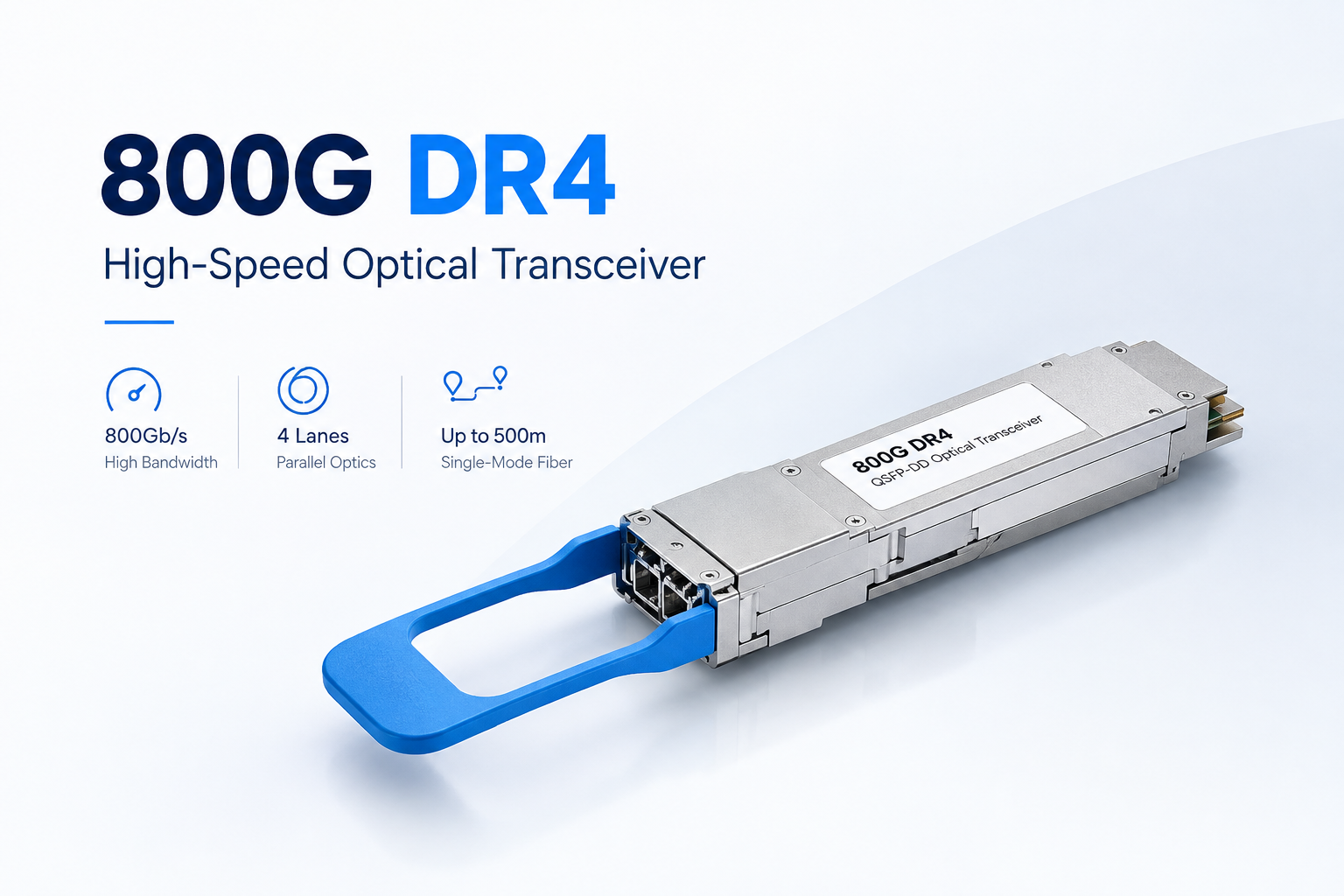
| 800G DR8 | Single-mode | Data center and AI cluster links | Around 500 m |
| 800G FR4 | Single-mode | Longer data center links | Around 2 km |
| 2×400G FR4 | Single-mode | 800G capacity using dual 400G interfaces | Around 2 km |
| 800G Twin-port | MMF or SMF | High-density switch interconnection | Application dependent |
The exact distance depends on the optical standard, fiber type, connector, insertion loss, and product implementation.
For example, Cisco lists 800GBASE-DR8 products with 500 m parallel single-mode fiber reach and 2×400G FR4 products with up to 2 km reach.
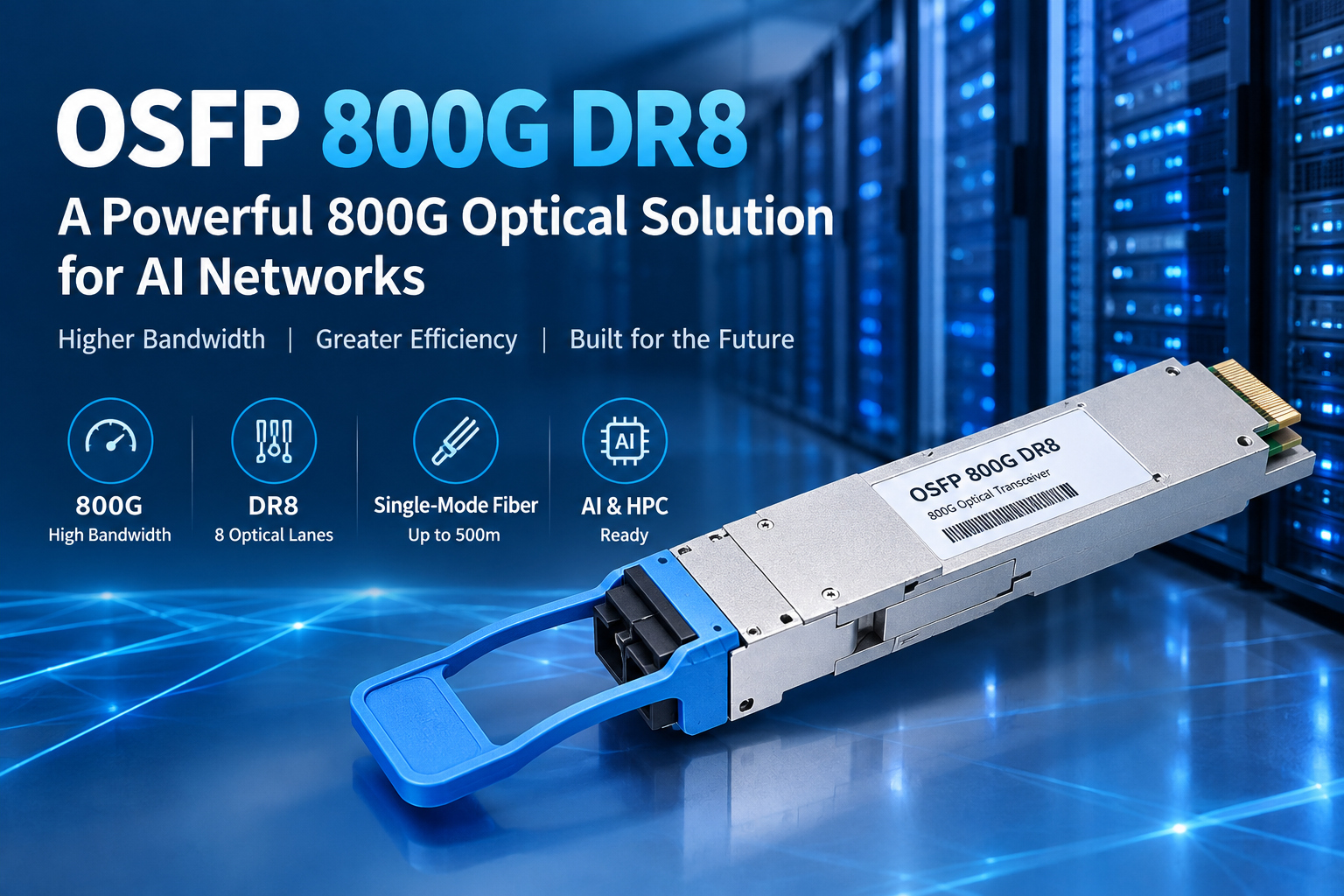
800G DR8 Optical Transceiver
An 800G DR8 optical transceiver is designed for relatively short single-mode fiber connections.
The “DR8” architecture generally uses eight parallel optical lanes.
A common implementation is:
8 × 100G PAM4 = 800G
NVIDIA’s 800G DR8 single-mode product uses eight 100G-PAM4 channels and is specified for up to 500 meters.
Cisco similarly lists 800GBASE-DR8 modules with 500 m parallel single-mode fiber reach.
Because single-mode fiber is used, DR8 is suitable for applications where more reach is required than short multimode connections can provide.
Typical DR8 Applications
800G DR8 is commonly considered for:
AI cluster networking
Switch-to-switch connections
High-performance computing
Data center spine networks
GPU cluster interconnects
High-density Ethernet networks
However, connector selection is important. Different products may use different MPO configurations, so the optical interface should always be checked before ordering.
800G FR4 Optical Transceiver
FR4 uses a different optical architecture from DR8.
Instead of eight parallel wavelengths operating independently, an FR4 design typically uses four wavelengths around the 1310 nm region.
A common 400G FR4 architecture uses four optical wavelengths, while an 800G implementation may be designed as two 400G optical channels.
Cisco’s OSFP-2X400G-FR4 is an example of this approach. It supports 2×400GE and 800GE over a dual duplex fiber connection with up to 2 km reach.
This architecture can be particularly attractive where LC duplex fiber connectivity is preferred.
800G FR4 vs DR8
The two architectures can be compared at a high level:
| Feature | 800G DR8 | 800G / 2×400G FR4 |
| Optical technology | Parallel optics | WDM-based architecture |
| Typical wavelength region | Around 1310 nm | Around 1310 nm |
| Fiber | Single-mode | Single-mode |
| Typical reach | Up to about 500 m | Up to about 2 km |
| Optical lanes | 8 | 4 wavelengths per 400G section |
| Common connector | MPO-based | LC duplex |
| Typical use | Short data center links | Longer data center links |
This comparison is only a general guide. The exact specifications can differ between manufacturers and product generations.
800G SR8 and Multimode Solutions
Not every 800G connection requires single-mode fiber.
For short links inside a rack or between nearby racks, multimode fiber can be a practical option.
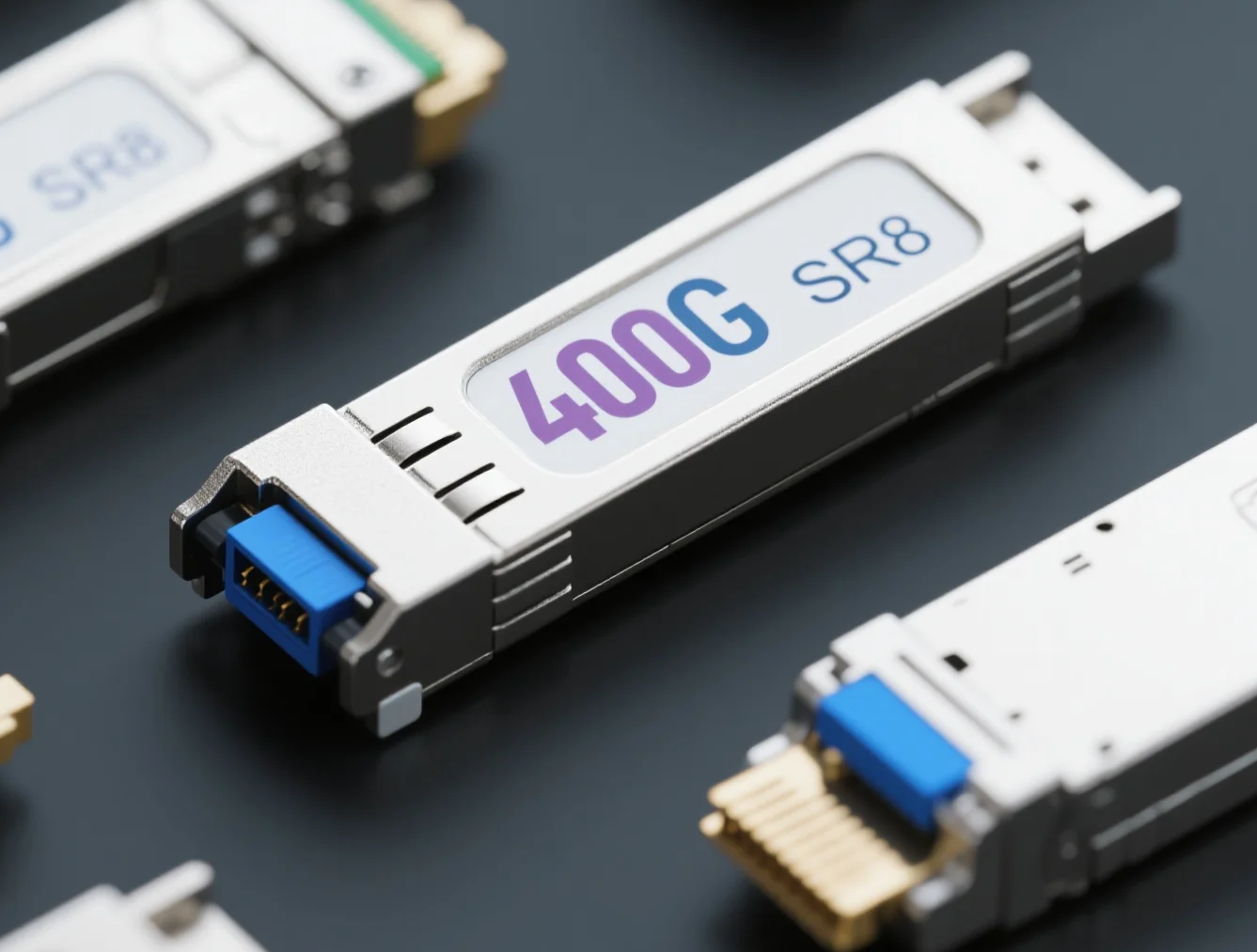
An 800G SR8 or VR8 architecture is designed for short-reach multimode applications. For example, Cisco specifies its 800G VR8 solution for 30 m over OM3 and 50 m over OM4/OM5.
NVIDIA also lists 800G multimode products using 850 nm VCSEL technology, with up to 30 m over OM3 and 50 m over OM4.
These solutions can be useful when:
The distance is short.
Existing multimode fiber is available.
Low-cost short-reach connectivity is required.
High-density GPU or switch connections are installed within the same data hall.
Therefore, selecting single-mode fiber simply because the speed is 800G is not always necessary.
OSFP and 800G Optical Transceiver Design
The OSFP form factor has become an important platform for high-speed 800G networking.
OSFP provides sufficient physical space for high-speed electronics, optical components, and thermal management.
Heat management is particularly important at 800G.
A module operating at high data rates can consume significantly more power than earlier generations. NVIDIA, for example, specifies up to 17 W for several 800G OSFP products.
Consequently, the mechanical design of the module should not be ignored.
Why Cooling Matters
High-speed optical modules generate heat from several components:
DSP or signal processing circuits
Laser drivers
Optical engines
Receivers
Voltage regulators
High-speed electrical interfaces
If the temperature rises too high, optical performance can deteriorate.
Therefore, an 800G optical transceiver should be evaluated together with the airflow direction, switch thermal design, cage type, and operating temperature.
For example, NVIDIA specifies finned-top OSFP designs for some switch platforms where additional transceiver cooling is required.
Key Specifications to Check Before Buying
Choosing an 800G module should start with the network architecture rather than the product name.
The following specifications deserve particular attention.
| Specification | Why It Matters |
| Data rate | Confirms 800G operation |
| Form factor | Determines physical compatibility |
| Optical standard | Defines transmission architecture |
| Fiber type | MMF and SMF have different applications |
| Wavelength | Must match the optical architecture |
| Reach | Determines suitable link distance |
| Connector | Must match the fiber infrastructure |
| Modulation | Affects signal transmission |
| Power consumption | Impacts system cooling |
| Operating temperature | Important for dense data centers |
| Host compatibility | Determines switch/NIC interoperability |
| CMIS support | Enables module management and diagnostics |
| FEC requirements | Can affect end-to-end compatibility |
For example, Cisco specifies CMIS 5.3 support on its 800G OSFP products, while NVIDIA’s 800G products also specify CMIS compliance.
Compatibility Is More Than a Connector
A common mistake is to assume that two modules are compatible simply because they use the same physical connector.
In reality, compatibility can involve:
Switch → cage → electrical interface → firmware → module → optical interface → fiber → receiving module
Every part of the chain matters.
A module may physically fit into an OSFP cage but still require specific firmware, electrical signaling, thermal conditions, or host-side support.
For this reason, buyers should provide the original switch or NIC model when requesting an alternative 800G optical transceiver.
800G Optical Transceiver Applications
The technology is being used in several demanding networking environments.
AI Data Centers
AI workloads are one of the major drivers for high-speed optical networking.
Large GPU clusters require high-bandwidth communication between computing nodes and network switches.
An 800G optical transceiver can be deployed in these environments to support high-capacity connections between switches and compute infrastructure.
NVIDIA’s current networking portfolio specifically positions 800G and 1.6T optical technologies for AI networking and high-performance Ethernet and InfiniBand environments.
Cloud Data Centers
Cloud providers operate massive infrastructure where network traffic changes constantly.
High-speed optical links allow operators to increase aggregate network capacity while maintaining high port density.
For this reason, 800G is becoming an important building block in the evolution from 400G toward higher-speed data center networks.
High-Performance Computing
Scientific computing, simulation, financial modeling, and other HPC applications can require fast communication between large numbers of computing nodes.
In these environments, network latency and bandwidth can directly affect overall application efficiency.
Therefore, high-speed optical interconnects can play an important role in system design.
800G Optical Transceiver vs 400G
The move from 400G to 800G is not simply a matter of doubling the number printed on the product label.
The electrical architecture, optical lane rate, thermal requirements, fiber design, and switch capabilities may all change.
| Item | 400G | 800G |
| Nominal bandwidth | 400 Gb/s | 800 Gb/s |
| Common modulation | PAM4 | PAM4 |
| Typical high-speed lane | 50G/100G | 100G/200G depending on architecture |
| Common form factors | QSFP-DD, OSFP, QSFP112 | OSFP and other high-speed platforms |
| Thermal challenge | High | Higher |
| AI networking use | Widely deployed | Rapidly expanding |
| Port density | High | Very high |
The transition therefore needs to be planned at the system level.
How to Select the Right 800G Optical Transceiver
A simple selection process can reduce compatibility problems.
Step 1: Identify the Switch or NIC
Start with the exact equipment model.
Do not use only the brand name.
The complete part number is much more useful.
Step 2: Confirm the Form Factor
Determine whether the platform requires OSFP, QSFP112, or another interface.
Step 3: Confirm the Required Distance
For example:
Under 50 m: multimode options may be suitable.
Around 500 m: DR8 may be considered.
Around 2 km: FR4-based solutions may be appropriate.
These are general ranges, not universal rules.
Step 4: Check the Fiber Infrastructure
Confirm whether the existing cabling uses:
OM3
OM4
OM5
OS2 single-mode fiber
The module and cable must be designed to work together.
Step 5: Check the Connector
MPO and LC interfaces are not interchangeable without the correct optical architecture and cabling.
The polarity and fiber count should also be verified.
Step 6: Check Power and Cooling
This step is especially important for dense 800G deployments.
A switch may support an 800G module electrically but still have platform-specific requirements for thermal management.
Step 7: Verify Firmware and Management Support
Check CMIS, DOM/DDM, firmware requirements, and vendor interoperability before deployment.
Common Questions About 800G Optical Transceiver
1. What is an 800G optical transceiver?
An 800G optical transceiver is a high-speed optical networking module designed to transmit and receive data at up to 800 Gb/s. It converts electrical signals into optical signals and converts received optical signals back into electrical signals.
2. What is the difference between 800G DR8 and 800G FR4?
DR8 generally uses eight parallel optical lanes and is commonly associated with approximately 500 m single-mode links. FR4-based 800G solutions can use a 2×400G architecture and may support approximately 2 km over single-mode fiber. Exact specifications depend on the product.
3. Does 800G always require single-mode fiber?
No. Short-reach 800G solutions such as VR8 or SR8 can use multimode fiber. For example, current products are available for OM3 and OM4/OM5 short-reach connections.
4. Why is PAM4 used in 800G optical transceivers?
PAM4 uses four signal levels, allowing two bits to be represented per symbol. This helps achieve higher data rates without requiring the symbol rate to increase at the same proportion as the total bit rate.
5. What should I provide when purchasing an 800G optical transceiver?
The most useful information includes the switch or NIC model, original module part number, required distance, fiber type, connector type, desired optical standard, and operating environment. With these details, compatibility can be checked more accurately.
Final Thoughts on 800G Optical Transceiver Technology
The development of 800G optical transceiver technology reflects a broader change in data center networking. AI clusters, cloud computing, and high-performance applications are pushing network bandwidth far beyond the levels that traditional 100G and 400G infrastructures were designed to handle.
At the same time, 800G is not a single standardized product configuration. DR8, SR8, VR8, FR4, and 2×400G architectures can serve very different network requirements.
Therefore, the right solution should be selected according to the complete link design.
First, confirm the switch or NIC. Next, determine the required reach and fiber type. Then check the optical architecture, connector, power consumption, thermal requirements, firmware, and management interface.
When these factors are evaluated together, an 800G optical transceiver can provide a scalable foundation for next-generation data center, AI, cloud, and high-performance networking environments.
As network speeds continue to increase, the ability to match optical technology with the actual system architecture will become increasingly important. Rather than choosing a module based only on bandwidth, network designers should evaluate the entire optical link from the host port to the fiber and the receiving device.