Introduction: Why QSFP 100G DR Matters in Modern Networks
As data traffic continues to grow rapidly, faster and more efficient network connections are being demanded across industries. From cloud computing to AI clusters and enterprise data centers, 100G connectivity has become a critical foundation. Among the many available optical transceiver options, QSFP 100G DR has emerged as one of the most practical and cost-effective solutions.
QSFP 100G DR is specifically designed to provide high-speed transmission over single-mode fiber while maintaining simple deployment and excellent scalability. Compared with older 100G technologies, it offers lower power consumption, reduced fiber complexity, and easier upgrades.
Moreover, as data centers continue to expand, network engineers are increasingly choosing QSFP 100G DR because it balances performance, flexibility, and cost. In this guide, you will learn everything about QSFP 100G DR, including its technical features, applications, advantages, comparisons, and deployment considerations.
What Is QSFP 100G DR?
Understanding QSFP 100G DR Technology
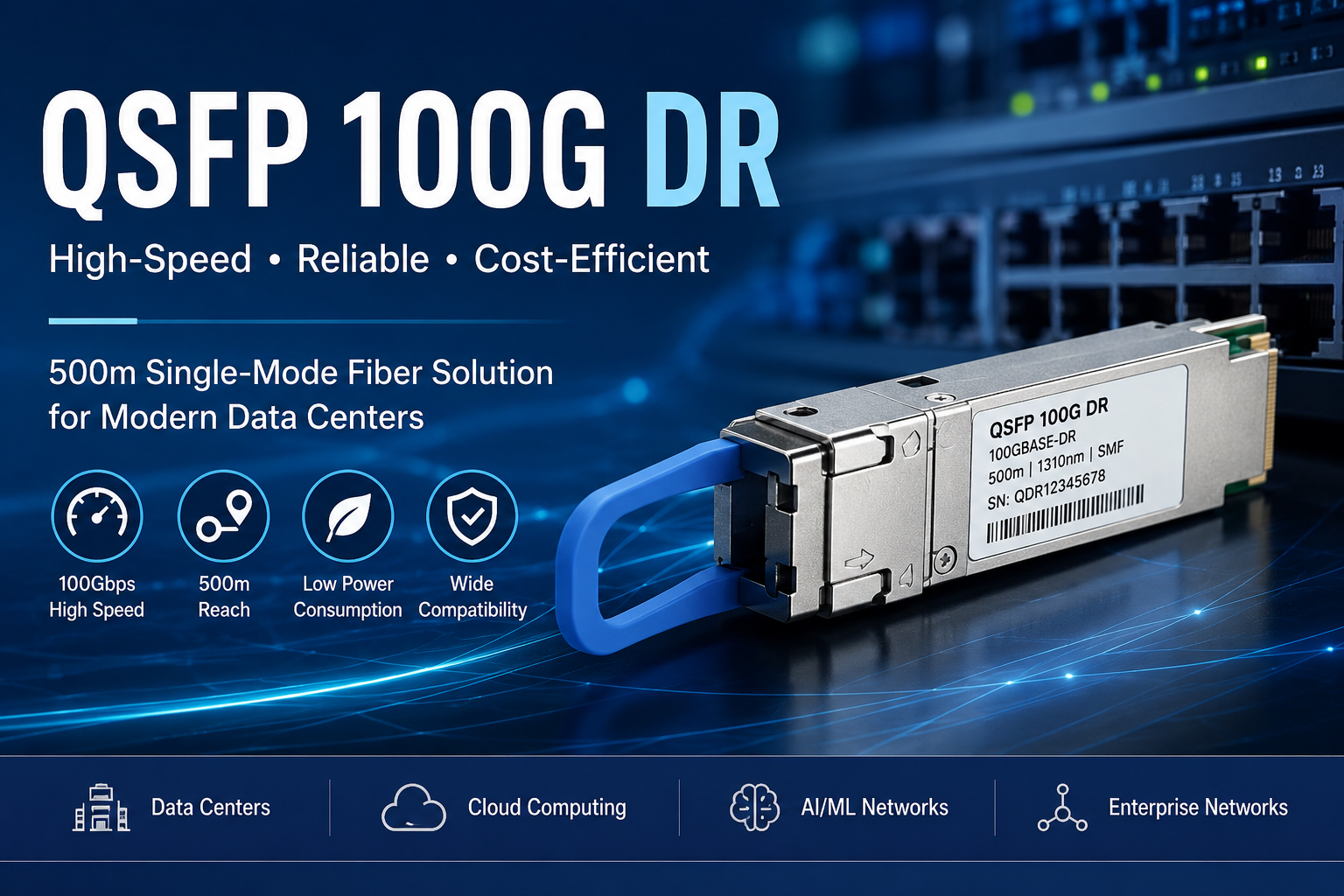
A QSFP 100G DR transceiver is a hot-pluggable optical module designed to deliver 100 Gigabit Ethernet connectivity over single-mode fiber (SMF).
The term can be broken down as follows:
| Term | Meaning |
| QSFP | Quad Small Form-factor Pluggable |
| 100G | 100 Gigabit data rate |
| DR | 100GBASE-DR (single lambda 500m standard) |
Unlike older multi-lane optical modules, QSFP 100G DR uses single-lambda PAM4 technology, which allows one optical wavelength to transmit 100Gbps efficiently.
As a result, fewer optical components are required, and deployment complexity can be reduced significantly.
QSFP 100G DR Key Specifications
The main technical specifications of QSFP 100G DR are summarized below.
| Specification | QSFP 100G DR |
| Form Factor | QSFP28 |
| Data Rate | 100Gbps |
| Connector Type | Duplex LC |
| Fiber Type | Single-mode fiber (OS2) |
| Maximum Distance | 500 meters |
| Optical Technology | PAM4 |
| Wavelength | 1310nm |
| Interface Standard | 100GBASE-DR |
| Operating Temperature | 0°C to 70°C |
| Power Consumption | Typically <4.5W |
These specifications make QSFP 100G DR highly suitable for modern leaf-spine architectures and short-reach interconnects.
How QSFP 100G DR Works
PAM4 Signaling Explained Simply
Traditional NRZ signaling uses two signal levels. However, QSFP 100G DR uses PAM4 (Pulse Amplitude Modulation 4), which uses four signal levels.
Because more bits can be carried per symbol, higher speeds can be achieved without doubling the bandwidth.
This technology enables:
Faster data transmission
Lower component count
Improved spectral efficiency
Reduced optical complexity
Although PAM4 can be more sensitive to noise, modern DSP technology helps maintain signal quality effectively.
Single-Lambda Transmission Benefits
Another major advantage of QSFP 100G DR is single-lambda transmission.
Instead of splitting data across multiple optical lanes, a single wavelength is used.
This offers several benefits:
Easier fiber management
Lower cabling costs
Simplified installation
Better upgrade flexibility
Consequently, network expansion can be performed more smoothly.
Key Advantages of QSFP 100G DR
1. Lower Infrastructure Cost
Because only duplex single-mode fiber is required, fewer fiber strands are needed compared with SR4 modules.
For example:
| Module Type | Fiber Count |
| QSFP 100G SR4 | 8 fibers |
| QSFP 100G DR | 2 fibers |
Therefore, cabling expenses can be reduced significantly.
2. Better Future Scalability
Single-mode fiber infrastructure is considered more future-proof.
As networks evolve toward:
200G
400G
800G
Existing fiber plants can often still be reused.
Thus, investing in QSFP 100G DR today can help reduce future migration costs.
3. Improved Power Efficiency
Energy efficiency is increasingly important.
Compared with some legacy optical solutions, QSFP 100G DR modules are often designed with optimized DSP chips and lower thermal output.
Benefits include:
Lower cooling requirements
Reduced operational expenses
Improved equipment reliability
4. Simple Plug-and-Play Deployment
Most QSFP 100G DR modules are designed to be fully hot-swappable.
As a result:
Installation can be completed quickly
Downtime can be minimized
Maintenance becomes easier
For busy data center teams, this is a major operational advantage.
QSFP 100G DR vs Other 100G Optical Modules
QSFP 100G DR vs QSFP 100G SR4
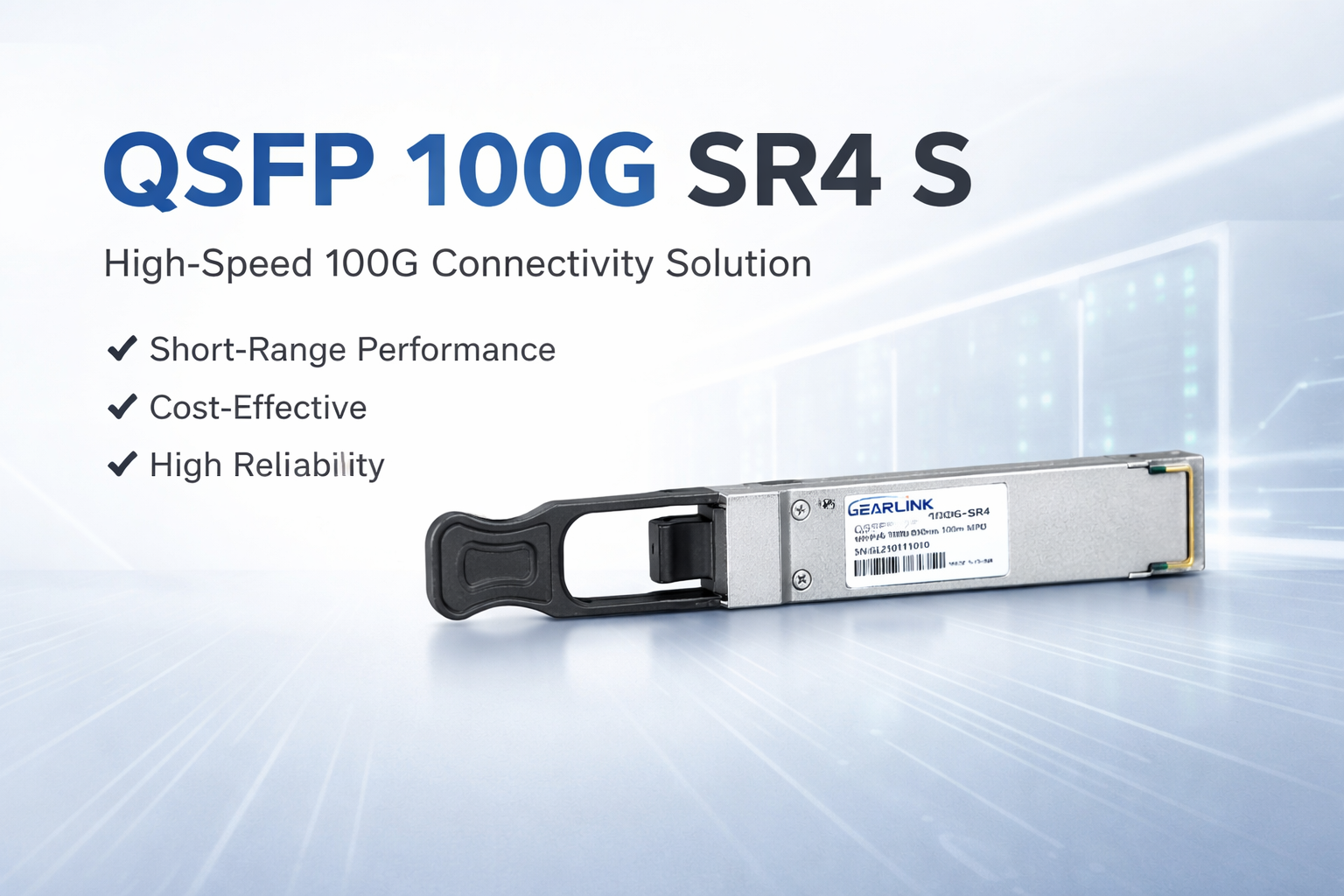
| Feature | QSFP 100G DR | QSFP 100G SR4 |
| Fiber Type | Single-mode | Multimode |
| Distance | 500m | 70-100m |
| Connector | LC Duplex | MPO-12 |
| Fiber Count | 2 | 8 |
| Cost of Module | Higher | Lower |
| Cabling Cost | Lower | Higher |
In many cases, QSFP 100G DR provides a better long-term total cost.
QSFP 100G DR vs QSFP 100G LR4
| Feature | QSFP 100G DR | QSFP 100G LR4 |
| Distance | 500m | 10km |
| Complexity | Lower | Higher |
| Power Consumption | Lower | Higher |
| Typical Use | Data center | Metro links |
If your transmission distance is under 500m, QSFP 100G DR is often the more efficient choice.
Common Applications of QSFP 100G DR
Cloud Data Centers
Cloud providers demand:
Massive bandwidth
Low latency
Efficient scaling
Therefore, QSFP 100G DR is widely deployed between switches and servers.
AI and Machine Learning Clusters
AI workloads generate enormous east-west traffic.
Fast GPU-to-GPU communication is essential.
Because of its low latency and efficient architecture, QSFP 100G DR is increasingly used in AI networks.
Enterprise Network Upgrades
Many enterprises are moving from:
10G
25G
40G
to 100G infrastructure.
QSFP 100G DR provides an ideal migration path.
QSFP 100G DR Deployment Considerations
Choosing the right transceiver is important, but successful deployment also depends on proper planning. Before installing QSFP 100G DR modules, several technical details should be carefully reviewed.
Fiber Compatibility Requirements
One of the first things that should be checked is fiber compatibility.
QSFP 100G DR is designed for OS2 single-mode fiber. This means multimode fiber cannot be used.
Below is a simple compatibility reference:
| Fiber Type | Compatible with QSFP 100G DR? | Notes |
| OS2 Single-Mode Fiber | Yes | Recommended standard |
| OM3 Multimode Fiber | No | Not supported |
| OM4 Multimode Fiber | No | Not supported |
| OS1 Single-Mode Fiber | Sometimes | Depends on environment |
Therefore, verifying your existing cabling infrastructure before purchase can prevent unnecessary costs.
Additionally, fiber cleanliness should always be checked. Dirty LC connectors can significantly reduce optical performance.
Switch and Hardware Compatibility
Another critical factor is switch compatibility.
Although most QSFP 100G DR modules follow industry standards, vendor-specific firmware coding is often required.
Common supported platforms include:
Cisco
Juniper
Arista
NVIDIA
HPE
Dell
Huawei
A compatibility table can help simplify selection:
| Network Vendor | Typical Compatibility |
| Cisco | Supported with Cisco-coded modules |
| Arista | Supported |
| Juniper | Supported |
| NVIDIA | Supported |
| Dell | Supported |
| HPE | Supported |
As a result, many buyers choose third-party compatible QSFP 100G DR modules to reduce procurement costs while maintaining performance.
Power and Thermal Management
Although QSFP 100G DR is relatively power efficient, thermal planning remains important.
Typical module power consumption is:
3.5W to 4.5W
This is lower than many LR4 modules, yet sufficient airflow is still needed.
To improve reliability:
Maintain proper rack ventilation
Avoid blocked airflow paths
Monitor module temperatures regularly
Use qualified switch cooling profiles
Consequently, module lifespan can often be extended.
How to Choose the Right QSFP 100G DR Module
Selecting the best QSFP 100G DR transceiver depends on several factors. A structured evaluation can simplify the process.
1. Check Transmission Distance
First, calculate your real link distance.
Use this simple guide:
| Distance Requirement | Recommended Module |
| Under 100m | QSFP 100G SR4 |
| Up to 500m | QSFP 100G DR |
| Up to 10km | QSFP 100G LR4 |
If your data center interconnect falls within 500 meters, QSFP 100G DR is often the ideal solution.
2. Evaluate Fiber Infrastructure
Next, review your existing cabling.
If your network already uses single-mode fiber, deploying QSFP 100G DR can be straightforward.
However, if multimode fiber is installed, migration costs should be considered.
Questions to ask:
Is OS2 fiber already available?
Are LC patch panels installed?
Is fiber quality verified?
These answers can strongly influence purchasing decisions.
3. Verify Vendor Compatibility
Compatibility remains one of the most common concerns.
Before ordering, confirm:
Switch model number
Required firmware version
Coding requirements
Vendor lock policies
Many suppliers provide compatibility testing services, which can reduce deployment risk.
4. Assess Supplier Quality
Not all optical modules perform equally.
A reliable supplier should offer:
Full compatibility testing
DOM support
Performance reports
Warranty coverage
Technical support
Quality assurance matters because unstable optical links can create difficult troubleshooting problems later.
QSFP 100G DR Common Challenges and Solutions
Even reliable technologies can present deployment issues. Fortunately, most problems can be solved quickly.
Optical Link Failure
Possible causes include:
Dirty connectors
Fiber damage
Incorrect polarity
Compatibility mismatch
Recommended actions:
Clean LC connectors
Verify fiber continuity
Check switch logs
Confirm module coding
In many cases, simple cleaning resolves the issue.
High Bit Error Rate
Signal errors may occasionally increase.
Potential causes:
Poor fiber quality
Excessive attenuation
Temperature instability
Possible solutions:
Replace damaged patch cords
Measure optical loss
Improve airflow
Because QSFP 100G DR uses PAM4 signaling, signal quality is especially important.
Compatibility Warnings
Sometimes a switch may display unsupported transceiver messages.
This often happens because:
EEPROM coding does not match
Vendor restrictions are enabled
In such cases, a compatible coded QSFP 100G DR module is usually required.
QSFP 100G DR vs Emerging Optical Technologies
The optical networking industry continues to evolve rapidly. Still, QSFP 100G DR remains highly relevant.
Migration Toward 400G and 800G
Many data centers are planning upgrades to:
400G DR4
800G DR8
Interestingly, these newer technologies follow similar design principles:
Single-mode fiber
PAM4 modulation
Duplex or parallel optics
Because of this, deploying QSFP 100G DR today can prepare infrastructure for future expansion.
Why QSFP 100G DR Remains Important
Despite higher-speed options, 100G is still widely used because:
Equipment costs are lower
Deployment is simpler
Network demand often fits 100G capacity
Existing hardware supports it
For many organizations, QSFP 100G DR offers the best balance between performance and affordability.
Benefits of Using Compatible QSFP 100G DR Modules
Third-party compatible optics have become increasingly popular.
Advantages include:
Lower Procurement Costs
Savings can often reach:
30%
50%
Even 70%
compared with OEM pricing.
Equal Performance Standards
High-quality compatible modules are typically tested for:
Optical power
BER performance
Temperature stability
EEPROM compatibility
Therefore, performance can match OEM expectations.
Faster Delivery
OEM lead times may be long.
Independent suppliers often provide:
Ready stock
Faster shipping
Flexible coding
This can significantly reduce project delays.
Future Trends for QSFP 100G DR
Several trends are shaping the future of QSFP 100G DR deployment.
Growing AI Infrastructure Demand
AI training clusters require dense optical connectivity.
As GPU networking expands, demand for reliable short-reach 100G links continues to grow.
Sustainable Networking Focus
Energy-efficient optics are becoming more important.
Lower-power QSFP 100G DR modules help support sustainability goals.
Wider Open Networking Adoption
Organizations increasingly prefer flexible, vendor-neutral networking strategies.
Compatible QSFP 100G DR optics fit this trend well.
Final Thoughts on QSFP 100G DR
As network traffic continues to increase, choosing the right optical transceiver has never been more important.
QSFP 100G DR offers a powerful combination of:
High-speed 100G performance
Cost-efficient single-mode connectivity
Simple deployment
Strong future scalability
Broad compatibility
For data centers, cloud environments, and enterprise upgrades, it remains one of the most practical optical solutions available.
Ultimately, if your network requires reliable 100G connectivity within 500 meters, QSFP 100G DR is likely one of the smartest investments you can make.