As enterprise networks continue to grow, higher bandwidth and longer transmission distances are being demanded across data centers, telecom systems, and cloud platforms. Therefore, the need for stable and efficient optical modules has increased rapidly. Among many 100G solutions, the cfp 100g lr4 module has remained a reliable option for long-distance Ethernet transmission.
Although smaller form factors such as QSFP28 are widely used today, the cfp 100g lr4 solution is still deployed in many carrier and backbone environments because excellent transmission stability and mature interoperability can be achieved. In addition, many legacy 100G systems were originally designed around CFP technology, which means these modules are still actively required in large-scale infrastructure projects.
In this article, the main features, working principles, technical specifications, advantages, applications, and deployment considerations of cfp 100g lr4 modules will be explained in a simple and practical way.
What Is CFP 100G LR4?
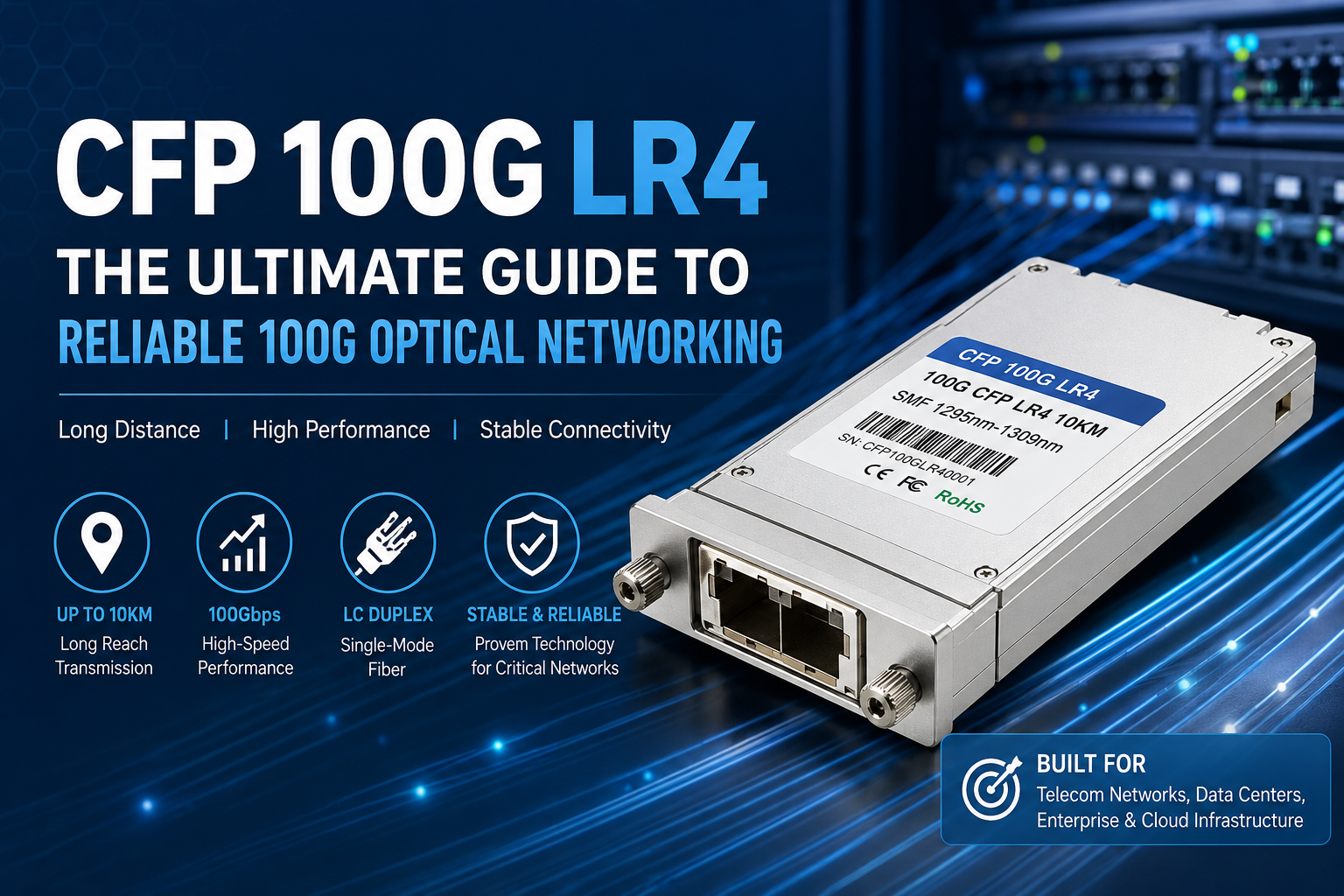
The cfp 100g lr4 module is a 100G optical transceiver designed for long-range single-mode fiber transmission. It follows the CFP Multi-Source Agreement and supports 100 Gigabit Ethernet connectivity over distances up to 10km.
The term “LR4” stands for:
| Term | Meaning |
| LR | Long Reach |
| 4 | Four optical lanes |
A cfp 100g lr4 module typically converts 100G electrical signals into four optical wavelengths. Afterwards, those wavelengths are multiplexed into a single fiber pair through WDM technology.
As a result, high-speed data transmission can be delivered efficiently over long distances without requiring multiple fiber connections.
How CFP 100G LR4 Works
To better understand the value of cfp 100g lr4 modules, it is important to look at how they operate internally.
Optical Lane Structure in CFP 100G LR4
The module usually works with four independent optical lanes. Each lane carries approximately 25Gbps of data.
The wavelengths commonly used include:
| Lane | Typical Wavelength |
| Lane 1 | 1295nm |
| Lane 2 | 1300nm |
| Lane 3 | 1304nm |
| Lane 4 | 1309nm |
Then, CWDM technology is applied so all four wavelengths can travel through a duplex LC single-mode fiber connection simultaneously.
Consequently, fiber usage is greatly optimized.
Key Specifications of CFP 100G LR4
The following table summarizes the core technical specifications of a standard cfp 100g lr4 module.
| Feature | Specification |
| Form Factor | CFP |
| Data Rate | 100Gbps |
| Connector Type | Duplex LC |
| Fiber Type | Single-Mode Fiber (SMF) |
| Transmission Distance | Up to 10km |
| Optical Technology | CWDM |
| Operating Temperature | 0°C to 70°C |
| Standard Compliance | IEEE 802.3ba |
| Wavelength Range | 1295nm–1309nm |
| Digital Diagnostics | Supported |
| Power Consumption | Higher than QSFP28 |
Because the CFP package is larger than newer optical formats, more power is usually consumed. However, thermal performance is often improved as well.
Advantages of CFP 100G LR4
Many organizations still choose cfp 100g lr4 modules because several practical benefits can be obtained.
Stable Long-Distance Transmission
First of all, reliable 10km transmission over single-mode fiber is supported. Therefore, the module can easily handle metro links, campus networks, and inter-building connections.
Mature and Proven Technology
Unlike some newer optical standards, cfp 100g lr4 technology has already been tested extensively in real-world deployments. Consequently, network compatibility issues are reduced.
Strong Carrier Network Compatibility
Many telecom-grade switches and routers were designed around CFP interfaces. Thus, the cfp 100g lr4 module continues to be widely used in carrier backbone environments.
Easier Thermal Management
Since the CFP package is physically larger, heat can often be dissipated more effectively. As a result, long-term stability may be improved under heavy workloads.
CFP 100G LR4 vs QSFP28 LR4
One of the most common comparisons involves cfp 100g lr4 and QSFP28 LR4 modules.
Although both support 100G long-range transmission, several major differences exist.
| Feature | CFP 100G LR4 | QSFP28 LR4 |
| Form Factor | Larger | Compact |
| Power Consumption | Higher | Lower |
| Port Density | Lower | Higher |
| Deployment Age | Earlier Generation | Modern Generation |
| Heat Dissipation | Better | Moderate |
| Cost | Usually Higher | More Competitive |
| Typical Use | Carrier Networks | Data Centers |
Generally speaking, QSFP28 LR4 is preferred in modern hyperscale data centers. Nevertheless, cfp 100g lr4 remains important in many legacy infrastructures where CFP ports are already installed.
Common Applications of CFP 100G LR4
The cfp 100g lr4 module can be found in many networking scenarios.
Telecom Backbone Networks
Large telecom operators often rely on stable long-distance optical transmission. Therefore, cfp 100g lr4 modules are commonly deployed in backbone routing systems.
Enterprise Interconnection
Many enterprises need to connect multiple buildings or campuses. Since 10km transmission is supported, the module becomes a practical solution.
Cloud Computing Infrastructure
Although newer modules are growing rapidly, certain cloud environments still operate older CFP-based equipment.
Internet Exchange Platforms
High-bandwidth traffic aggregation can also be supported effectively through cfp 100g lr4 technology.
CFP 100G LR4 Optical Architecture
The internal optical design of cfp 100g lr4 modules is relatively sophisticated.
Main Internal Components
Several key components are included:
| Component | Function |
| CWDM Multiplexer | Combines optical wavelengths |
| Laser Driver | Controls optical output |
| DSP Chip | Signal processing |
| PIN Receiver | Optical signal detection |
| Heat Sink | Thermal management |
Because multiple optical lanes are synchronized simultaneously, signal integrity must be carefully maintained.
Fiber Requirements for CFP 100G LR4
Correct fiber infrastructure is extremely important for successful deployment.
Recommended Fiber Type
The cfp 100g lr4 module is mainly designed for:
OS2 single-mode fiber
Duplex LC connectivity
Low-loss optical cabling
Fiber Distance Guidelines
| Fiber Type | Maximum Distance |
| Single-Mode Fiber | 10km |
| Multi-Mode Fiber | Not Supported |
Using the wrong fiber type may lead to severe optical loss and unstable transmission.
Power Consumption Considerations
Compared with newer optical modules, cfp 100g lr4 modules consume relatively high power.
| Module Type | Typical Power Consumption |
| CFP 100G LR4 | 20W–24W |
| QSFP28 LR4 | 4W–6W |
Consequently, sufficient cooling capacity should be planned during deployment.
However, because CFP systems were originally engineered for high-power operation, this issue is usually manageable in carrier-grade equipment.
CFP 100G LR4 Compatibility
Compatibility is one of the most important purchasing factors.
Fortunately, many vendors manufacture compatible cfp 100g lr4 modules for mainstream networking brands.
Common Compatible Platforms
| Brand Platform | Compatibility |
| Cisco | Supported |
| Juniper | Supported |
| Huawei | Supported |
| Nokia | Supported |
| HPE | Supported |
Still, compatibility coding should always be verified before deployment.
Installation Tips for CFP 100G LR4
Proper installation practices can significantly improve long-term reliability.
Clean Fiber Connectors Carefully
Dust contamination may reduce optical performance dramatically. Therefore, fiber connectors should always be cleaned before insertion.
Verify Optical Power Levels
Optical attenuation should be checked carefully, especially in long-distance links.
Monitor Module Temperature
Because higher power is consumed, adequate airflow should be maintained around the module.
Use Certified Fiber Infrastructure
Low-quality cabling may introduce insertion loss and signal instability.
CFP 100G LR4 vs CFP2 and CFP4
Over time, smaller CFP-family modules were introduced.
Comparison Table
| Feature | CFP | CFP2 | CFP4 |
| Size | Largest | Smaller | Smallest |
| Power Consumption | Highest | Medium | Lower |
| Port Density | Lowest | Medium | Higher |
| Market Age | Oldest | Mid-Generation | Newer |
| Deployment Today | Legacy Systems | Limited | Less Common |
Although CFP2 and CFP4 provide better density, many installed systems still require traditional cfp 100g lr4 modules.
Why CFP 100G LR4 Is Still Relevant
Some people assume CFP technology is obsolete. However, that assumption is not completely accurate.
Several reasons explain why cfp 100g lr4 continues to remain relevant:
Large telecom infrastructures still use CFP ports
Existing hardware replacement costs are high
Proven interoperability remains valuable
Long operational stability is trusted
Migration cycles in carrier environments are slower
Therefore, many businesses continue purchasing cfp 100g lr4 modules for maintenance and expansion projects.
Choosing the Right CFP 100G LR4 Supplier
Selecting the correct supplier is extremely important.
Important Evaluation Factors
| Factor | Why It Matters |
| Compatibility Testing | Reduces deployment issues |
| Quality Control | Improves reliability |
| Warranty Support | Protects long-term investment |
| Inventory Availability | Speeds project delivery |
| Technical Support | Helps troubleshooting |
Moreover, reputable suppliers usually provide EEPROM coding customization for different networking brands.
Future Trends of CFP 100G LR4
Although compact optical modules are becoming dominant, cfp 100g lr4 products are expected to remain active in certain markets for years.
Several trends can already be observed:
Gradual migration toward QSFP28 and OSFP
Continued maintenance demand for CFP systems
Increased third-party compatible module adoption
Longer lifecycle support in telecom environments
Consequently, the market demand may shrink slowly rather than disappear suddenly.
Frequently Asked Questions About CFP 100G LR4
What is CFP 100G LR4 used for?
The cfp 100g lr4 module is mainly used for 100G long-distance optical transmission over single-mode fiber up to 10km.
Does CFP 100G LR4 support multimode fiber?
No. The module is designed specifically for single-mode fiber environments.
Is CFP 100G LR4 still widely used?
Yes. Although newer modules exist, many telecom and enterprise systems still rely on cfp 100g lr4 infrastructure.
What connector does CFP 100G LR4 use?
Most cfp 100g lr4 modules use a duplex LC optical connector.
What is the difference between CFP 100G LR4 and QSFP28 LR4?
The biggest differences involve size, power consumption, and port density. QSFP28 LR4 is smaller and more power efficient, while cfp 100g lr4 is commonly used in older carrier-grade systems.
Final Thoughts on CFP 100G LR4
The cfp 100g lr4 module remains an important part of many high-speed optical networking environments. Even though newer form factors continue to emerge, this technology still delivers reliable long-distance 100G connectivity for telecom operators, enterprises, and legacy data center infrastructures.
Furthermore, mature interoperability, strong stability, and broad equipment compatibility continue to make cfp 100g lr4 a dependable choice. For organizations operating existing CFP-based systems, these modules still provide excellent practical value.
As network traffic continues to grow worldwide, stable and efficient optical transmission solutions will remain essential. Therefore, the cfp 100g lr4 module is expected to maintain a meaningful role in the global optical communication market for years to come.