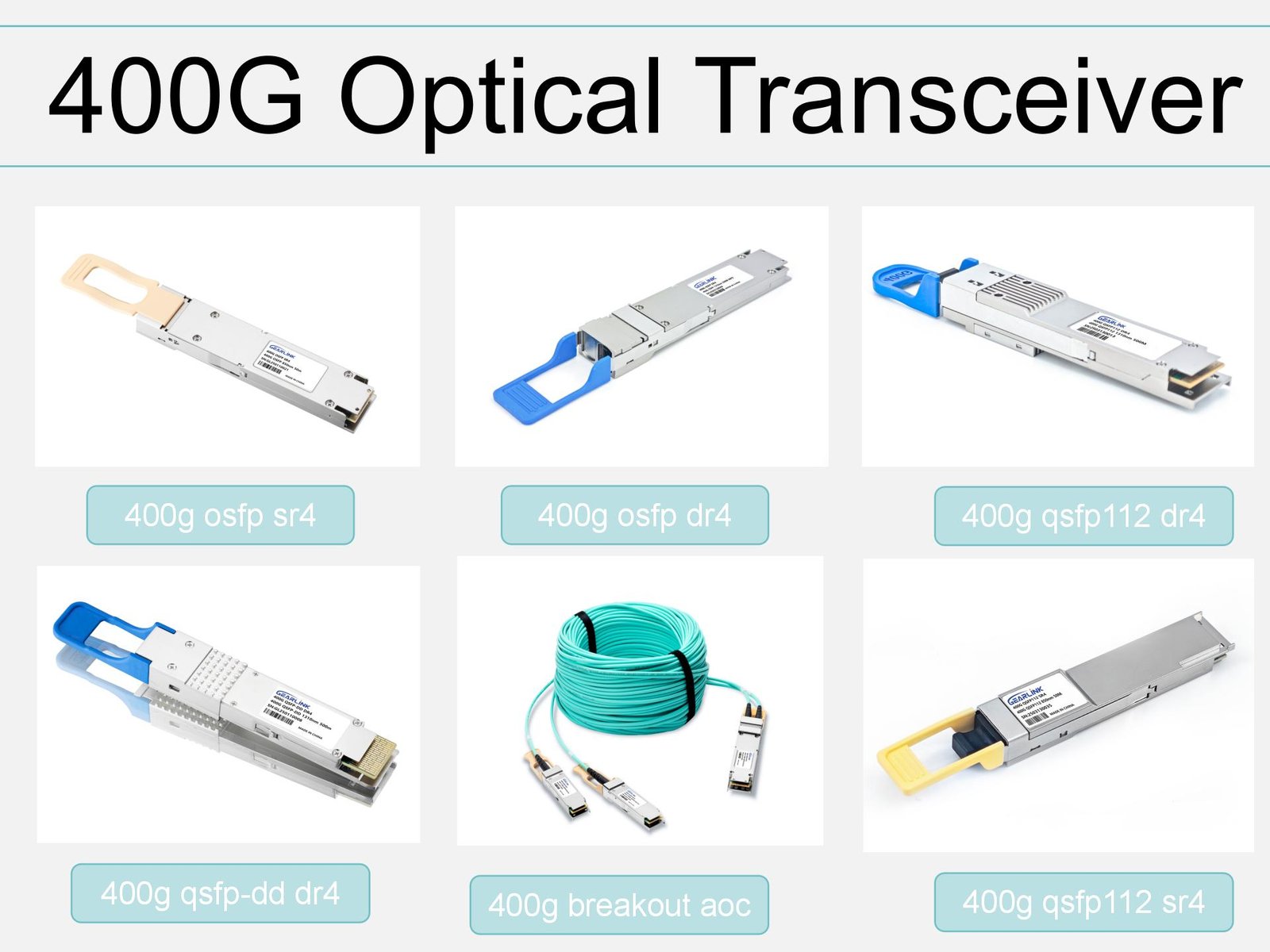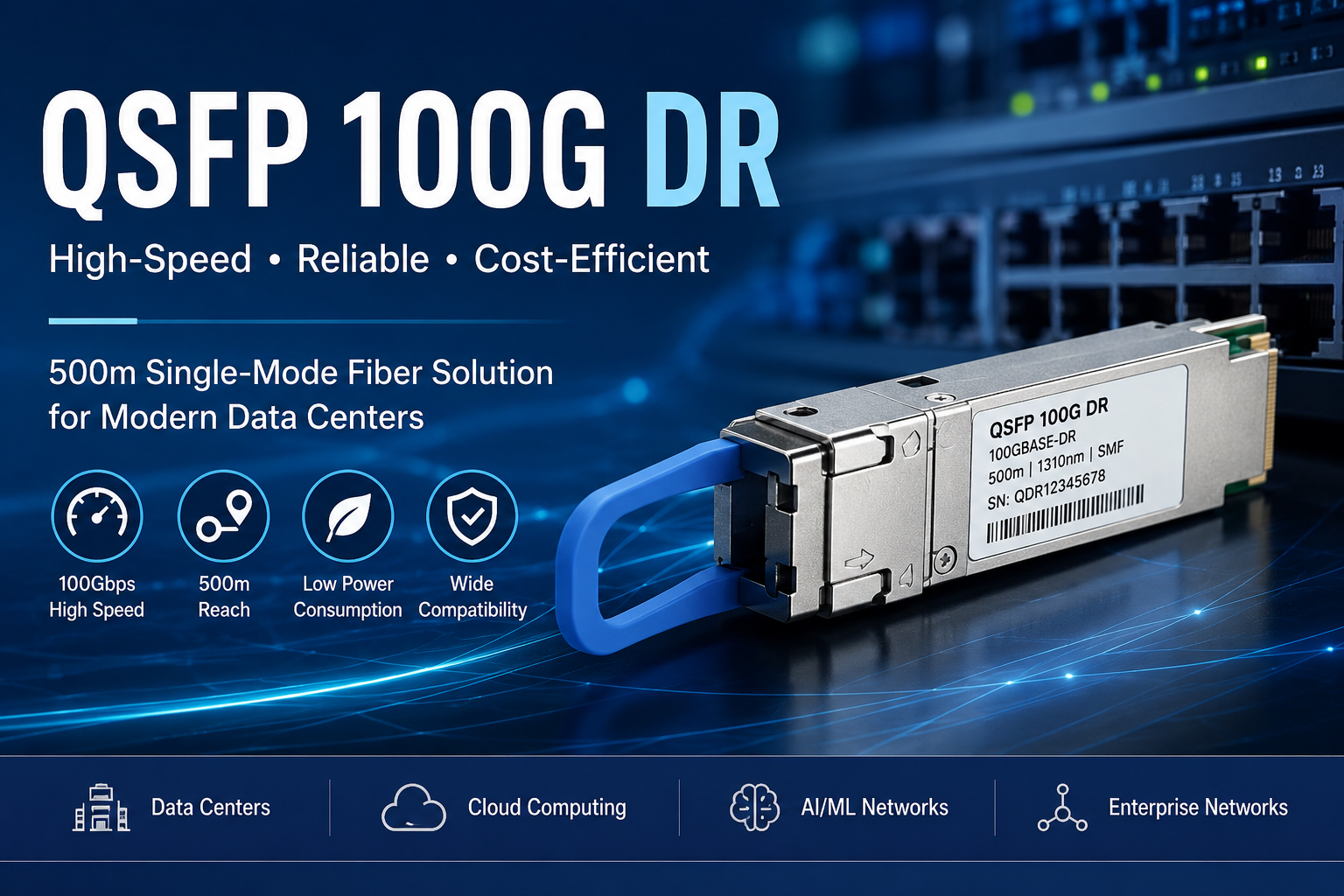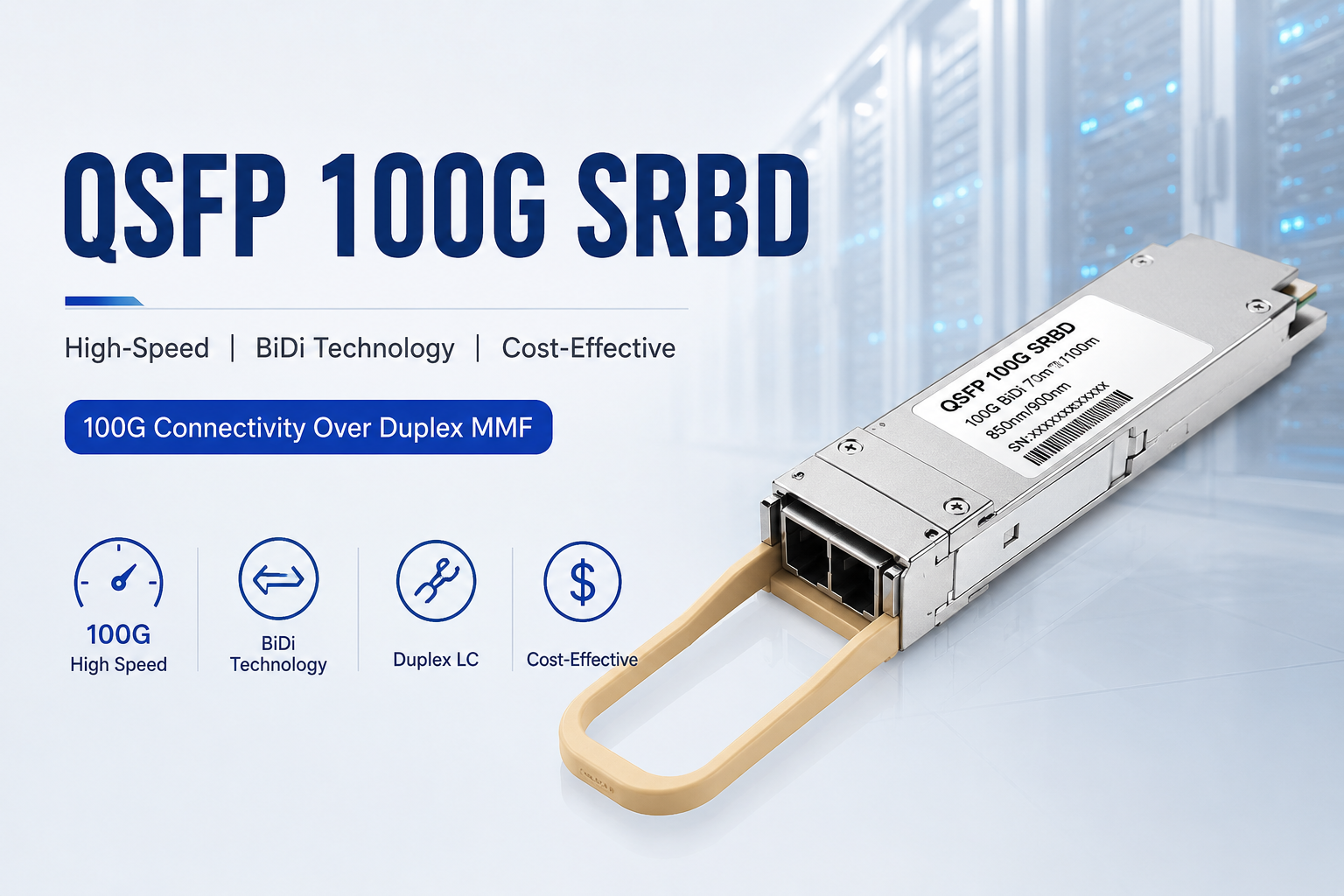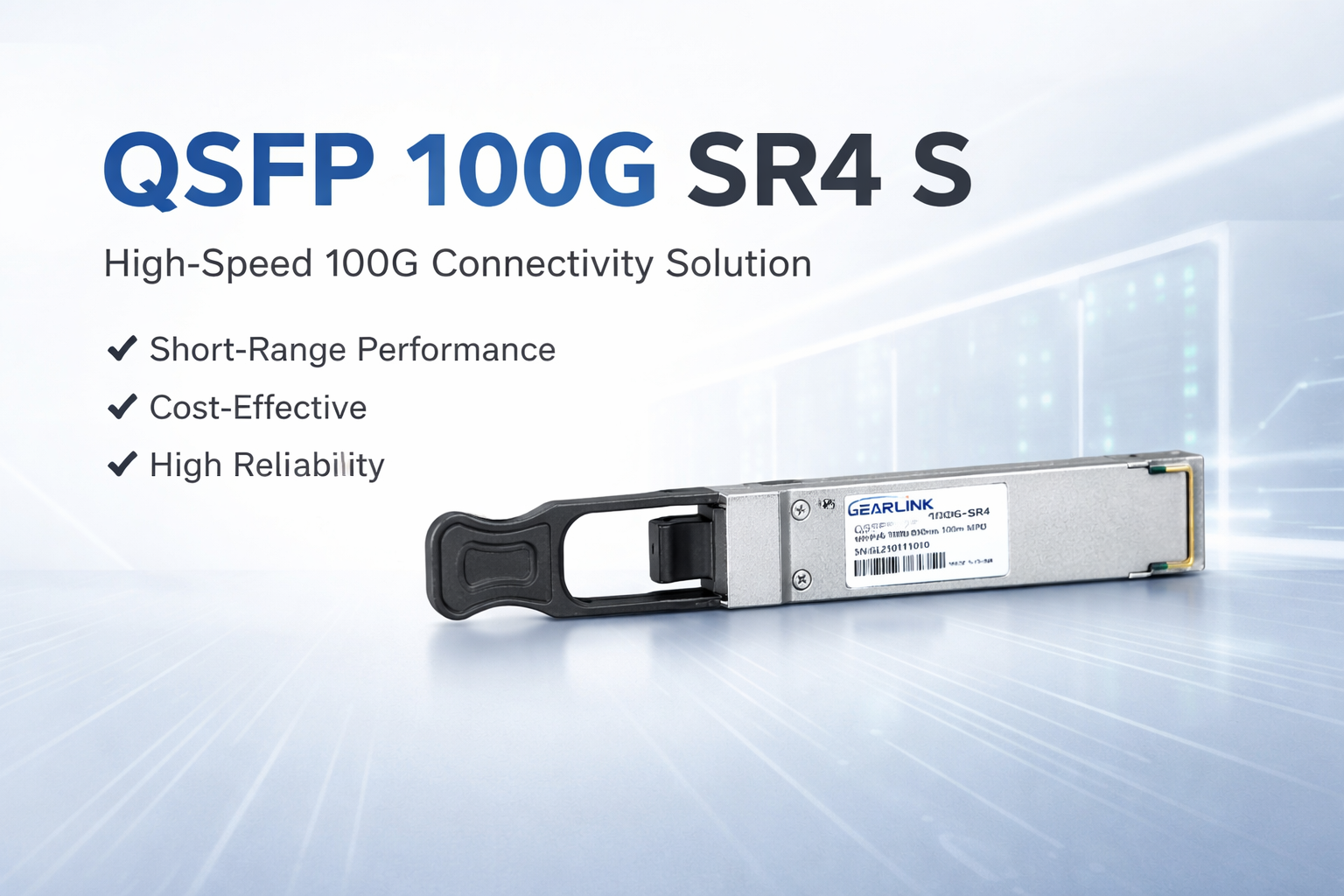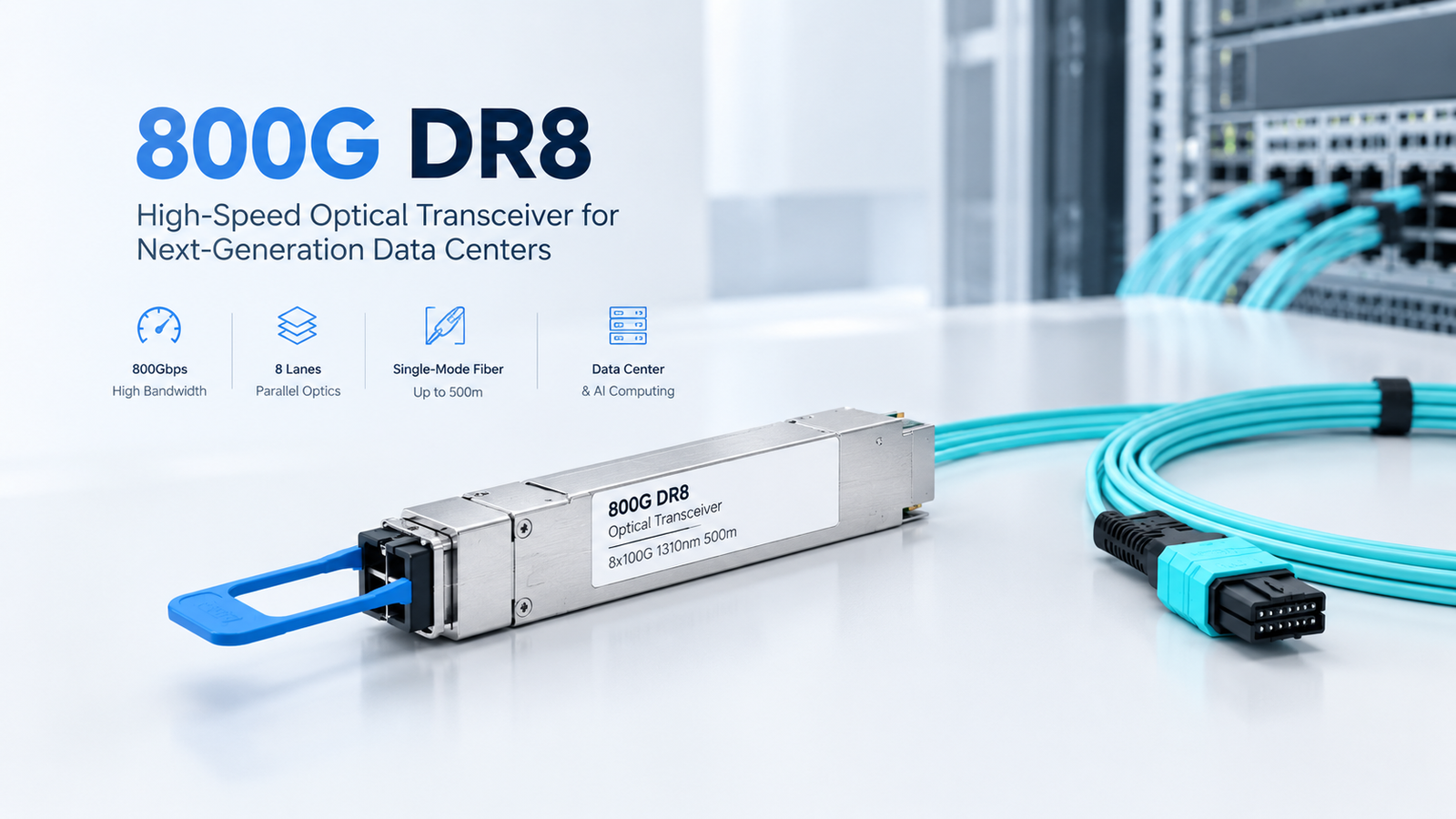
As artificial intelligence, cloud computing, and high-performance computing continue to grow, data centers need faster and more efficient network connections. 800G DR8 optical transceivers have therefore become an important option for next-generation data center networks. They provide 800Gbps bandwidth while using parallel optical transmission to support high-capacity connections over single-mode fiber.
Compared with earlier 400G solutions, an 800G DR8 transceiver can provide approximately twice the aggregate bandwidth in a similar high-density networking environment. As a result, it can help reduce the number of optical connections required for large-scale computing clusters.
At the same time, the technology behind 800G DR8 is easier to understand when it is divided into several basic parts: data rate, optical wavelength, fiber type, transmission lanes, connector design, and application scenario.
This guide explains how 800G DR8 works, where it is used, how it compares with other 800G solutions, and what network designers should consider before deployment.
What Is 800G DR8?
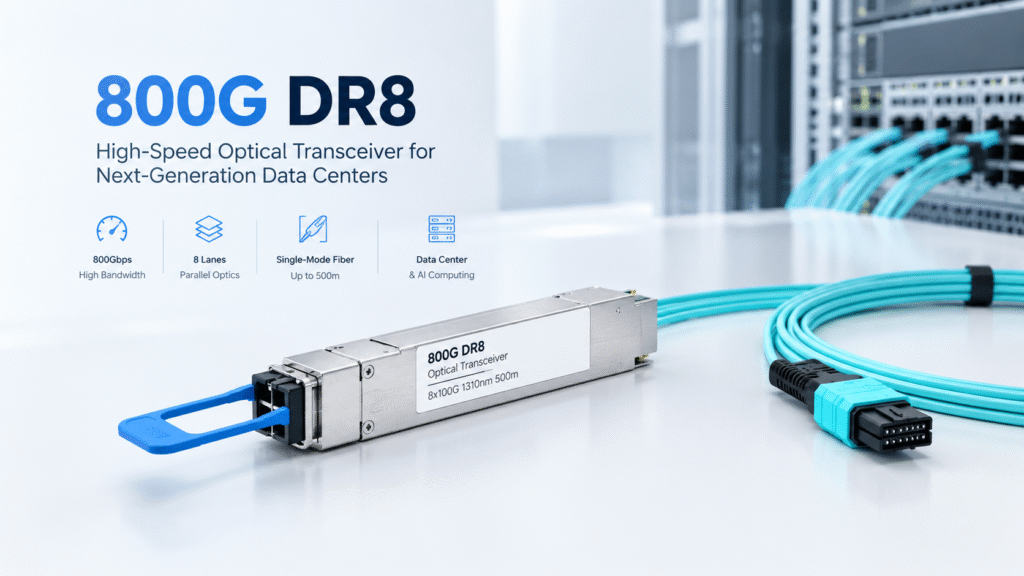
The term 800G DR8 describes an 800Gbps optical transceiver designed for short-reach single-mode fiber connections. The name itself provides several useful clues.
800G means an aggregate data rate of 800Gbps.
DR generally refers to Data Center Reach.
8 indicates eight parallel optical lanes.
In a typical implementation, the 800G optical signal is divided across eight lanes. Each optical lane carries approximately 100Gbps using PAM4 modulation.
Therefore:
8 lanes × 100Gbps = 800Gbps
This parallel architecture allows a very high data rate to be delivered without requiring an extremely long transmission distance.
800G DR8 Optical Architecture
An 800G DR8 module normally uses eight optical transmit lanes and eight optical receive lanes. The electrical interface and optical interface are handled through high-speed components inside the transceiver.
A simplified transmission path looks like this:
Switch → Electrical Interface → DSP/Optical Engine → 8 Optical Lanes → MPO/MTP Fiber → 8 Optical Lanes → Receiver
Because eight optical lanes are used, a suitable parallel-fiber connection is required.
In many deployments, an MPO/MTP connector is used to connect the transceiver to a parallel single-mode fiber assembly.
| Feature | Typical 800G DR8 Configuration |
| Aggregate data rate | 800Gbps |
| Optical lanes | 8 |
| Optical lane speed | 100Gbps |
| Modulation | PAM4 |
| Fiber | Single-mode fiber |
| Wavelength | Around 1310nm |
| Connector | MPO/MTP |
| Typical reach | Around 500m |
| Main application | Data center networking |
| Primary advantage | High bandwidth and density |
The exact electrical interface, optical engine, FEC implementation, and host-side architecture can vary between products. Therefore, the complete datasheet should always be checked before deployment.
How Does 800G DR8 Work?
To understand 800G DR8, it helps to start with PAM4.
Traditional NRZ signaling carries one bit per symbol. PAM4, however, uses four signal levels. Because four different levels can represent two bits per symbol, PAM4 can deliver twice the bit density of NRZ at the same symbol rate.
This is one of the key technologies that makes 800G networking practical.
800G DR8 and PAM4 Transmission
An 800G DR8 optical transceiver generally uses eight 100G optical lanes.
Each lane can operate at approximately 100Gbps using PAM4 signaling. The lanes work in parallel rather than sending the entire 800Gbps stream through one optical channel.
For example:
| Optical Lane | Approximate Rate |
| Lane 1 | 100Gbps |
| Lane 2 | 100Gbps |
| Lane 3 | 100Gbps |
| Lane 4 | 100Gbps |
| Lane 5 | 100Gbps |
| Lane 6 | 100Gbps |
| Lane 7 | 100Gbps |
| Lane 8 | 100Gbps |
| Total | 800Gbps |
This approach is particularly useful in data centers because high bandwidth can be achieved while keeping the optical architecture relatively modular.
Why PAM4 Matters
PAM4 does introduce additional signal-processing requirements. Since four voltage or optical levels are used instead of two, the difference between adjacent levels becomes smaller.
Consequently, signal quality becomes more important.
DSP technology, FEC, optical design, PCB layout, and signal integrity all play important roles in achieving stable 800Gbps transmission.
For network operators, this means that an 800G module should not be evaluated only by its nominal speed. Compatibility with the switch, host port, fiber, and software or firmware environment should also be considered.
800G DR8 Reach and Fiber Requirements
One of the most important characteristics of 800G DR8 is its intended transmission distance.
DR8 is generally designed for data center connections of approximately 500 meters. This makes it different from longer-reach 800G solutions such as FR8, which are designed for longer optical links.
Because the optical architecture uses parallel lanes, the fiber infrastructure must also support those lanes.
Single-Mode Fiber Is Required
800G DR8 normally uses single-mode fiber rather than multimode fiber.
This is an important point because some data center users may associate short-distance optical modules with multimode fiber. However, DR-class 800G solutions are generally based on single-mode optical transmission.
The use of single-mode fiber provides better support for high-speed optical transmission and allows the module to reach distances beyond typical multimode applications.
| Item | 800G DR8 |
| Fiber type | Single-mode |
| Typical wavelength | 1310nm |
| Typical reach | Up to about 500m |
| Optical architecture | 8 parallel lanes |
| Common connector | MPO/MTP |
| Application | High-density data center links |
The actual supported distance can depend on the optical budget, fiber quality, connector loss, and module specification. Therefore, the published product datasheet should be used for the final link calculation.
800G DR8 Connector and Fiber Polarity
Because eight optical lanes are used, connector configuration deserves special attention.
MPO/MTP-based assemblies are commonly used for parallel optical transmission. However, the physical connector alone does not guarantee that two modules will communicate correctly.
Fiber polarity must also be considered.
For example, the transmit lanes on one side must be correctly connected to the corresponding receive lanes on the other side. If the polarity is incorrect, the modules may remain operational while the link itself fails to establish.
Before installation, network engineers should therefore verify:
MPO/MTP connector type
Fiber count
Fiber polarity
Key orientation
Single-mode fiber type
Insertion loss
End-face quality
Transceiver compatibility
A simple polarity check can prevent significant troubleshooting time during large-scale deployment.
800G DR8 vs 800G FR8
Although both are 800G optical solutions, DR8 and FR8 are designed for different transmission requirements.
The primary difference is the intended reach and optical architecture.
| Feature | 800G DR8 | 800G FR8 |
| Data rate | 800Gbps | 800Gbps |
| Optical lanes | 8 | 8 |
| Typical wavelength | 1310nm | 1310nm |
| Fiber | Single-mode | Single-mode |
| Typical reach | Around 500m | Around 2km |
| Application | Data center / campus-scale links | Longer data center interconnects |
| Cost | Generally lower | Generally higher |
| Main advantage | Efficient short-reach 800G | Longer optical reach |
Therefore, DR8 is often attractive when the optical path remains within a large data center or nearby campus environment.
FR8, by contrast, becomes more useful when the required distance exceeds the normal DR8 operating range.
Choosing a longer-reach module when it is not required may increase network cost unnecessarily. On the other hand, selecting a DR8 module for a link beyond its specified reach can create reliability problems.
800G DR8 vs 800G SR8
Another common comparison is between DR8 and SR8.
The two modules can both provide 800Gbps bandwidth, but they use different fiber technologies.
SR8 is generally associated with multimode fiber, while DR8 is associated with single-mode fiber.
| Feature | 800G DR8 | 800G SR8 |
| Data rate | 800Gbps | 800Gbps |
| Fiber | Single-mode | Multimode |
| Typical wavelength | Around 1310nm | Around 850nm |
| Optical lanes | 8 | 8 |
| Typical connector | MPO/MTP | MPO/MTP |
| Reach | Around 500m | Shorter reach |
| Typical environment | Large data center links | Short data center links |
| Fiber cost | Higher | Lower in suitable environments |
The choice should therefore be based on the existing fiber infrastructure.
If a facility already has a large amount of OM4 multimode fiber and the required distance is short, SR8 may be attractive.
However, if the network is built around single-mode fiber or longer distances are needed, DR8 can be a more suitable solution.
800G DR8 and 2×400G Connectivity
One particularly important application is connecting an 800G port to two 400G ports.
In some network architectures, an 800G interface can be broken out into two 400G connections. This makes high-speed migration easier because existing 400G switches or network devices can continue to be used.
A common architecture can be represented as:
800G Switch Port → 800G DR8 → Breakout Fiber → 2 × 400G Ports
This approach can be useful during network upgrades.
Instead of replacing an entire network at once, operators can gradually introduce 800G interfaces while maintaining compatibility with selected 400G equipment.
However, breakout compatibility depends on the switch platform, transceiver design, electrical interface, firmware, FEC configuration, and port mode.
Therefore, the phrase “800G to 2×400G” should not automatically be interpreted as universal plug-and-play compatibility.
Why 800G DR8 Is Important for AI Data Centers
Artificial intelligence workloads are placing enormous pressure on data center networks.
Large GPU clusters need to exchange data quickly. When hundreds or thousands of accelerators operate together, network bottlenecks can significantly affect overall system performance.
This is why high-speed optical connectivity has become increasingly important.
High Bandwidth
An 800G connection provides twice the aggregate bandwidth of a 400G connection.
As GPU clusters become larger, this additional capacity can help reduce network congestion.
High Port Density
Higher-speed transceivers can reduce the number of physical ports needed to achieve a particular aggregate bandwidth.
For example, a network requiring 6.4Tbps of aggregate bandwidth could theoretically use:
16 × 400G ports, or
8 × 800G ports
The actual architecture will depend on the switch and network design, but the example illustrates why 800G can improve port density.
Better Network Scaling
Moreover, high-speed optical modules allow data center operators to plan for future bandwidth growth.
Instead of continually adding more low-speed connections, operators can gradually move toward higher-speed interfaces.
This can simplify cabling and potentially reduce rack-level complexity.
800G DR8 in AI and High-Performance Computing
AI clusters and high-performance computing systems are among the most demanding environments for optical networking.
GPU servers often communicate with each other continuously. Consequently, the network must provide high bandwidth, low latency, and predictable performance.
An 800G DR8 module can be used in these environments when the physical distance is appropriate.
Typical applications include:
AI training clusters
GPU data centers
High-performance computing
Cloud data centers
Large-scale Ethernet networks
Data center spine-leaf networks
High-density switch connections
Short-reach data center interconnects
However, optical transceivers are only one part of the complete system. Switch ASICs, NICs, cables, FEC, DSPs, fiber infrastructure, and software configurations must all work together.
Key Benefits of 800G DR8
The main advantages can be summarized in several areas.
1. High Bandwidth
The most obvious advantage is the 800Gbps aggregate data rate.
As network traffic increases, higher-speed interfaces can help reduce congestion.
2. Efficient Parallel Optics
Eight optical lanes allow the total bandwidth to be distributed across multiple channels.
This makes the architecture easier to scale using established parallel-optical technologies.
3. Suitable for Single-Mode Infrastructure
DR8 is designed around single-mode fiber. Therefore, it can fit into data center environments where single-mode cabling is already widely deployed.
4. Useful for Network Upgrades
800G interfaces can support modern high-performance computing and AI networks while also providing options for breakout connectivity.
5. Better Port Efficiency
Higher-speed interfaces can deliver more bandwidth per switch port, which may help improve overall rack and network efficiency.
What Should You Check Before Buying 800G DR8?
Selecting an 800G transceiver requires more than checking the 800Gbps label.
Several technical parameters should be reviewed carefully.
| Parameter | Why It Matters |
| Data rate | Determines total network capacity |
| Fiber type | Must match the infrastructure |
| Reach | Must cover the required link distance |
| Wavelength | Important for optical compatibility |
| Connector | Must match the fiber assembly |
| Optical power | Affects link budget |
| Receiver sensitivity | Determines minimum usable signal |
| Power consumption | Important for high-density systems |
| Operating temperature | Must match deployment conditions |
| DOM/DDM | Helps monitor module health |
| FEC | Can affect link compatibility |
| Host compatibility | Required for stable operation |
In addition, the switch manufacturer may have specific requirements for supported optical modules.
For third-party or compatible transceivers, it is especially important to confirm the exact switch model and port type before ordering.
Common 800G DR8 Deployment Problems
Even when the optical module is technically correct, several installation issues can cause link failures.
Incorrect Fiber Polarity
This is one of the simplest problems to overlook.
If transmit and receive lanes are not correctly mapped, the optical link cannot operate normally.
Dirty MPO Connectors
At 800Gbps, optical performance becomes increasingly sensitive to connector quality.
Dust or contamination on the connector end face can increase insertion loss and reduce link stability.
Therefore, connectors should be inspected and cleaned according to proper fiber-cleaning procedures before installation.
Incorrect Breakout Configuration
When an 800G interface is connected to two 400G interfaces, the breakout configuration must be supported by the network device.
The switch port mode and firmware may also need to be configured correctly.
FEC Mismatch
PAM4-based high-speed links rely heavily on forward error correction.
If the two devices use incompatible FEC configurations, the optical modules may show normal status while the actual link fails to come up.
Therefore, FEC should be checked whenever a high-speed link cannot establish successfully.
800G DR8 Compatibility Considerations
Compatibility should be evaluated at several levels.
First, check the physical interface.
Next, verify the optical specifications.
Then, check the host equipment and software configuration.
A useful compatibility checklist includes:
Host Port → Module Form Factor → Electrical Interface → Optical Specification → Fiber → FEC → Firmware → Breakout Mode
This systematic approach can significantly reduce troubleshooting time.
For example, two products may both be described as “800G DR8,” but their host-side electrical implementation or vendor-specific requirements may differ.
Therefore, identical product names do not always guarantee complete interoperability.
Future of 800G DR8 Networking
As AI and cloud workloads continue to expand, 800G networking is expected to become increasingly important.
At the same time, the industry is already moving toward even higher-speed interfaces.
Technologies such as 1.6T optical connectivity are being developed for future data center architectures. Nevertheless, 800G will remain an important transition point because it provides a practical step from 400G toward higher bandwidth.
For many data centers, the transition will not happen overnight.
Instead, networks may evolve through several stages:
100G → 200G → 400G → 800G → 1.6T
This gradual progression allows operators to upgrade bandwidth as computing requirements increase.
In this environment, DR8 can remain useful for short-reach single-mode connections where its reach and lane architecture match the network design.
Final Thoughts on 800G DR8
800G DR8 is an important optical solution for high-bandwidth data center networks. By combining 800Gbps aggregate throughput with eight parallel 100G optical lanes, it provides a practical way to support demanding AI, cloud computing, and high-performance networking applications.
More importantly, DR8 should not be selected simply because it offers 800Gbps.
The correct choice depends on the complete link:
Required distance
Fiber type
Connector
Optical budget
Switch compatibility
Electrical interface
FEC configuration
Breakout requirements
Power consumption
Operating environment
For links of around 500 meters using single-mode fiber, DR8 can provide an effective balance between bandwidth, reach, and network density.
As data center traffic continues to increase, higher-speed optical connectivity will become increasingly important. Therefore, understanding the architecture and deployment requirements of 800G DR8 can help network engineers make better decisions when planning the next generation of high-speed infrastructure.
Frequently Asked Questions About 800G DR8
1. What is 800G DR8 used for?
800G DR8 is mainly used for high-speed data center connections. It can support AI clusters, cloud computing infrastructure, high-performance computing systems, and high-density Ethernet networks where 800Gbps bandwidth is required.
2. What fiber does 800G DR8 use?
800G DR8 normally uses single-mode fiber. It commonly operates around the 1310nm wavelength and uses eight parallel optical lanes.
3. How far can 800G DR8 transmit?
A typical 800G DR8 solution is designed for a reach of around 500 meters. However, the actual supported distance depends on the specific module, optical budget, fiber, connectors, and installation conditions.
4. What is the difference between 800G DR8 and 800G SR8?
The main difference is the fiber technology and transmission distance. DR8 generally uses single-mode fiber and supports a longer reach, while SR8 normally uses multimode fiber for shorter data center connections.
5. Can 800G DR8 connect to two 400G ports?
An 800G interface may be configured for 2×400G breakout in supported network architectures. However, this depends on the switch, module, port configuration, FEC, firmware, and breakout cable. Compatibility should be confirmed before deployment.